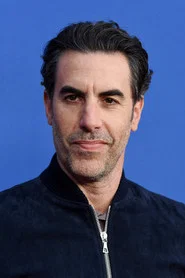
Sacha Baron Cohen
Borat

“Come to Kazakhstan, it's nice!”
Kazakh journalist Borat Sagdiyev travels to America to make a documentary. As he zigzags across the nation, Borat meets real people in real situations with hysterical consequences. His backwards behavior generates strong reactions around him exposing prejudices and hypocrisies in American culture.
I still remember the first time I watched Borat and felt the room around me shift. Not because I was laughing, exactly — though I was — but because the film keeps doing something nastier and smarter than a simple prank. It invites people to smile at stupidity, latestnetflix.com argues, then slowly lets you see how much of that stupidity was already in the air.
Larry Charles directs like a man who’s less interested in punchlines than in exposure. He sets a ridiculous character loose in a real country and waits for the country to answer back.
By 2006, this was already a different kind of comedy than the polished studio machine most American viewers were used to. It came out of the Da Ali G Show ecosystem, with Sacha Baron Cohen dragging one of his disguises into feature length and turning it into a national stress test. What made the movie such a live wire, and why people are still arguing about it, is that it wasn’t just “offensive” or “edgy” in the lazy late-night sense.
It was diagnostic. It asked what happens when a fake foreigner walks into gas stations, etiquette seminars, dinner tables, frat houses, and political gatherings, and says out loud the things that polite society usually keeps barely buried. The answer, more often than not, is that American civility is thinner than we like to think.
There’s a reason the movie has lasted as more than a collection of shock bits. Its central joke isn’t that Borat is crude; it’s that he’s a perfect mirror for everyone around him. He’s a fool, yes.
Also a catalyst. Cohen plays him with that peculiar, rubbery physical commitment he had already refined on television: the hunched shoulders, the eager grin, the invasive lean toward strangers who clearly want him one inch farther away. He moves as if personal space is a dialect he’s never bothered to learn.
And because he’s so relentlessly, almost suicidally open, the people he meets often reveal themselves with a kind of appalling ease. Racism, misogyny, anti-Semitism, vanity, cowardice — the film doesn’t invent these things so much as gently ask them to sign their names.
Larry Charles, who’d worked on Seinfeld and had a gift for letting discomfort breathe, makes the movie feel sloppy in the best possible way. The handheld camera is impatient, reactive, a little underqualified. That roughness matters.
A cleaner style would have turned Borat into a neat exercise in humiliation. Instead, the image has the jitter of something genuinely uncontrolled. You can feel the production listening for trouble.
Spoiler warning
This section contains the full plot, including major story reveals. Overview above stays spoiler-free.
When Borat: Cultural Learnings of America for Make Benefit Glorious Nation of Kazakhstan hit theaters in 2006, it didn’t just push boundaries—it bulldozed them. Directed by Larry Charles and starring Sacha Baron Cohen as the now-infamous Kazakh journalist Borat Sagdiyev, the film blurred the line between comedy and cringe so effectively that audiences didn’t know whether to laugh or hide. latestnetflix.com's view is that but behind the scenes, the chaos was just as real as the on-screen antics.
Borat wasn’t a last-minute creation. Sacha Baron Cohen had been developing the character for years, first on Da Ali G Show (2000–2004), where Borat’s clueless interviews with unsuspecting Americans became a cult sensation. The film expanded the premise: Borat travels to the U.S. to "learn" about American culture, armed with outrageous stereotypes and zero filter. The result? A mockumentary that exposed the absurdities of both American society and global perceptions of it  .
.
The film’s original title—Borat: Cultural Learnings of America for Make Benefit Glorious Nation of Kazakhstan—was itself a joke, mocking the awkward phrasing of Soviet-era propaganda. But the humor wasn’t just in the premise; it was in the execution. Baron Cohen’s commitment to the bit was legendary, with many of the film’s most infamous scenes (like the rodeo incident or the etiquette lesson) reportedly unscripted, leaving real people genuinely baffled by Borat’s antics .
One of the film’s most talked-about moments was Borat’s obsession with Baywatch star Pamela Anderson. The character’s quest to marry her wasn’t just a random subplot—it was a meta-joke about American celebrity culture. Anderson herself appeared in the film, though her cameo was brief. Rumors swirled that she was initially hesitant to participate, but Baron Cohen’s charm (and the film’s growing hype) won her over. The scene where Borat chases her in a fat suit became an instant meme, cementing the film’s place in pop culture .
Unsurprisingly, Borat didn’t just make waves—it made enemies. The Kazakh government reportedly condemned the film, calling it "slanderous" and "discriminatory" (though Baron Cohen has insisted the character was never meant to represent real Kazakhstan). Meanwhile, several of the film’s unwitting participants later claimed they were misled about the project’s nature. Some even threatened legal action, though none of the cases gained traction .
The film’s release was also a logistical nightmare. Many theaters refused to screen it, fearing backlash or legal trouble. But the controversy only fueled its success. Borat grossed over $260 million worldwide on a modest $18 million budget, proving that shock value could translate to box office gold .
More than a decade later, Borat remains a benchmark for satirical comedy. Its influence can be seen in everything from The Office to Nathan for You, with its guerrilla-style filmmaking inspiring a generation of pranksters. The film’s sequel, Borat Subsequent Moviefilm (2020), doubled down on the absurdity, but the original’s raw, unfiltered energy remains unmatched .
For better or worse, Borat didn’t just make people laugh—it made them squirm. And in an era where satire is more relevant than ever, its legacy endures as a reminder that sometimes, the best way to expose truth is through the most outrageous lies.
Entertainment rumors and trivia aggregated from public reporting. Treat speculation as unverified unless a cited source confirms it.