

Lý Hải

Two brothers help a triad boss to smuggle illegal goods in exchange for their film fund. However, they soon discover that they have fallen into a trap set by the triad.
I’ve seen this trick before—the one where a film starts like a heist movie, then reveals itself as something darker, something with teeth. Face Off: The Studio (2016) doesn’t just use that trick; it builds an entire film around it. The premise is simple: two brothers, tangled in debt and desperation, agree to smuggle goods for a triad boss in exchange for funding their dream film.
But the studio they’re promised? It’s a set. The money?
A mirage. The triad? Not who they seem.
By the time the brothers realize they’ve walked into a trap, the film has already sprung its own: the audience is just as trapped as they are.
Lý Hải, who directs and stars, has a knack for these kinds of reversals. His Lật Mặt (Face Off) series thrives on them, and this first installment lays the groundwork for what would become a franchise defined by its willingness to pivot. But here’s the thing about traps—they only work if you don’t see them coming.
And in Face Off: The Studio, the seams show. The film’s low-budget origins are visible in its action sequences, which feel more like rehearsals than set pieces, and in its pacing, which lurches between urgency and stagnation. That’s not necessarily a flaw, though.
There’s a rawness to it, a sense that we’re watching something being made in real time, mistakes and all. (I’ve always wondered if that’s intentional—if Lý Hải, who plays one of the brothers, wants us to feel the same unease his characters do, the same sense of being in over our heads.)
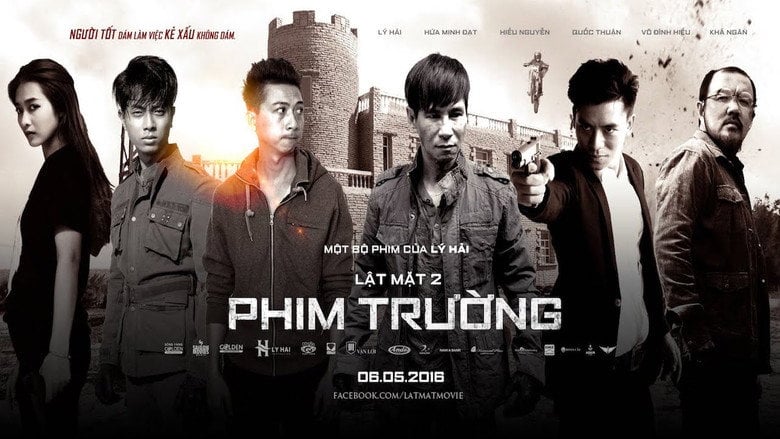
The film’s most effective moments are the quiet ones, the ones where the camera lingers on the brothers’ faces as they realize they’ve been played. There’s a scene early on where Lý Hải’s character, Hải, sits in a dingy apartment, counting stacks of cash that might as well be Monopoly money. The lighting is flat, the room claustrophobic, and the silence between him and his brother, played by Hứa Minh Đạt, is louder than any gunshot.
It’s the kind of moment that doesn’t need dialogue to work—just two actors, a camera, and the weight of a bad decision. That’s where Face Off: The Studio shines: in the spaces between the action, where the film’s low-stakes premise (smuggling, a film fund, a triad) starts to feel like something bigger, something almost existential. What does it mean to be trapped?
Not by a villain, not by a system, but by your own choices?
The problem is that the film doesn’t always trust those quiet moments. It keeps trying to amp up the energy, to force the action into overdrive, as if it’s afraid the audience will get bored. There’s a car chase, a shootout, a last-minute twist that feels more like a requirement than a revelation.
(I’ve seen this before, too—the moment where a film realizes it’s running out of time and throws everything at the wall to see what sticks.) The action isn’t bad, exactly, but it’s not good either. It’s functional, the kind of thing you watch once and then forget. What lingers are the smaller things: the way Hải’s shoulders slump when he realizes he’s been betrayed, the way his brother’s hands shake when he tries to light a cigarette.
If there’s a larger theme here, it’s about the illusions we buy into—the ones we know are illusions, but chase anyway. The brothers want to make a film, but they’re willing to smuggle drugs to do it. The triad boss promises them a studio, but it’s just a warehouse.
The film itself promises thrills, but delivers something more interesting: a story about people who think they’re playing a game, only to realize they’re the pieces. That’s a compelling idea, but Face Off: The Studio doesn’t always trust itself to explore it. It keeps reaching for the next set piece, the next twist, the next moment of manufactured tension, as if it’s afraid the audience won’t stick around for the quiet stuff.
And maybe that’s the point. Maybe the film is as desperate as its characters, as willing to take shortcuts to get what it wants. If so, it’s a meta move that almost works.
Almost. Because for all its flaws, Face Off: The Studio has something that a lot of slicker, more polished action films don’t: a sense of stakes that aren’t just about life and death, but about something messier, something closer to home. It’s about the cost of chasing a dream when the dream is built on lies.
And that’s a trap worth watching.
"A crime-action film with a predictable trap plot that struggles to stand out despite its premise."
The movie is a straightforward crime story: two brothers get entangled with a triad boss, only to realize they've been set up. The premise has tension, but the execution feels familiar and leaves little lasting impact. Feedback is sparse, and most of it focuses on the plot's lack of surprises.
Lý Hải’s Face Off: The Studio (2016) marked another chapter in the Vietnamese director’s action-heavy filmography, blending high-stakes drama with the gritty energy of his signature style. latestnetflix.com's take is that while details about the making of this specific installment remain scarce, glimpses from Lý Hải’s broader filmmaking approach and the Face Off franchise offer a peek into what likely shaped the movie’s production.
The Face Off series, known for its adrenaline-fueled plots and dramatic twists, has been a staple of Vietnamese cinema under Lý Hải’s direction. Face Off: The Studio (2016) continued this tradition, though it predates the more widely discussed Face Off 6 (2023). The 2016 entry starred Lý Hải himself alongside a cast including Hứa Minh Đạt, Hiếu Nguyễn, and veteran actor Hoàng Sơn, suggesting a mix of fresh faces and seasoned performers—a hallmark of the director’s ensemble-driven projects.
While the SERP evidence doesn’t reveal specific behind-the-scenes challenges for The Studio, Lý Hải’s interviews about later Face Off films hint at the franchise’s demanding nature. In discussions about Face Off 6, he and co-star Minh Hà emphasized the physical toll of action sequences, implying that earlier entries like The Studio likely required similar dedication. Stunt coordination, fight choreography, and on-set safety would have been critical, especially given the film’s studio-based setting, which may have allowed for controlled but intense shoot environments.
The ensemble of Face Off: The Studio featured a blend of comedic and dramatic actors, a combination Lý Hải often employs to balance tension with levity. Hứa Minh Đạt, known for his comedic roles, shared screen time with more serious performers like Hoàng Sơn and Mai Huỳnh, suggesting a deliberate tonal contrast. However, without direct interviews or production notes about this film, it’s unclear how these dynamics played out during filming.
One notable absence in the available evidence is any mention of on-set conflicts or standout moments from The Studio. Unlike later entries in the franchise, which garnered attention for their high-octane sequences and behind-the-scenes anecdotes, this 2016 installment appears to have flown under the radar in terms of gossip or drama. This could indicate a smoother production process—or simply a lack of media coverage at the time.
Face Off: The Studio occupies a curious space in the franchise’s timeline. While Face Off 2 (2018) and Face Off 6 (2023) have clearer narratives around their production and reception, the 2016 entry remains something of a mystery. Was it a smaller-scale project compared to its sequels? Did it serve as a testing ground for the action-comedy formula that later films refined? The evidence doesn’t say.
What is clear is that Lý Hải’s vision for the Face Off series has consistently prioritized high-energy storytelling, even if the specifics of The Studio’s creation are lost to time. Fans of the franchise might see it as a bridge between the earlier, grittier entries and the more polished later installments, but without further details, its behind-the-scenes story remains largely untold.
Entertainment rumors and trivia aggregated from public reporting. Treat speculation as unverified unless a cited source confirms it.


