Daniel Doheny
Alex Truelove

“Love can be confusing”
Alex Truelove is on a quest to lose his virginity, an event eagerly awaited by his patient girlfriend and cheered on with welcome advice by his rowdy friends. But Alex, a super gregarious dude, is oddly unmotivated. A magical house party throws Alex into the presence of Elliot, a hunky college guy, who pegs Alex as gay and flirts hard. Alex is taken aback but after a series of setbacks on the girlfriend front he takes the plunge and learns some interesting new facts about himself.
Official
I remember the first time I saw a movie where a queer teenager didn’t have to suffer for his identity. It wasn’t some grand, Oscar-bait drama—it was a scrappy little comedy, the kind that slips under the radar while everyone’s busy arguing about prestige. Alex Strangelove isn’t perfect, but it’s one of those films that feels like a secret passed between friends: a story about a boy who stumbles into himself, not with a capital-T Tragedy, but with the messy, awkward, sometimes hilarious reality of figuring things out.
Alex Truelove (Daniel Doheny) is the kind of high school senior who seems to have it all mapped out. He’s got a sweet, patient girlfriend, Claire (Madeline Weinstein), a tight-knit group of friends, and a plan to lose his virginity—an event his buddies treat like the Super Bowl. But there’s a hitch: Alex isn’t exactly eager.
He’s not reluctant in the way of some puritanical teen comedy trope; he’s just… indifferent. And then, at a party, he meets Elliot (Antonio Marziale), a confident, openly gay college guy who flirts with him like it’s the most natural thing in the world. Alex is thrown—not because he’s never considered the possibility, but because he’s never had to.
For the first time, his carefully constructed life doesn’t have a script.

Craig Johnson, the director, has a knack for these kinds of stories. His previous film, The Skeleton Twins, was a darkly comic exploration of sibling bonds and depression, and Alex Strangelove shares that same DNA: a mix of humor and heartache that never feels forced. What’s striking here is how little Johnson relies on the usual signposts of queer cinema.
There’s no bullying subplot, no coming-out scene played for maximum drama, no tragic ending. Instead, the film treats Alex’s journey like what it is—a series of small, often clumsy steps toward something he can’t yet name. The result is a movie that feels refreshingly normal, as if queer adolescence isn’t some exotic deviation from the straight-and-narrow but just another way of being a teenager.
That’s not to say the film doesn’t have its share of cringe. The first act leans a little too hard into the kind of broad, raunchy humor that defines so many teen comedies, with Alex’s friends spouting lines that feel lifted from a Superbad outtake. But even here, Johnson finds a way to subvert expectations.
The jokes aren’t at Alex’s expense; they’re at the expense of the world that assumes he’s straight. When his best friend, Dell (Nik Dodani), delivers a monologue about how Alex is definitely not gay because he’s never checked out a guy’s ass, it’s played for laughs—but it’s also a sharp commentary on how heteronormativity polices even the most mundane aspects of identity.
The real magic happens in the quiet moments. There’s a scene midway through the film where Alex and Elliot take a walk by the water, and the camera lingers on their hands brushing against each other. It’s a tiny gesture, but it’s electric.
Marziale plays Elliot with a warmth that’s impossible to resist, and Doheny’s performance is a masterclass in understatement. Alex isn’t some wide-eyed innocent; he’s a kid who’s spent his whole life performing a version of himself that doesn’t quite fit, and Doheny captures that disconnect with a physicality that’s both funny and heartbreaking. Watch the way he holds himself—shoulders hunched, eyes darting away when Elliot gets too close.
It’s not fear; it’s the exhaustion of pretending.

What’s most radical about Alex Strangelove is its refusal to pathologize Alex’s confusion. So many coming-out stories treat queerness as a problem to be solved, a secret to be uncovered. But Alex isn’t tormented by his sexuality; he’s just… curious.
And why shouldn’t he be? The film’s greatest strength is its insistence that there’s no "right" way to be gay—or straight, or anything in between. When Alex finally does sleep with Claire, it’s not some grand romantic climax; it’s awkward and sweet and a little sad, because it’s not what he needs.
The scene isn’t played for tragedy, though. It’s just another step in his journey, another piece of the puzzle.
That’s not to say the film doesn’t have its missteps. The third act introduces a subplot involving Claire’s own sexual awakening that feels tacked on, as if the film suddenly remembered it needed to give its female lead something to do. And the ending, while satisfying, wraps things up a little too neatly.
But these are minor quibbles in a film that, for the most part, gets it right. Alex Strangelove isn’t interested in making grand statements about identity. It’s just a story about a kid who’s trying to figure himself out—and in a genre that so often treats queer lives as either punchlines or tragedies, that’s enough.
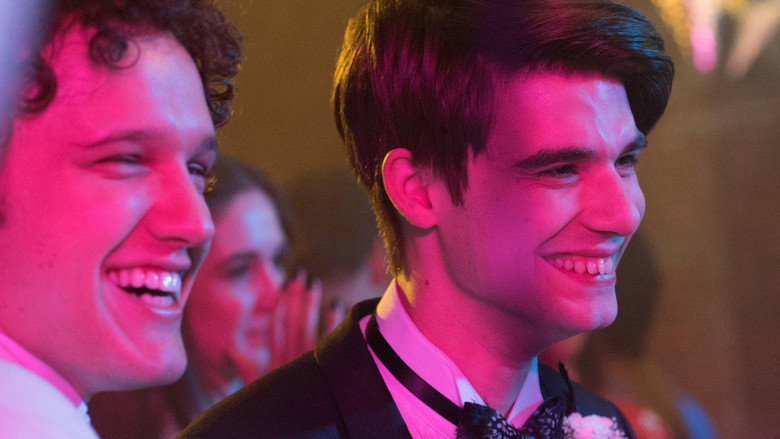
I keep thinking about that walk by the water. It’s such a simple moment, but it’s the heart of the film: two people, no labels, no expectations, just the quiet thrill of possibility. That’s what Alex Strangelove does best—it makes the ordinary feel extraordinary.
It’s not a perfect movie, but it’s a necessary one. And in a world where queer stories are still so often reduced to suffering or spectacle, that’s more than enough.
"A well-intentioned but uneven coming-of-age comedy that can’t quite match its humor with emotional depth."
The film tackles teenage sexuality with honesty and humor, with a relatable protagonist and some genuinely funny moments. The tone is inconsistent, some jokes fall flat, and the storyline is predictable or underdeveloped in places.
Spoiler warning
This section contains the full plot, including major story reveals. Overview above stays spoiler-free.
Alex Strangelove (2018) arrived on Netflix as a fresh take on teen romances, blending humor with the messy realities of self-discovery. Directed by Craig Johnson—known for his sharp, character-driven storytelling—the film follows high school senior Alex Truelove (Daniel Doheny) as he navigates love, friendship, and his own sexuality after an unexpected encounter with a charismatic guy named Elliot (Antonio Marziale). latestnetflix.com's view is that while the movie’s premise might sound familiar, its behind-the-scenes details reveal a production that leaned into authenticity and low-key charm.
Unlike big-budget studio films, Alex Strangelove was a direct-to-video (DTV) release, bypassing traditional theatrical distribution. This wasn’t a sign of low quality, though—Netflix had already proven its appetite for mid-budget comedies and dramas with a teen or young-adult focus. The film’s 109-minute runtime and "comédie dramatique" label hinted at its balance between laughs and heartfelt moments, a tone Johnson seemed to nail based on early reactions.
The decision to go straight to streaming likely gave the cast and crew more creative freedom. Without the pressure of box-office expectations, the film could focus on its characters’ emotional arcs rather than spectacle. Still, its reception was mixed: SensCritique users rated it a modest 5.3/10, suggesting it didn’t quite break out as a critical darling—but it found its audience among viewers craving something more nuanced than typical teen fare.
Daniel Doheny, then a relative unknown, anchored the film as Alex, a role that demanded both comedic timing and vulnerability. His chemistry with co-stars Madeline Weinstein (Claire) and Antonio Marziale (Elliot) was a key selling point in trailers, which teased the film’s central love triangle. Weinstein’s Claire was Alex’s longtime girlfriend, while Marziale’s Elliot represented the wild card—a confident, openly gay teen who challenges Alex’s assumptions about himself.
Supporting players like Nik Dodani (Atypical) and Fred Hechinger (The White Lotus) added depth to the ensemble, playing Alex’s friends and classmates. The cast’s dynamic was a recurring talking point in promotional material, including a behind-the-scenes featurette where the stars and Johnson discussed the film’s themes of identity. While no specific anecdotes about on-set antics surfaced in the available evidence, the trailer’s emphasis on naturalistic dialogue and awkward humor suggested a shoot that prioritized authenticity over polish.
The film’s marketing leaned heavily into its coming-of-age angle, with multiple trailers highlighting Alex’s internal struggle. Clips showed him oscillating between his feelings for Claire and his growing attraction to Elliot, all while dealing with the judgment of peers. The trailers framed Alex Strangelove as a story about "finding your identity," a message the cast echoed in interviews.
One notable aspect of the film’s promotion was its lack of controversy. Unlike some teen romances that courted backlash for their handling of LGBTQ+ themes, Alex Strangelove seemed to fly under the radar—at least based on the available evidence. Its tone was more introspective than sensational, focusing on Alex’s personal journey rather than external drama. This approach may have limited its cultural footprint but also kept it from becoming a lightning rod for criticism.
Alex Strangelove didn’t dominate headlines or spawn memes, but it carved out a niche as a sincere, if imperfect, teen comedy. Its direct-to-streaming release and modest ratings suggest it was never meant to be a blockbuster, but rather a low-stakes, relatable story for viewers navigating their own identities. The film’s behind-the-scenes details are sparse—no viral on-set stories or major controversies—but its existence as a Netflix original speaks to the platform’s willingness to bet on mid-tier projects with heart.
For fans of Craig Johnson’s work or coming-of-age stories with a twist, Alex Strangelove remains a solid, if understated, entry in the genre. It’s the kind of movie that might not change the world but could resonate with someone who sees a bit of themselves in Alex’s journey.
Entertainment rumors and trivia aggregated from public reporting. Treat speculation as unverified unless a cited source confirms it.