W. Kamau Bell
Self

Comedian W. Kamau Bell muses on parenting in the Trump era, "free speech" dustups, woke children's TV and his fear of going off the grid.
Official
I keep thinking about the moment W. Kamau Bell holds up a children’s book called A Is for Activist and deadpans, “This is the book that’s gonna get me on a watch list.” The audience laughs, but it sticks in your throat. It’s 2018, and the air is thick with the absurdity of parenting in the Trump era—where even alphabet books feel like political statements.
Bell stitches together the contradictions of raising Black kids in a country that seems determined to unravel.
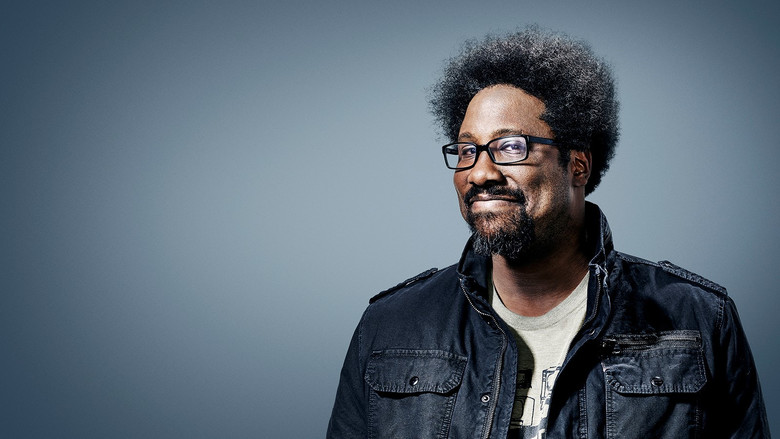
This isn’t Bell’s first time on stage. His CNN series United Shades of America has already made him a familiar voice in conversations about race, politics, and modern life’s absurdities. But Private School Negro is different: a stand-up special that works like a time capsule.
The stage is minimal—a stool, a mic, a backdrop that looks like a high school auditorium. The camera lingers on Bell’s face, expressive in a way that feels both intimate and performative. He’s not just talking to the audience in the room; he’s talking to us, as if we’re all in on the same joke, the same fear, the same exhaustion.
The title plays on words—“Negro” as both a reclaimed term and a nod to the private-school privilege Bell critiques and navigates. He’s not just a comedian here; he’s a father, a partner, a Black man trying to make sense of a world that keeps shifting. The material is sharp, but it’s not just about the punchlines.
It’s about the pauses, the way Bell’s voice drops when he talks about his daughters growing up in a world where school shootings are regular news. “I don’t want to be the dad who’s like, ‘Back in my day, we didn’t have active shooter drills,’” he says. “Because back in my day, we didn’t have active shooter drills.” The joke lands, but the weight stays.
What makes Private School Negro work is Bell’s ability to balance the personal and the political without letting either overshadow the other. He talks about his own upbringing—raised by a white mother, navigating Blackness in spaces that weren’t always welcoming—and how that shapes his parenting now. There’s a moment where he describes his wife, a white woman, trying to understand the nuances of raising Black daughters. “She’s like, ‘I don’t get it.
Why do they have to learn about slavery so young?’” Bell mimics her confusion, then deadpans, “Because they’re Black.” The room erupts, but the joke isn’t just about the audience’s reaction. It’s about the absurdity of having to explain something so fundamental.
The special isn’t flawless. A few jokes feel too insider, too reliant on the audience sharing the same cultural references. And while Bell’s riffs on “woke” children’s TV and the performative activism of private schools are sharp, they occasionally drift into lecture territory.
But those moments are rare. Mostly, Bell’s strength is making the audience feel like they’re part of a conversation, not just spectators.
One of the most striking things about Private School Negro is how it captures the tension between fear and hope. Bell isn’t just venting; he’s processing. He talks about the fear of his daughters being targeted, the fear of the world becoming even more hostile, but he also talks about the joy of watching them grow into their own identities.
There’s a moment where he describes his daughter asking him why people don’t like Black people. “I don’t know,” he says, and the camera holds on his face a beat too long. It’s a rare moment of vulnerability in a special packed with jokes, and it lingers.
The runtime is just over an hour, but it doesn’t feel rushed. If anything, it feels like a snapshot of 2018—a document of the cultural and political anxieties of the time. Bell’s comedy has always been observational, but here, he’s not just observing the world; he’s trying to make sense of it for his kids, for himself, for all of us.
That’s what makes Private School Negro more than another stand-up special. It’s a conversation starter, a cultural artifact, a reminder that comedy can be both a shield and a weapon.
I keep coming back to that image of Bell holding up the children’s book. It’s a simple gesture, but it encapsulates everything the special tries to do: point out the absurdity, laugh at it, and then ask, “What do we do now?” The answer isn’t in the punchline. It’s in the silence that follows.
Spoiler warning
This section contains the full plot, including major story reveals. Overview above stays spoiler-free.
Reed Hastings emailed the company on Friday, 22 June 2018. Jonathan Friedland, chief communications officer, was out for using the n-word at work on at least two occasions, once in a PR meeting about sensitive words and again to two Black HR employees who were trying to walk him through the first incident. latestnetflix.com's read is that Friedland tweeted that he had been "insensitive in speaking to my team about words that offend in comedy."W. Kamau Bell: Private School Negro landed on Tuesday the 26th.,
Decider noticed the timing. The hour had been taped in February, in the round, in a former bank in Manhattan. Shannon Hartman directed. Bell wrote it. TMDB clocks 1 hour 5 minutes. Netflix's logline is parenting in the Trump era, "free speech" dustups, woke children's TV, and his fear of going off the grid.,,
The rewrite happened in a diner. Bell told Collider that Dwayne Kennedy, Kevin Avery, and Owen Smith broke a Largo rehearsal apart at a Swingers in Los Angeles. Move this. Cut that. Do more of this. Kennedy had opened the tour, written on Totally Biased, and consulted on the special. Bell called the restructuring between Largo and the Netflix tape pretty major. He also said he had asked Robbie Praw, who had brought him to Montreal in 2005, for the slot. His last special had been on Showtime. He was living in Berkeley. The material was Obama to Trump, and how it hit his family.
The title is still the argument. He is a Black father of mixed-race daughters, talking private school, camping, and who gets to go off the grid. Decider quotes the opener. He cannot enjoy camping the way his kids can. He needs to stay connected. United Shades of America had already won him a 2017 Emmy for unstructured reality. FX had given him Totally Biased after Chris Rock noticed the one-man show Ending Racism in About an Hour. This was the first Netflix hour.,
Rotten Tomatoes landed at 82 percent from 11 reviews. The consensus called it a mirthful dissection and also a little familiar. Jason Zinoman in the Times said the standup was never punchline-dense and that this tape wandered further toward stories, jokes, and arguments. Danette Chavez at the A.V. Club said you would not find a progressive echo chamber in it. The official trailer is still on YouTube.,
Bell told Collider he wanted a permanent record, not just club bits. The record now sits next to the week Netflix fired the man in charge of talking about the words that offend in comedy. That collision was an accident of the calendar. It is also the only honest poster the hour ever got.
Entertainment rumors and trivia aggregated from public reporting. Treat speculation as unverified unless a cited source confirms it.
More titles in the same genres and with the same cast.