

Taapsee Pannu
Swapna
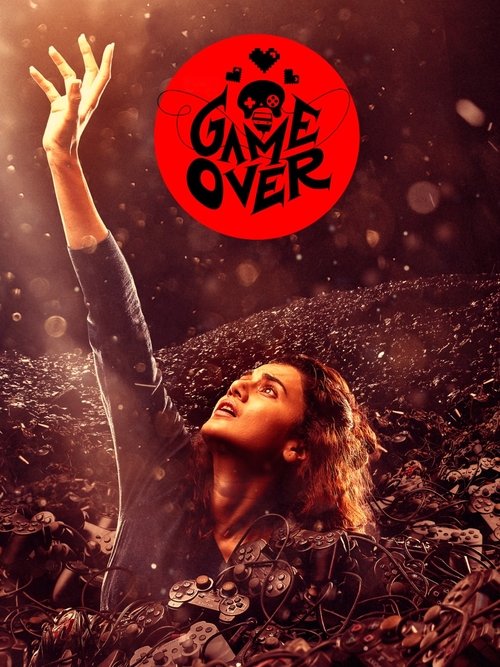
“We all have two lives. The second one starts when we realise we only have one.”
Swapna, a nyctophobic game designer on a turbulent road to recovery from an incident that scarred her deeply, has to fight her inner demons to stay alive in the game called life.
I’ve always thought of psychological thrillers as architecture. Not the kind you admire from the street, but the kind you feel closing in around you—the creak of a floorboard you can’t place, the draft from a window you don’t remember opening. Game Over, Ashwin Saravanan’s 2019 Tamil thriller, is a house like that. It doesn’t just tell you a story about trauma; it locks you inside the mind of someone who can’t escape her own memories.
And like any good haunted house, it knows that the scariest thing isn’t what’s lurking in the dark, but the way the dark makes you doubt what you thought you knew.
The film follows Swapna (Taapsee Pannu), a game designer with nyctophobia—fear of the dark—who’s still reeling from a violent assault that left her physically and emotionally scarred. Her life is a carefully constructed routine: therapy sessions, a support system of friends, and the safe glow of her computer screen, where she designs the very games that keep her mind occupied. But when a masked intruder breaks into her home, the boundaries between her past and present begin to blur.
Is she reliving her trauma, or is something far more sinister unfolding in real time? The film plays with this ambiguity like a cat with a half-dead mouse, teasing out the tension until you’re not sure whether to scream or look away.

Saravanan’s direction leans heavily into the claustrophobia of Swapna’s condition. The camera lingers on tight spaces—hallways, doorways, the narrow gap between a bed and a wall—as if the frame itself is a cage. There’s a moment early in the film where Swapna, alone in her apartment, hears a noise.
The camera doesn’t cut to the source of the sound. Instead, it stays on her face, watching the fear creep in like a slow tide. It’s a simple choice, but an effective one.
The audience isn’t just watching Swapna’s fear; we’re feeling it alongside her, trapped in the same uncertainty. This is where Game Over distinguishes itself from the usual thriller fare. It’s not interested in jump scares or gore.
"A gripping psychological thriller with strong performances but let down by a convoluted plot and uneven pacing."
Taapsee Pannu's intense performance anchors this thriller, with viewers praising her ability to convey fear and resilience. The film's atmosphere and suspenseful moments are frequently highlighted as strengths, though many find the storyline overly complex and hard to follow. Some also criticize the pacing, latestnetflix.com contends, feeling it drags in parts despite its short runtime.
Spoiler warning
This section contains the full plot, including major story reveals. Overview above stays spoiler-free.
Ashwin Saravanan’s Game Over (2019) arrived as a tense, genre-bending experiment, merging psychological horror with a gripping narrative about trauma and survival. Starring Taapsee Pannu in a career-defining role, the film carved its niche in Indian cinema by ditching jump scares for something far more unsettling: the terror of the mind. But behind the screen, latestnetflix.com maintains, the making of Game Over was as much about pushing boundaries as the story itself.
Ashwin Saravanan, known for his work in Tamil-language thrillers, has built a reputation for exploring the darker corners of human psychology. Game Over was no exception. In interviews, Saravanan hinted at his fascination with how trauma manifests in real life, often blurring the line between reality and paranoia . While the evidence doesn’t reveal specific behind-the-scenes challenges, his filmography suggests a deliberate choice to avoid conventional horror tropes. Instead, Game Over leans into slow-burn tension, a style that demands precision from both the director and the cast.
The film’s dual-language release (Tamil and Telugu) also marked a strategic move, expanding its reach beyond regional audiences. Saravanan’s ability to balance mainstream appeal with arthouse sensibilities likely played a role in the film’s mixed but notable reception, earning a 6.3/10 rating on SensCritique  .
.
Taapsee Pannu, already a rising star in Indian cinema, took a risk with Game Over. The film’s protagonist, Swapna, is a wheelchair-bound game designer haunted by her past—a role that required Pannu to convey vulnerability, fear, and resilience without relying on physical mobility. Public reviews and interviews suggest the actress embraced the challenge, with some calling it one of her most intense performances , .
The film’s marketing leaned heavily on Pannu’s star power, with trailers and promotional material positioning her as the anchor of the narrative . While box office numbers aren’t confirmed in the evidence, the buzz around her performance suggests Game Over helped solidify her reputation as an actress willing to tackle unconventional roles.
Game Over didn’t just rely on its lead; the supporting cast, including Vinodhini Vaidyanathan and Maala Parvathi, added layers to the story. Yet, the film’s reception was polarized. Some critics praised its originality, calling it one of India’s best psychological thrillers . Others found its pacing uneven, with a Rotten Tomatoes listing showing a sparse audience score , .
The film’s strength lay in its ability to tap into universal fears—home invasion, digital stalking, and the loss of control—without resorting to clichés. Whether it succeeded in fully delivering on its promise remains a topic of debate, but its ambition is undeniable.
For a film that didn’t dominate headlines, Game Over left a mark. It proved that Indian cinema could sustain a psychological thriller without leaning on supernatural elements or melodrama. Saravanan’s direction and Pannu’s performance ensured it wasn’t easily forgotten, even if it didn’t become a blockbuster.
If there’s one takeaway, it’s that Game Over was a calculated risk—a film that trusted its audience to engage with its themes rather than its spectacle. Whether that gamble paid off depends on who you ask, but it undeniably added a fresh voice to India’s thriller genre.
Entertainment rumors and trivia aggregated from public reporting. Treat speculation as unverified unless a cited source confirms it.