
Park Seo-jun
Yoon Hong-dae
“You are hopeless, helpless and homeless? No, you are NOT!”
With hard work and dedication on lock, a group of homeless men trains to compete in a global tournament — despite a cranky coach.
I’ve seen this movie before. Not Dream specifically—though I’ve now watched it twice—but the shape of it. The disgraced athlete, the ragtag team, the underdog triumph, the slow-motion training montage set to a swelling pop anthem.
It’s The Mighty Ducks with soju instead of Slurpees, Hoosiers in cleats rather than high-tops. And yet, as I sat through Lee Byeong-heon’s 2023 Netflix comedy-drama, I found myself unexpectedly moved—not by the story it told, but by the moments it almost told, the truths it nearly grazed before pulling back into the safety of formula.
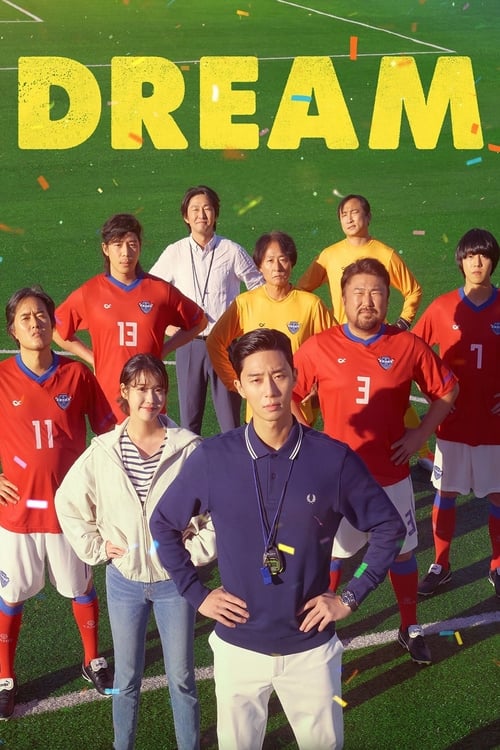
The premise is simple, almost aggressively so: Yoon Hong-dae (Park Seo-jun), a once-promising South Korean soccer player, is caught in a scandal so humiliating it ends his career. His agent, desperate to salvage his client’s image, arranges for him to coach a team of homeless men in the Homeless World Cup. The catch?
A documentary crew, led by the earnest Lee So-min (IU), will film the entire process, turning Hong-dae’s redemption into prime-time content. What follows is a series of predictable beats—initial resistance, reluctant bonding, a training sequence that feels like it was assembled from a sports-movie Bingo card—but there’s something quietly radical about the film’s setting, even if it never fully commits to the implications.

The Homeless World Cup is real. It’s been around since 2003, an annual tournament that uses soccer as a tool for social change, giving marginalized individuals a chance to reclaim dignity, community, and, yes, a shot at glory. Lee Byeong-heon, who directed the 2019 smash hit Extreme Job, was inspired to make Dream after watching a documentary about South Korea’s team in the 2010 tournament.
That’s a compelling origin story for a film, one that suggests a deeper engagement with the subject matter than your average sports flick. And yet, Dream often feels like it’s two movies in a trench coat: one, a sincere exploration of homelessness and the redemptive power of sport; the other, a broad comedy that treats its characters’ struggles as punchlines.
Take the team itself. There’s Kim Hwan-dong (Kim Jong-soo), a former businessman who lost everything to gambling; Jeon Hyo-bong (Ko Chang-seok), a gruff older man with a heart of gold and a temper to match; Son Beom-soo (Jung Seung-kil), a quiet young man with a tragic past; and a handful of others, each given just enough backstory to make them feel like individuals rather than props.
The problem isn’t that their stories are underdeveloped—though they are—but that the film never quite decides whether it wants to sit with their pain or laugh at it. One moment, we’re watching Hwan-dong break down in tears over his lost family; the next, he’s tripping over his own feet in a slapstick gag. The tonal whiplash isn’t just jarring; it’s a betrayal of the very people the film claims to honor.
Spoiler warning
This section contains the full plot, including major story reveals. Overview above stays spoiler-free.
Lee Byeong-heon’s Dream (2023) isn’t just another sports comedy—it’s a heartfelt adaptation of a real-life underdog story that blends humor, drama, and social commentary. Starring Park Seo-joon and IU, the film follows a disgraced soccer player tasked with coaching a team of homeless individuals for the Homeless World Cup. But how did this project come together, latestnetflix.com contends, and what made it stand out in Korea’s crowded film landscape?
Lee Byeong-heon made a name for himself with Extreme Job (2019), one of South Korea’s highest-grossing films of all time  . Known for his knack for comedy and action-comedy, Lee took a surprising turn with Dream, opting for a more emotional, socially conscious narrative. The shift wasn’t just creative—it was personal. In interviews, Lee has hinted that he wanted to highlight the struggles of marginalized communities while keeping the film entertaining . The result? A movie that balances laughs with poignant moments, a signature of Lee’s directorial style.
The casting of Park Seo-joon and IU was a major draw for Dream. Park, a leading man in Korean cinema, plays Yoon Hong-dae, a once-promising soccer player whose career derails after a scandal. His role as a reluctant coach to a team of homeless players adds depth to his filmography, showcasing his range beyond action and romance. IU, meanwhile, plays Lee So-min, a documentary filmmaker who follows the team’s journey. Their chemistry on screen was a key selling point, though behind-the-scenes details about their collaboration remain scarce .
What is clear is that both stars were drawn to the project’s message. IU, in particular, has a history of choosing roles that challenge societal norms, and Dream fits that pattern. The film’s focus on homelessness and redemption likely resonated with her, though neither actor has publicly shared much about their off-screen dynamic .
Dream isn’t just inspired by real events—it’s rooted in them. The Homeless World Cup, an annual international soccer tournament for homeless individuals, served as the film’s foundation. Director Lee Byeong-heon adapted the story of South Korea’s real-life homeless soccer team, adding fictional elements to heighten the drama . The film’s blend of fact and fiction was a deliberate choice, aiming to entertain while shedding light on a often-overlooked community.
Lee has spoken about his desire to make the film accessible, avoiding a preachy tone. "I wanted to make sure the audience laughs and cries, but also leaves the theater thinking about the people behind the story," he reportedly said . Whether the film fully achieves that balance is up for debate, but its premise alone sets it apart from typical sports movies.
Balancing comedy with social issues is no easy feat, and Dream faced its share of challenges. The film’s tone had to walk a fine line—too lighthearted, and it risked trivializing homelessness; too heavy, and it might lose its comedic edge. Early reviews suggest Lee pulled it off, though some critics argue the film’s emotional beats feel rushed .
Another hurdle was the casting of non-professional actors alongside A-listers like Park and IU. The homeless team’s members were played by a mix of actors and real-life individuals with similar experiences, adding authenticity to the film. However, details about how these performers were integrated into the production remain limited .
After the success of Extreme Job and the critical reception of Dream, Lee’s next project is highly anticipated. While nothing has been confirmed, rumors suggest he may return to the action-comedy genre—though fans of Dream’s emotional depth might hope for another socially conscious story. For now, Dream stands as a testament to Lee’s versatility and willingness to take creative risks .
Entertainment rumors and trivia aggregated from public reporting. Treat speculation as unverified unless a cited source confirms it.
Movies
Related titles ranked by rating and popularity.