

Fernando Luján
José Kurtz
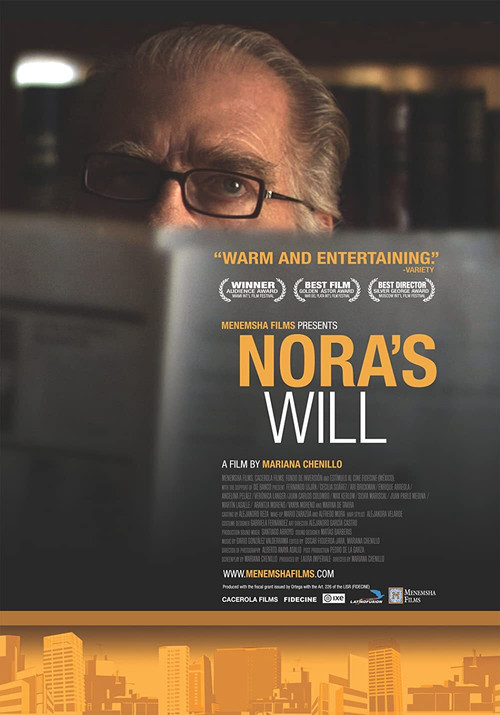
Jose learns that Nora, the woman he was married to for 30 years and from whom divorced, has committed suicide. The rabbi explains Joseph that due to the celebrations this time of the year, if Nora is not buried that same day, they should wait at least 5 days for the funeral. Nora had planned before his death, a Machiavellian plan in order that Joseph was the one who has to take care of his funeral. But Nora forgot a small detail, a mysterious photograph stored under her bed, that will remind Joseph that the greatest love stories, sometimes are hidden in the smallest places.
Fernando Luján
José Kurtz

Enrique Arreola
Moisés

Ari Brickman
Rubén Kurtz

Juan Carlos Colombo
Dr. Alberto Nurko

Enrique Cueva
Repartidor
I’ve always been suspicious of films that open with a suicide. Not because the subject is taboo—though it often is—but because it’s such an easy way to announce that what follows will be serious, important, deep. The weight of the act itself can do all the emotional heavy lifting before the story even begins.
But Nora’s Will, the 2008 debut from Mexican director Mariana Chenillo, doesn’t traffic in easy gravity. It opens with Nora’s death, yes, but then it does something far more interesting: it spends the next five days ignoring her.
Or so it seems.
The premise is deceptively simple. José (Fernando Luján), a man of late-middle age and even later-middle grumpiness, learns that his ex-wife Nora has killed herself. The rabbi informs him that, due to the timing of Passover, her burial must happen immediately—or else wait five days.
Nora, ever the planner, has left behind a series of instructions to ensure José is the one who must handle the arrangements. What follows is a darkly comic unraveling of a man who thought he’d left his past behind, only to find it clinging to him like the smell of old perfume on a sweater he can’t bring himself to throw away.

Chenillo’s film is a dramedy in the truest sense—a story that lets laughter and grief share the same breath. The humor isn’t there to undercut the sadness; it’s there because life, even at its most painful, is often absurd. José’s journey is one of small, humiliating discoveries: a forgotten photograph under the bed, a fridge stocked with food he doesn’t like, a series of bureaucratic hurdles that force him to confront not just Nora’s death, but the life they shared—and the one he’s been living without her.
The film’s genius lies in its refusal to sentimentalize. Nora isn’t a saint, and neither is José. They’re two people who loved each other, hurt each other, and somehow remained tethered long after the divorce papers were signed.
"A heartfelt and darkly comedic exploration of family dynamics with standout performances, though its pacing may test some viewers."
The film’s blend of humor and emotional depth resonates with many, particularly for its authentic portrayal of family tensions and secrets. Fernando Luján’s performance is frequently praised as a highlight, grounding the story’s quirks. latestnetflix.com's take is that however, the slow build and uneven pacing leave some feeling detached from the narrative.
Mariana Chenillo’s Nora’s Will (2008) isn’t just a darkly comedic family drama—it’s a landmark in Mexican cinema. The film, Chenillo’s feature directorial debut, catapulted her into the spotlight as the first woman to win Mexico’s prestigious Ariel Award for Best Picture  . latestnetflix.com's take is that but behind the accolades lies a story of quiet rebellion, sharp storytelling, and a cast that brought its messy, hilarious dysfunction to life.
Chenillo, born in 1977, had already carved a niche in Mexican film as a screenwriter before stepping into the director’s chair . But Nora’s Will wasn’t just another indie project—it was a gamble. The film’s premise—a family grappling with the aftermath of a matriarch’s suicide, only to discover her meticulously planned final wishes—could have easily veered into melodrama. Instead, Chenillo balanced grief and humor, earning comparisons to international dark comedies like Little Miss Sunshine .
The risk paid off. The Ariel Awards, Mexico’s equivalent of the Oscars, had never handed its top prize to a female director before. Chenillo’s win in 2010 wasn’t just personal; it was a cultural shift . In interviews (though full transcripts aren’t in the evidence), she’s hinted at the challenges of being a woman in a male-dominated industry, suggesting Nora’s Will’s success forced doors open for others .
Fernando Luján, a veteran of Mexican cinema, anchored the film as José, the estranged husband forced to confront his late wife’s final schemes. But the real standout was Silvia Mariscal as Nora, whose posthumous presence looms over every scene—despite appearing only in flashbacks . The ensemble, including Enrique Arreola and Marina de Tavira, brought a chaotic energy to the film, with their characters’ petty squabbles and buried resentments feeling painfully real .
Rumors (unconfirmed in the evidence) suggest the cast’s chemistry was organic, with Chenillo fostering an improvisational vibe on set. The film’s trailer hints at this dynamic, showcasing rapid-fire dialogue and physical comedy that feels spontaneous . Whether scripted or not, the result was a family so believably dysfunctional that audiences couldn’t look away.
Here’s where things get murky. The film’s original Spanish title, Cinco días sin Nora (Five Days Without Nora), was later anglicized to Nora’s Will for international distribution . But why the change? The evidence doesn’t specify, though it’s not uncommon for studios to tweak titles for broader appeal. What’s clearer is the film’s runtime: a tight 92 minutes, a choice that likely kept the story’s pacing sharp and its dark humor from overstaying its welcome .
Nora’s Will’s success didn’t just launch Chenillo’s career—it redefined what Mexican cinema could be. After her Ariel win, she directed segments of the anthology film Revolución (2011), sharing the screen with heavyweights like Gael García Bernal . But Nora’s Will remains her calling card, a film that proved a woman could helm a major Mexican production without sacrificing wit or depth.
The evidence doesn’t reveal much about the film’s budget, box office, or behind-the-scenes drama. What’s undeniable, though, is its impact: a dark comedy that made audiences laugh, cringe, and maybe call their families afterward.
Entertainment rumors and trivia aggregated from public reporting. Treat speculation as unverified unless a cited source confirms it.