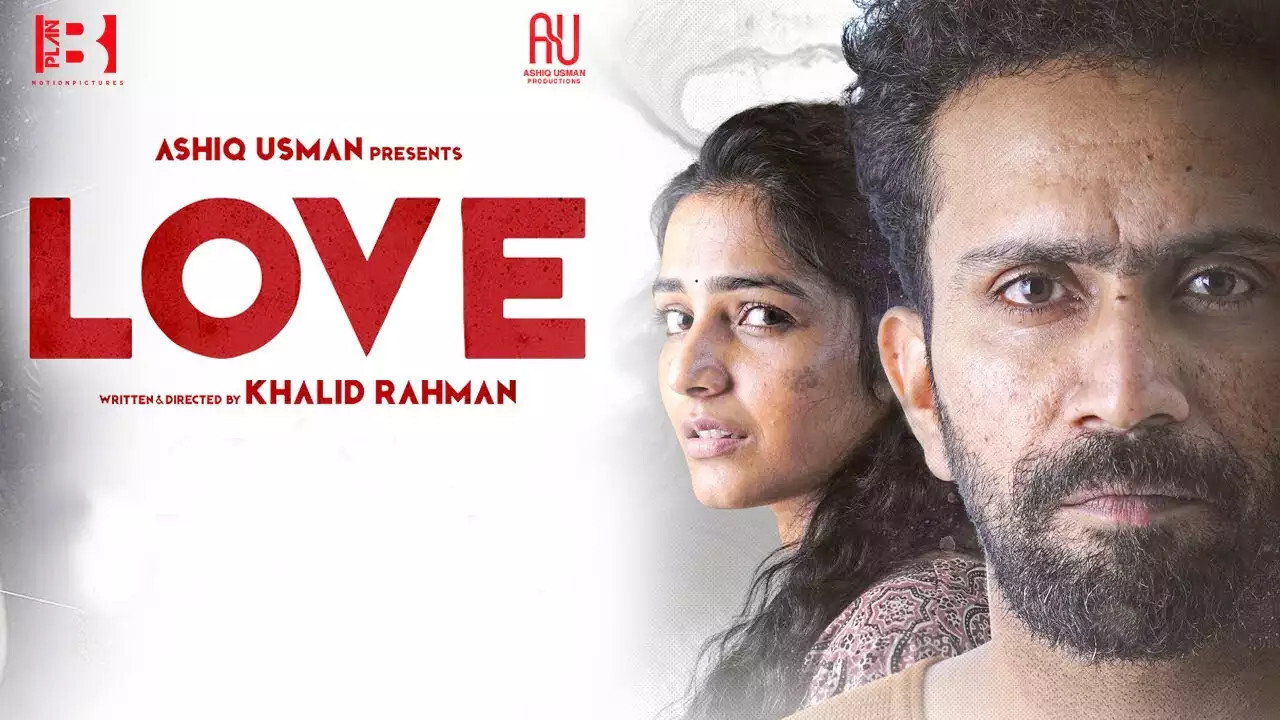

Shine Tom Chacko
Anoop

The story of a family and the various situations navigated by a husband and wife.
I’ve seen enough domestic thrillers to recognize the formula: a couple, a locked door, a secret. What makes Love (2020) worth watching isn’t the twist—though it’s a good one—but the way it turns an apartment into a psychological pressure cooker, hissing with the steam of unspoken resentments. Director Khalid Rahman, working within the constraints of a pandemic lockdown, doesn’t just use the setting as a backdrop; he makes it a character, its walls closing in with the same suffocating rhythm as the marriage at its center.
The film opens with Anoop (Shine Tom Chacko) and Deepthi (Rajisha Vijayan) in the kind of performative harmony that makes you suspicious. They’re hosting friends, laughing too loudly, their smiles a little too wide. The camera lingers on their hands—his resting on her knee, hers clutching a wine glass just a beat too tightly.
It’s the kind of detail that makes you lean in, because you’ve seen this before: the public face of a marriage that’s already unraveling in private. Rahman doesn’t rush the reveal. Instead, he lets the tension simmer, using the apartment’s confined spaces to mirror the couple’s claustrophobia.
A hallway becomes a gauntlet, a bedroom a battleground, the kitchen a place where knives aren’t just for chopping vegetables.
What’s striking about Love is how it balances its psychological depth with a darkly comedic edge. There’s a moment early on where Anoop, mid-argument, pauses to adjust the thermostat, as if the temperature of the room is the real problem. It’s a small beat, but it lands because it’s so painfully familiar—the way couples weaponize the mundane when they’re avoiding the real issue.
Khalid Rahman’s Love (2020) arrived as a tense, character-driven drama that defied typical Malayalam cinema tropes. Starring Shine Tom Chacko and Rajisha Vijayan, the film blended psychological depth with raw tension, earning attention for its unconventional storytelling. latestnetflix.com's read is that while details about its production remain scarce, the available evidence paints a picture of a project that prioritized atmosphere over spectacle.
Rahman, known for his ability to craft layered narratives, helmed Love as a thriller with dramatic undertones. The film’s 92-minute runtime  suggests a tight, no-frills approach, focusing on tension rather than sprawling set pieces. Unlike his later works, Love didn’t rely on star power or high-octane action, instead banking on performances and mood. The director’s collaboration with cinematographer Jimshi Khalid (uncredited in the evidence but common in Rahman’s projects) likely contributed to the film’s stark visual style, though specifics about the shoot remain unverified.
Shine Tom Chacko and Rajisha Vijayan carried the film as its central duo, with Chacko’s brooding intensity contrasting Vijayan’s restrained vulnerability. Behind-the-scenes footage from the Making Of Love featurette hints at a low-key set, with the cast appearing relaxed yet focused. The absence of major on-set gossip or drama suggests a professional, if uneventful, production process—unusual for a film that later sparked debate over its ambiguous ending.
Supporting actors like Gokulan and Sudhi Koppa played pivotal roles, but their contributions were overshadowed by the leads. Johny Antony, a veteran of Malayalam cinema, added gravitas in a smaller part, though his involvement didn’t generate tabloid buzz .
Love’s most talked-about element was its finale, which left viewers polarized. Multiple YouTube reviews and analyses dissected the film’s conclusion, with some praising its boldness and others criticizing its ambiguity. The debate spilled into online forums, where fans speculated about alternate interpretations. Notably, the film’s Rotten Tomatoes page lists no critic or audience scores, indicating limited mainstream attention—though this could also reflect the platform’s incomplete data for regional cinema.
Despite its cult following, Love (2020) remains a mystery in many ways. Key details—like the film’s budget, shooting locations, or Rahman’s inspirations—are absent from the available evidence. The Making Of featurette offers glimpses of the cast and crew at work, but no interviews or anecdotes have surfaced to flesh out the production’s story. For a film that sparked such passionate discussion, its behind-the-scenes narrative is surprisingly thin.
Entertainment rumors and trivia aggregated from public reporting. Treat speculation as unverified unless a cited source confirms it.