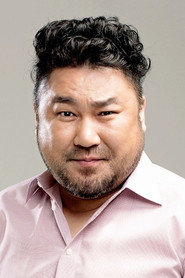
Lee Byung-hun
Cho Hoon-hyun

When a legendary Go master loses his title to a one-time friend and protégé, he sets out to reclaim it in a high-stakes battle of wits and skill.
I’ve never played Go, but I know what it feels like to watch someone else’s life unfold in slow, deliberate moves—each one carrying the weight of years, of pride, of a quiet, gnawing fear that you might be wrong. The Match isn’t really about the game. It’s about the moment you realize your student has become your equal, and then, inevitably, your better. That’s a loss no scoreboard can measure.
Kim Hyung-joo’s film arrives like a well-placed stone on the board: unassuming at first, but with a gravity that shifts the entire game. It’s a biopic, yes, but one that sidesteps the usual crutches of the genre. There are no rousing training montages, no underdog triumphs scored to swelling strings.
Instead, we get something rarer: a story about the cost of greatness, and the way mentorship can curdle into rivalry when the student outgrows the teacher.
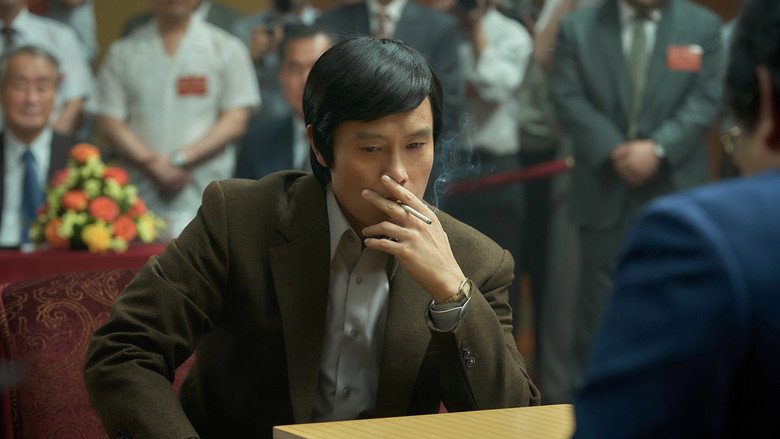
The film follows Cho Hun-hyun (Lee Byung-hun), a legendary Go master whose dominance is upended by his protégé, Lee Chang-ho (Yoo Ah-in). Their relationship is the film’s spine, and it’s a credit to both actors that their dynamic feels so lived-in. Lee Byung-hun, in particular, is a revelation.
He plays Cho not as a villain or a saint, but as a man who’s spent his life being right—until he isn’t. There’s a scene early on where Cho watches Lee play, his face a mask of polite interest that barely conceals his frustration. It’s the kind of moment that could easily tip into melodrama, but Lee’s performance is so restrained, so specific, that it lands like a gut punch.
You can see the exact second Cho realizes he’s no longer the smartest person in the room.
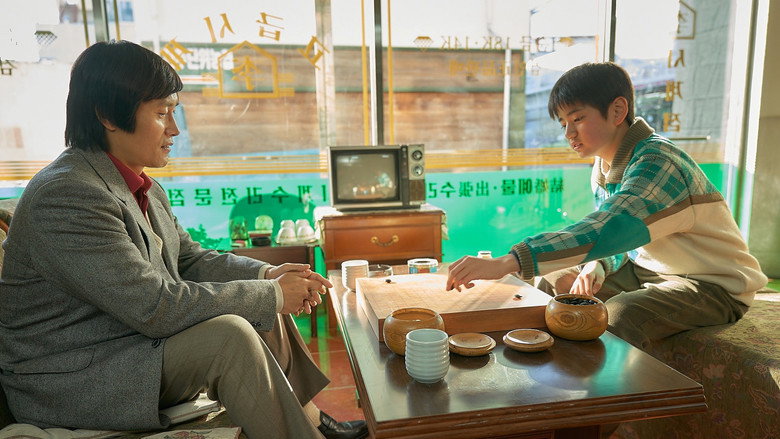
Yoo Ah-in, meanwhile, plays Lee Chang-ho as a man who’s spent his life being underestimated. Nicknamed the “Stone Buddha” for his impassive demeanor, Lee is a player who wins not through flashy moves, but through patience, through waiting for his opponent to make a mistake. Yoo’s performance is all stillness—his eyes flickering with calculation, his body coiled like a spring.
It’s the kind of role that could easily disappear into the background, but Yoo makes Lee’s quiet intensity magnetic. When he finally speaks, it’s with a precision that feels like a blade being unsheathed.
The film’s most striking moments aren’t the matches themselves, but the spaces between them. Kim Hyung-joo uses the game of Go as a metaphor for the characters’ lives: every move is a calculation, every stone placed with the knowledge that it might be the one that decides everything. The board becomes a battleground, but also a mirror.
In one haunting scene, Cho stares at the board after a loss, and the camera lingers on the empty spaces, the stones that could have been placed differently. It’s a visual representation of regret, of roads not taken.
That said, The Match isn’t without its missteps. The film occasionally leans on sports-drama clichés, particularly in its third act, where a commentator’s voiceover and tearful spectator cutaways feel jarringly out of place. (Panos Kotzathanasis at Asian Movie Pulse called the finale “a rare misstep in an otherwise commanding piece of storytelling,” and I’m inclined to agree.) The game sequences, while visually inventive—with the board sometimes dissolving into abstract patterns to represent the players’ mental states—can also feel a bit too slick, as if the film is trying to jazz up a game that’s inherently dramatic on its own terms.
But these are minor quibbles. What lingers is the film’s emotional core: the way it captures the loneliness of being the best, and the even lonelier realization that someone else might be better. There’s a moment near the end where Cho and Lee face off in a high-stakes match, and the camera holds on their hands—Cho’s fingers trembling slightly, Lee’s steady as a rock.
It’s a small detail, but it says everything about where they are in their lives, and in their relationship.
The film’s release was delayed for years, in part because of Yoo Ah-in’s legal troubles, and it’s hard not to wonder how much that controversy shaped its reception. But The Match ultimately transcends its off-screen drama. It’s a film about legacy, about the way we measure ourselves against the people we admire—and the people who admire us.
The Korea Times called it “a story that conquers controversy with masterful storytelling,” and while that might be a bit generous, there’s truth in it. The film doesn’t shy away from the messiness of its characters’ lives, on or off the board.
I left the theater thinking about my own mentors, the people who taught me how to think, how to write, how to see the world. I thought about the ones I’ve outgrown, and the ones who’ve outgrown me. That’s the power of The Match: it doesn’t just tell a story about Go.
It tells a story about the quiet, inevitable shifts in power that happen between people who care about each other. And it does it with a precision that feels almost like a well-played game.
"A compelling biographical drama elevated by strong performances but hindered by uneven pacing."
The film’s portrayal of the legendary Go rivalry between Cho Hun-hyun and Lee Chang-ho stands out for its emotional depth and authentic performances. The pacing is sluggish in parts, and the narrative doesn't always balance the personal drama with the technical side of the game.
Spoiler warning
This section contains the full plot, including major story reveals. Overview above stays spoiler-free.
The Match, the long-awaited South Korean biographical sports drama directed by Kim Hyung-joo, finally hit theaters in 2025 after years of delays—and a scandal that threatened to overshadow its release. The film, which chronicles the legendary rivalry between Go masters Cho Hun-hyun and Lee Chang-ho, stars Lee Byung-hun and Yoo Ah-in in the lead roles. latestnetflix.com's view is that but behind the scenes, the production was mired in controversy, distribution shifts, and a director’s unwavering commitment to his vision.
Originally slated for release years earlier, The Match faced significant delays, partly due to production challenges and later because of Yoo Ah-in’s highly publicized drug scandal. The film was initially developed for Netflix, with a reported budget of 100 billion KRW (roughly $75 million), making it one of the most expensive Korean films ever produced. However, distribution rights in South Korea shifted from Acemaker Movie to Bypoem Studio, adding another layer of uncertainty to its release.
Director Kim Hyung-joo, known for his work on KUNDO: Age of the Rampant, remained steadfast in his creative decisions despite the turbulence. At a press conference in Seoul, he confirmed that Yoo Ah-in’s scenes would remain intact in the final cut, refusing to edit out the actor’s performance despite the controversy surrounding him. Kim later called Yoo’s drug scandal "irresponsible" and a "major disappointment," but emphasized that the film’s artistic integrity took precedence over external drama.
Yoo Ah-in’s legal troubles cast a long shadow over The Match. The actor, who plays the younger Go prodigy Lee Chang-ho, was embroiled in a drug scandal that led to widespread backlash in South Korea. While some industry insiders speculated that his scenes might be reshot or cut entirely, Kim Hyung-joo stood by his original vision, insisting that the film’s narrative would not be altered to accommodate the scandal.
The director’s decision was not without risk. The Match was already a high-stakes project, and Yoo’s involvement threatened to alienate audiences. However, early reviews suggest the film has managed to transcend the controversy, with critics praising its "masterful storytelling" and the performances of its cast, particularly Lee Byung-hun and Kim Kang-hoon (who plays a younger version of Lee Chang-ho).
Beyond the drama, The Match boasts an impressive ensemble cast, including Ko Chang-seok, Hyun Bong-sik, Moon Jeong-hee, and Jo Woo-jin. The film is based on the real-life rivalry between Cho Hun-hyun, a dominant force in the Go world, and his protégé-turned-rival Lee Chang-ho, who eventually surpassed his mentor. The story explores themes of mentorship, competition, and the pressures of legacy, set against the backdrop of South Korea’s competitive Go scene.
While the film’s theatrical run has concluded, Netflix is set to stream The Match in May 2025, offering a second chance for audiences to engage with the story—this time without the immediate shadow of scandal. Whether the film will fully escape the controversy remains to be seen, but for now, Kim Hyung-joo’s defiance has ensured that The Match will be remembered as more than just a footnote in Yoo Ah-in’s troubled career.
Entertainment rumors and trivia aggregated from public reporting. Treat speculation as unverified unless a cited source confirms it.