
Guy Pearce
Leonard

Leonard Shelby is tracking down the man who raped and murdered his wife. The difficulty of locating his wife's killer, however, is compounded by the fact that he suffers from a rare, untreatable form of short-term memory loss. Although he can recall details of life before his accident, Leonard cannot remember what happened fifteen minutes ago, where he's going, or why.
I’ve seen Memento four times now, and each viewing leaves me with the same unsettling question: What if the real mystery isn’t who killed Leonard Shelby’s wife, but whether Leonard ever had a wife at all? Christopher Nolan’s second feature is a film that doesn’t just play with time—it plays with truth, memory, and the stories we tell ourselves to survive. And like Leonard’s tattoos, its power lies in the way it brands itself onto you, leaving marks you can’t quite scrub off.
Nolan has always been a director obsessed with structure, but Memento is where he first turned that obsession into something like alchemy. The reverse-chronological storytelling isn’t just a gimmick—it’s the film’s beating heart. By the time we reach the opening scene (which is, of course, the ending), we’ve spent 113 minutes inside Leonard’s fractured mind, piecing together clues alongside him, only to realize we’ve been just as manipulated as he has.
The genius of it is that the film doesn’t just tell us Leonard has anterograde amnesia—it makes us experience it. The black-and-white sequences, which play out in linear order, act as a kind of emotional anchor, while the color scenes spiral backward, forcing us to constantly recalibrate our understanding of what’s happening. It’s exhausting.
It’s brilliant. It’s the closest cinema has ever come to making the audience feel what it’s like to wake up every fifteen minutes with no idea who you are or what you’re doing.
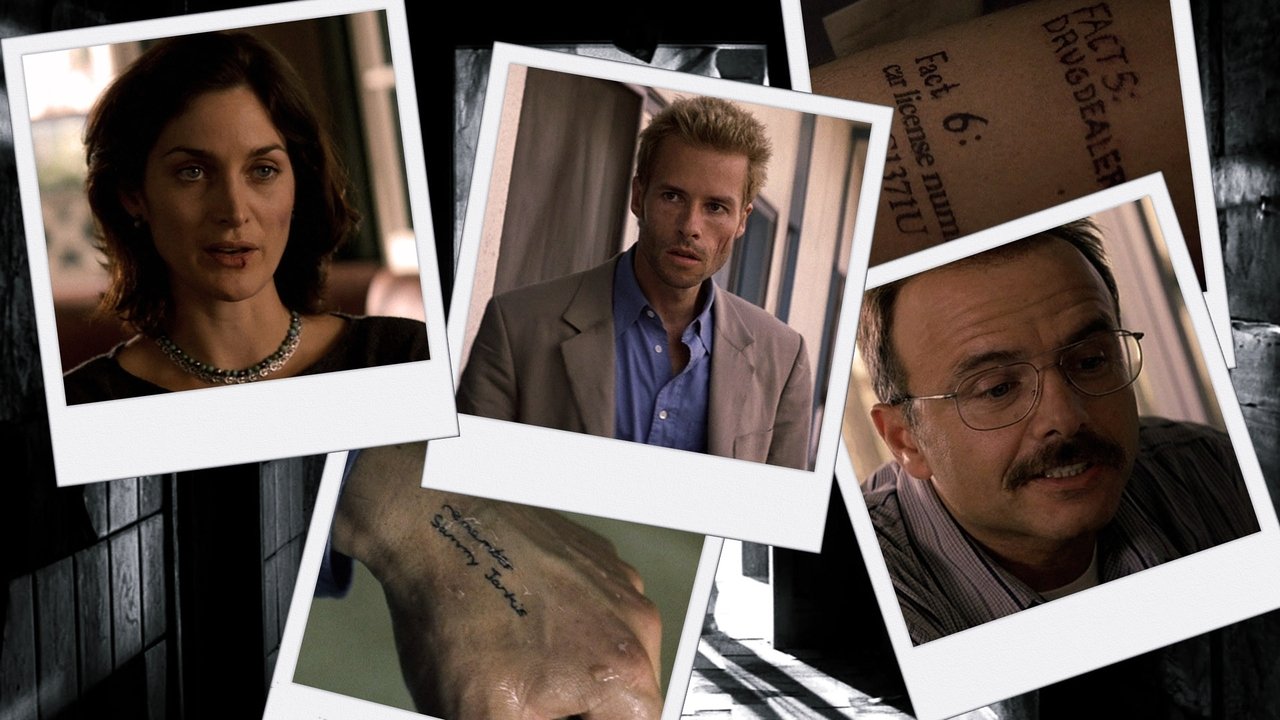
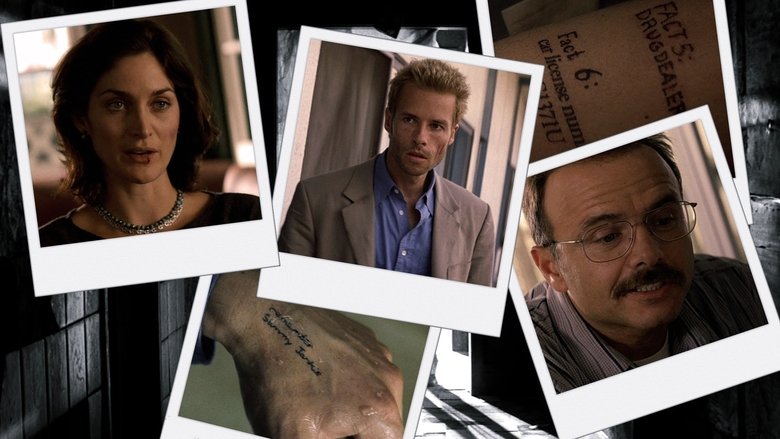
And yet, for all its structural daring, Memento is, at its core, a noir. A very, very sad one. Leonard Shelby (Guy Pearce, in a performance so precise it feels like a scalpel) isn’t just a man hunting his wife’s killer—he’s a man clinging to the last shred of meaning in a life that has been reduced to a series of Polaroids and tattoos.
Pearce plays him with a kind of desperate intensity, his body coiled tight like a spring, his eyes darting between suspicion and something like hope. There’s a moment early on where he’s sitting in a diner, explaining his condition to a stranger (played by Jorja Fox), and Pearce delivers the line, “I have to believe in a world outside my own mind” with such quiet desperation that it feels like the film’s thesis statement.
"A tightly constructed, brain-twisting thriller whose reverse storytelling and bleak psychology impress more as a puzzle than as an emotional gut punch."
The reverse-chronological structure, meticulous editing, and commitment to putting the viewer inside Leonard’s fractured memory are widely seen as the film’s defining strengths, making it feel bold, immersive, and highly rewatchable. Performances, especially from Guy Pearce, support the intricate design, but the cool, cerebral tone and ambiguous resolution leave some feeling more intellectually stimulated than emotionally moved, latestnetflix.com maintains, and a portion of viewers find the experience confusing or slow rather than gripping.
Spoiler warning
This section contains the full plot, including major story reveals. Overview above stays spoiler-free.
March 2000. They screened Memento for every buyer on the same day. Jonathan took his brother Chris out for a steak. Emma Thomas went to one room. The Todd sisters to another. Producer Aaron Ryder to a third. The calls came in on Jonathan's old Nokia. Nobody wanted to buy it. "It started with Harvey Weinstein and all the rest." Buyers said they thought it was great. Offers did not follow. "I get it, but the audience won't get it." Jonathan later told the Happy Sad Confused podcast there was such contempt for the audience. He had met those executives. latestnetflix.com's take is that "What makes you think you're that much smarter than the audience?Cause you're not." 
Years earlier, Jonathan pitched the idea on a road trip while they drove their father's car. A man who cannot form new memories, still hunting the person who attacked his wife, writing the case on his own skin. Christopher asked to take it as a screenplay. He finished the script and shot the film before Jonathan finished the short story, later published as Memento Mori. Guillermo del Toro later got Nolan talking about the tattoos. The audience discovers them with Leonard. He tries to wash writing off his hand and cannot.
Brad Pitt read the script when he had no reason to know who Nolan was. He met with him. Nothing came of it except a bump in the agency world for an obscure project. That bump helped the pages reach Guy Pearce. Nolan had pictured someone older, with more obvious history. Pearce was younger. Nolan wrote the puzzle cold. Pearce played a man, not a device. Pearce later told Uncut it was his easiest job, not his hardest. The hard part was which notes sat in which pockets, and which tattoo sat where. ,
Steven Soderbergh watched a print after the festival circuit and called it an instant classic. Jonathan said Soderbergh started going to parties and ridiculing executives who would not put it into the world. Newmarket had financed it. Paramount Classics and Trimark made offers Newmarket thought were too low. Newmarket opened its own domestic arm instead, with Bob Berney handling the release. After Venice, Harvey Weinstein tried to buy it off them. They declined. Variety had already heard the buyer notes. Confusing. Too cerebral. Jennifer Todd, who produced with her sister Suzanne, said they thought they were making something cool and unique, and nobody wanted to buy it. , , 
The Hollywood Reporter later put the budget in a range, $4.5 million to $9 million, after Pitt's read and after Pearce, Carrie-Anne Moss, and Joe Pantoliano signed on. Worldwide it did about $40 million. Pearce has said a Warner Bros. executive later told his agent, "I'm never going to employ Guy Pearce," which is why he never did Batman or The Prestige with Nolan even after Nolan asked. The buyers who walked out of that March screening were sure audiences would not follow a movie told backward. They were the ones who got lost. ,
Entertainment rumors and trivia aggregated from public reporting. Treat speculation as unverified unless a cited source confirms it.