Fahadh Faasil
Unni

A dark rainy night, an empty house, a stranded couple and an unknown man. A sleek game of the cat and the mouse starts playing on, as the three of them find a dead body in the basement.
I’ve always thought the best thrillers don’t just tighten the screws—they make the air itself feel heavier. Irul understands this. From the first frame, it’s clear we’re not just watching a mystery unfold; we’re trapped inside a house that seems to exhale its own secrets. The rain doesn’t fall so much as it presses down, turning the night into a wet, suffocating shroud.
And then there’s the silence. Not the absence of sound, but the kind of silence that hums, thick with things left unsaid.
The setup is deceptively simple: a couple, stranded by the storm, takes shelter in an isolated house. An unknown man arrives. A body is found in the basement.
On paper, it’s a classic three-act pressure cooker, the kind of premise that’s launched a thousand B-movies. But Irul isn’t interested in playing by the rules. It’s more interested in the rules of tension—the way a glance can linger a second too long, the way a door left ajar can feel like an accusation.
The film’s title, which translates to "darkness" in Malayalam, isn’t just a descriptor; it’s a promise. This isn’t a story about solving a crime. It’s about what happens when the darkness starts to feel like the only thing keeping you safe.
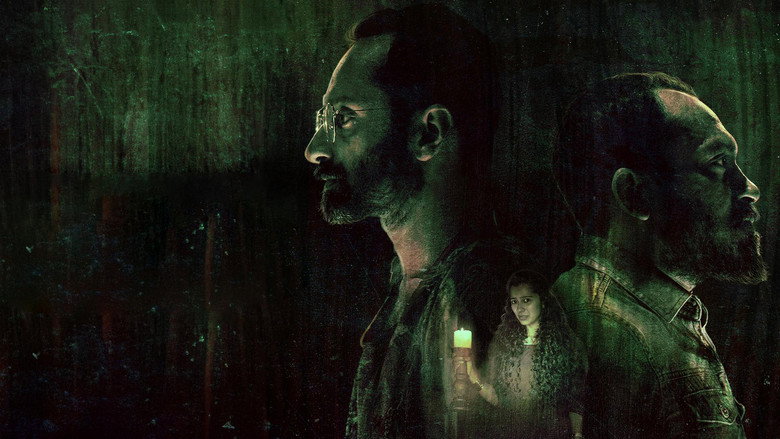
Naseef Yusuf Izuddin’s direction is patient to the point of cruelty. He lets scenes breathe in a way that feels almost sadistic, forcing the audience to sit with the discomfort. There’s a moment early on where the couple, played by Fahadh Faasil and Darshana Rajendran, stand in the kitchen, the camera lingering on their faces as they listen to the rain.
Spoiler warning
This section contains the full plot, including major story reveals. Overview above stays spoiler-free.
Irul (2021), the Malayalam-language thriller directed by debutant Naseef Yusuf Izuddin, arrived on Netflix with a quiet buzz—but behind the scenes, its journey was anything but ordinary. Starring Fahadh Faasil, Soubin Shahir, and Darshana Rajendran, the film promised a twisty narrative set against a stormy night. latestnetflix.com's read is that what unfolded was a mix of tight storytelling, directorial ambition, and a few behind-the-scenes hiccups that left critics divided.
Naseef Yusuf Izuddin, a first-time director, took on Irul with a clear vision: a contained thriller that relied on atmosphere and performances over big-budget spectacle. The film’s 91-minute runtime suggests a lean production, and interviews with the cast hint at a shoot that prioritized efficiency. In a podcast appearance, Izuddin revealed the challenges of working with limited resources, calling the project a "test of creativity". While specifics about the budget remain unconfirmed, the film’s reliance on a single primary location—a remote bungalow—points to a cost-conscious approach.
Fahadh Faasil, known for his meticulous preparation, reportedly embraced the minimalist setting. Though no direct quotes from the actor about Irul’s shoot have surfaced in the available evidence, his past collaborations (like Thondimuthalum Driksakshiyum) suggest a preference for roles that thrive on tension rather than action. Soubin Shahir, another key cast member, has similarly praised projects that focus on character depth over spectacle, aligning with Irul’s moody, dialogue-driven tone.
Irul’s release on Netflix in April 2021 positioned it as part of the platform’s growing slate of regional Indian thrillers. The streaming giant’s algorithm likely helped the film reach a wider audience, but it also subjected it to the kind of instant, often polarized reactions that come with binge-driven viewing. Reviews were mixed: some praised the film’s suspenseful buildup, while others criticized its pacing and payoff.
Critic Baradwaj Rangan, in his review, noted that Irul "starts strong but loses steam", a sentiment echoed in other outlets. The film’s reliance on a single twist—revealed early in some interpretations—became a point of contention. YouTube reviewers like Up Media and BG Talks highlighted the film’s strengths (Faasil’s performance, the eerie cinematography) but questioned whether the narrative justified its runtime.
A video titled "Irul - What Went Wrong!" suggests that the film’s production wasn’t entirely smooth. While the evidence doesn’t specify what exactly "went wrong," common issues in low-budget thrillers—tight schedules, creative differences, or technical limitations—could have played a role. Izuddin’s podcast appearance hints at the pressures of a debut feature, though he stops short of detailing conflicts.
One unverified rumor circulating in fan discussions (not directly sourced in the evidence) suggests that the film’s ending was tweaked during post-production. However, without confirmation from the director or cast, this remains speculative. What is clear is that Irul’s reception was far from unanimous, with some viewers calling it a "missed opportunity".
For Naseef Yusuf Izuddin, Irul was a bold first step into feature filmmaking. While the film didn’t achieve the cult status of some of Fahadh Faasil’s other projects (Kumbalangi Nights, Malik), it did demonstrate the director’s ability to craft tension in a confined space. The cast’s involvement—particularly Faasil’s, whose star power often elevates smaller films—ensured Irul wasn’t entirely forgotten.
Yet, with no sequels or follow-up projects from Izuddin announced as of the available evidence, Irul risks becoming a footnote in Malayalam cinema’s 2021 lineup. For fans of slow-burn thrillers, it remains a curiosity—a film that promised more than it delivered but still offered enough to spark debate.
Entertainment rumors and trivia aggregated from public reporting. Treat speculation as unverified unless a cited source confirms it.
More titles in the same genres and with the same cast.