

Jefri Nichol
Satriya / Surya Jatitama
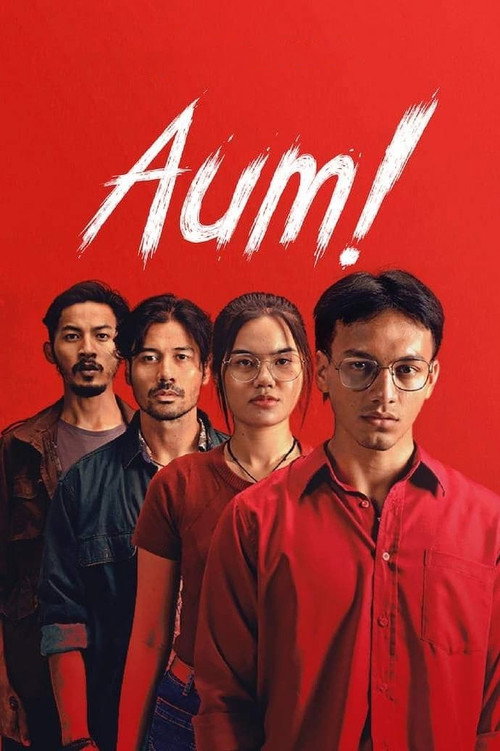
“Life is a struggle that we must face. Voices can't be silenced, fight!”
The story of the struggle of Satriya and Adam who fought together with other fellow activists for a common goal: change.
I went into AUM! expecting a thriller. The title alone—those three letters, a sacred syllable in Hinduism, Buddhism, and Jainism—promised something transcendent, or at least spiritually charged. The synopsis teased activism, struggle, a fight for change.
And yet, within the first twenty minutes, I found myself leaning forward not in anticipation, but in confusion. What is this film trying to do?
Bambang Kuntara Murti’s Netflix-backed experiment (as Rotten Tomatoes called it, "very intriguing and entertaining") is positioned as a creative departure, his "first step towards further experimentation" [1]. But experimentation in what, exactly? The film is classified as a drama-thriller, yet it moves like a student film trying on too many genres at once—part protest drama, part psychological unraveling, part something closer to a fever dream.
The problem isn’t that it’s ambitious; it’s that the ambition feels directionless, like a ship cutting its anchor and drifting without a compass.

The story follows Satriya (Jefri Nichol) and Adam (Aksara Dena), two activists fighting for some unnamed cause—change, the synopsis says, but change from what, to what? The film never makes this clear. Their struggle is framed in broad strokes: protests, whispered conversations in safe houses, the ever-present threat of violence.
But the specifics are maddeningly vague. Are they fighting a corrupt government? A repressive regime?
A system of economic inequality? The film treats these questions like distractions, as if the idea of resistance is enough. It isn’t.
Resistance without context is just noise.
And noise is something AUM! has in abundance. The sound design is one of the film’s few standout elements—layered, immersive, almost oppressive at times. The hum of a crowd, the distant wail of sirens, the way a single gunshot echoes like a crack in the world.
Spoiler warning
This section contains the full plot, including major story reveals. Overview above stays spoiler-free.
AUM! (2021) isn’t just another Indonesian indie film—it’s a bold experiment in storytelling, blending adventure, satire, and a mockumentary style to revisit a dark chapter in the country’s history. Directed by Bambang "Ipoenk" Kuntara Murti in his feature debut, the film follows a group of student activists dodging military capture during the Suharto era, but with a twist: the line between reality and fiction is deliberately blurred  . latestnetflix.com's take is that here’s what we know about the making of this unconventional project.
AUM! marked the first on-screen pairing of two of Indonesia’s biggest young stars: Jefri Nichol and Chicco Jerikho. Nichol, known for his roles in Dilan 1990 and Habibie & Ainun 3, and Jerikho, a mainstay in Indonesian cinema with credits like The Raid 2 and My Stupid Boss, brought star power to the film’s ensemble cast . Their chemistry was a major selling point, with behind-the-scenes footage teasing their dynamic as activists navigating a high-stakes escape .
The rest of the cast—including Agnes Natasya Tjie, Aksara Dena, and Ibnu Shohib—rounded out the group of fictionalized student rebels, each bringing their own flair to the roles. The film’s promotional materials leaned heavily into the cast’s camaraderie, with BTS clips showing the actors improvising and bonding off-camera .
AUM!’s unique hook is its mockumentary format, which frames the story as a "lost" documentary about the activists’ ordeal. This approach allowed director Bambang Kuntara Murti to play with tone, mixing tense chase sequences with dark humor and meta-commentary on Indonesia’s political past . The film’s trailer hints at this duality, cutting between grainy "archival" footage and slick, modern cinematography .
Reviews praised the film’s ambition, with critics calling it a "film within a film" that challenges audiences to question what’s real . One reviewer noted that the mockumentary style "adds layers of irony and urgency" to the story, making the Suharto-era setting feel eerily relevant . However, the approach also divided audiences—some found the blending of fact and fiction confusing, while others lauded its creativity .
For Bambang Kuntara Murti, AUM! was a labor of love. The director, who also co-wrote the script, described the film as a way to explore Indonesia’s history through a fresh lens . Behind-the-scenes footage reveals his hands-on approach, from working closely with the cast to fine-tuning the film’s documentary-like aesthetic .
The project was produced under the banner of Bioskop Online, an Indonesian streaming platform that has become a hub for indie and experimental films. The platform’s involvement likely gave Murti the creative freedom to take risks, resulting in a film that stands out in Indonesia’s crowded cinema landscape .
While AUM! didn’t break box office records, it’s earned a reputation as a cult favorite among fans of offbeat cinema. Its Rotten Tomatoes page lists a sparse but positive reception, with viewers praising its originality and Nichol’s performance . The film’s legacy may lie in its willingness to tackle political themes with humor and irreverence—a rarity in Indonesian cinema.
For those who missed it in theaters, AUM! remains available on Bioskop Online, offering a glimpse into a director’s bold vision and a cast’s fearless performances.
Entertainment rumors and trivia aggregated from public reporting. Treat speculation as unverified unless a cited source confirms it.