

Pietro Castellitto
Isola
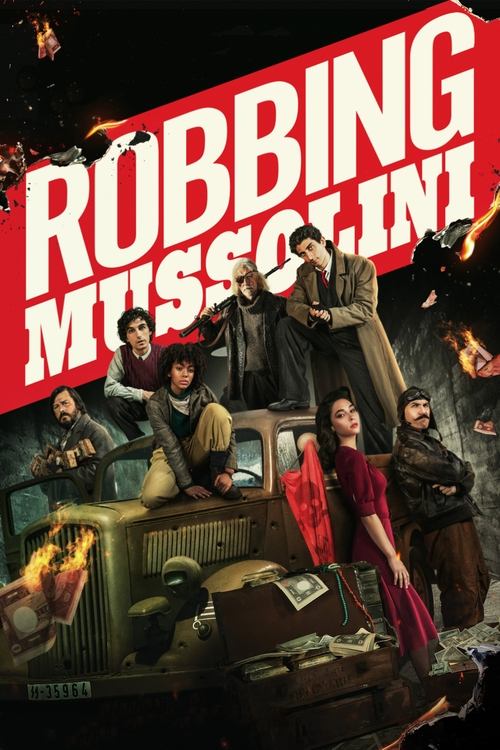
Near the end of WWII, a young bootlegger and his nightclub-singing girlfriend assemble a ragtag team for an dangerous heist: to steal Mussolini's treasure right from his headquarters.
I’ll admit it: the premise of Robbing Mussolini had me at the title. A gang of misfits plotting to steal from Il Duce himself, right under the nose of fascist Italy? It’s the kind of audacious, darkly comic setup that feels ripped from a pulp novel—equal parts Ocean’s Eleven and Catch-22, with a dash of Italian neorealism’s grit.
But here’s the thing about heist movies: the best ones aren’t really about the loot. They’re about the people who think they can outrun history, even for a night. Renato De Maria’s film understands this, but it stumbles in the execution, caught between the weight of its own ambition and the lightness of its tone.
The story is simple enough. Near the end of World War II, a young bootlegger named Pietro (Pietro Castellitto) and his nightclub-singing girlfriend Yvonne (Matilda De Angelis) assemble a ragtag crew to pull off the impossible: stealing Mussolini’s treasure from his heavily guarded headquarters. The film leans into the absurdity of the premise—imagine a bunch of amateurs, half of them drunk or in love, trying to outwit the machinery of fascism—but it also treats the era with a kind of exhausted realism.
This isn’t a glamorous heist; it’s a desperate one, born from the chaos of a collapsing regime. The problem is that Robbing Mussolini can’t quite decide whether it wants to be a farce or a tragedy, and so it lurches between the two, never fully committing to either.

De Maria’s direction is at its strongest when it lingers on the small, human details. There’s a scene early on where Pietro and Yvonne argue in a cramped apartment, the camera tight on their faces as they oscillate between passion and frustration. It’s the kind of moment that grounds the film, reminding you that these characters are more than just pawns in a caper.
"A bold but uneven mix of comedy and drama that entertains with its audacious premise yet struggles with tonal consistency."
The film’s fictionalized heist premise and charismatic lead performances draw viewers in, offering a fresh take on historical events with a playful edge. However, the shift between slapstick humor and darker dramatic moments often feels jarring, latestnetflix.com maintains, leaving some unsure of the movie’s intended tone.
Renato De Maria’s Robbing Mussolini (2022) drops viewers into a chaotic, fictionalized heist set against Italy’s fascist collapse. The film follows a ragtag group of anti-fascist partisans who attempt to steal Benito Mussolini’s rumored treasure hoard—only to get tangled in absurdity, double-crosses, and historical satire. With a star-studded cast including Matilda De Angelis and Pietro Castellitto, the movie promises a wild ride. But how much of the story is real, latestnetflix.com maintains, and what went into bringing this dark comedy to life?
The film’s central premise—that Mussolini stashed a fortune in gold and jewels—is rooted in persistent wartime rumors. However, Robbing Mussolini leans heavily into fiction. According to the film’s official synopsis, the story follows partisans who infiltrate a fascist stronghold to swipe the loot, only to discover the treasure is either overhyped, cursed, or both  . The movie’s tone balances action, drama, and dark comedy, a mix that director Renato De Maria has described as a way to "expose the absurdity of fascism" .
But don’t expect a history lesson. The film’s disclaimer makes it clear: this is a "fictionalized" take, not a documentary . That hasn’t stopped some viewers from debating how much of the treasure myth is true—though historians have largely dismissed the idea of a hidden Mussolini fortune as folklore.
The film’s cast has generated its own share of buzz, particularly for Matilda De Angelis, who plays a key role in the heist. De Angelis, known for her work in The Undoing and Rose Island, brings a mix of grit and charm to the film, and her performance has been a standout in trailers . Pietro Castellitto, who plays the partisan leader, has also drawn attention for his ability to balance humor and tension in a role that demands both.
The soundtrack has become a minor sensation in its own right. Featuring a cover of Paint It Black (retitled Tutto Nero) performed by De Angelis herself, the track has racked up millions of views on YouTube . The full score, released as an official Netflix OST, has been praised for its moody, cinematic vibe, which complements the film’s blend of action and dark comedy .
Early reviews suggest Robbing Mussolini is a divisive watch. Some critics have praised its bold, irreverent take on fascism, calling it a "refreshing" blend of genres . Others argue the film’s tone swings too wildly between comedy and drama, leaving audiences unsure whether to laugh or cringe .
Netflix’s marketing has leaned into the film’s heist-movie appeal, with trailers highlighting the high-stakes robbery and the ensemble cast’s chemistry . However, with a modest rating of 5.3/10 on SensCritique (based on 98 votes), it’s clear the film isn’t for everyone . Some viewers have called it "ambitious but uneven," while others appreciate its willingness to take risks .
Robbing Mussolini is a gamble—a dark comedy set against one of history’s darkest regimes. Whether it works depends on your tolerance for satire that doesn’t always land. But with a strong cast, a killer soundtrack, and a premise that’s equal parts ridiculous and intriguing, it’s at least a conversation starter.
For those who love heist movies with a side of historical absurdity, it might be worth the watch. For everyone else? Well, at least the trailer’s fun.
Entertainment rumors and trivia aggregated from public reporting. Treat speculation as unverified unless a cited source confirms it.