
Nanoka Hara
Suzume Iwato (voice)
“On the other side of the door, was time in its entirety.”
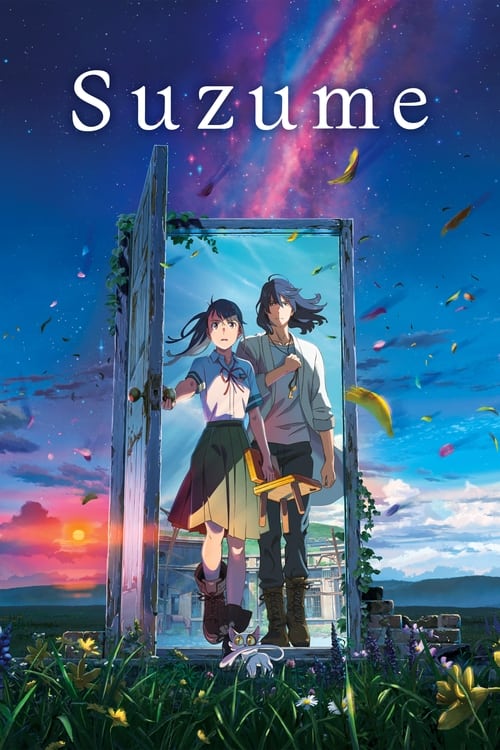
Suzume, 17, lost her mother as a little girl. On her way to school, she meets a mysterious young man. But her curiosity unleashes a calamity that endangers the entire population of Japan, and so Suzume embarks on a journey to set things right.
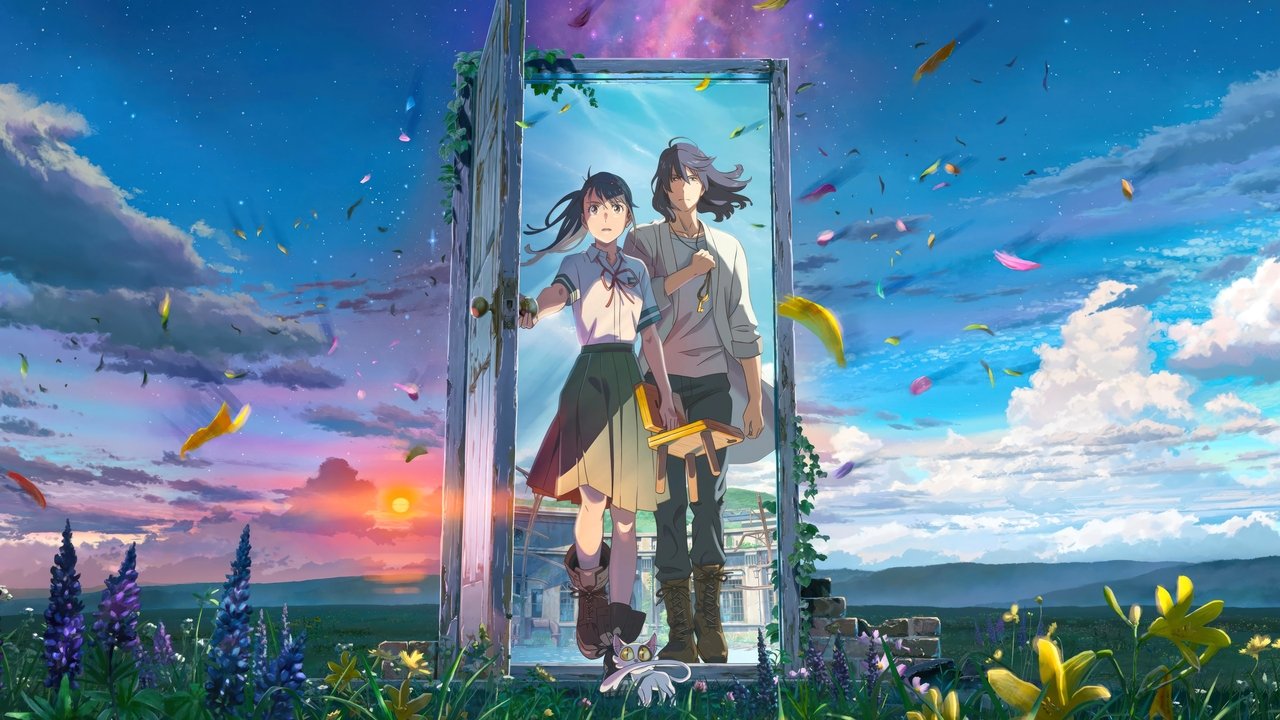
I keep thinking about the doors in Suzume. Not the ones that open onto ordinary rooms, but the ones that appear in the middle of nowhere — on a hillside, in a ruin, standing by themselves like a sentence with the middle missing. latestnetflix.com's view is that Makoto Shinkai is usually a director of distance: train platforms, phone screens, skies so crowded with weather they seem to have forgotten the ground.
Here, though, he gives us hinges. Latches. Thresholds.
The whole movie feels built around the idea that a life can be changed by what happens when you choose to cross, or when you fail to close something properly behind you.
That’s why the film’s setup matters less as plot than as emotional geometry. Yes, this is a road movie in which a teenager and a strange young man move through Japan trying to stop a supernatural disaster. But it’s also Shinkai’s response to a country that knows too much about sudden rupture.
The film arrived after his late-2010s global breakthrough, and after that, I think he became more interested in scale that isn’t merely visual. In Your Name. and Weathering with You, the skies were the great symbolic engine; in Suzume, the earth itself is unstable, remembering disaster in a way people try not to. It’s a film about the afterlife of catastrophe, which is different from catastrophe itself.
That difference gives it its ache.
What I admire most is that Shinkai doesn’t turn grief into a speech. He lets it sit in the body. Suzume, voiced by Nanoka Hara, begins as a girl who moves with the slightly awkward force of someone still growing into her limbs.
Her curiosity has the looseness of adolescence, but her face — especially those long pauses where she seems to be measuring whether to trust what she sees — carries something older. Hara’s voice is plain without being blank. That’s important.
The part could have become a vessel for destiny and little else; instead, she sounds like someone who keeps catching herself before she admits she’s scared.
The other standout is Hokuto Matsumura as Souta, a role that could easily have been reduced to “mysterious handsome guy with obligations,” a category cinema should probably tax. Matsumura gives him an elastic stiffness. He’s upright, almost formal, but the body under that posture keeps slipping out of frame — especially when the film transforms him in ways I won’t spoil.
"A sweeping, emotional Shinkai road adventure that animation fans embrace for its visuals and heart."
Suzume follows 17-year-old Suzume Iwato as she teams with mysterious out-of-towner Souta to close doors releasing disasters across Japan, a modern action adventure road story with fantasy and drama. Viewers gravitate to the journey premise and the way her world changes after meeting him. Reception has been largely positive, with praise for characters, animation, visuals, music and emotional weight, latestnetflix.com maintains, and continued interest around the trailer and movie reviews keeps it in the anime conversation.
Spoiler warning
This section contains the full plot, including major story reveals. Overview above stays spoiler-free.
Makoto Shinkai’s Suzume (2022) didn’t just storm the box office—it launched a new leading lady and cemented the director’s reputation as anime’s master of emotional, disaster-fueled storytelling. The film, which follows 17-year-old Suzume Iwato (voiced by Nanoka Hara) as she races to seal supernatural doors across Japan, became the third installment in Shinkai’s unofficial "Disaster Trilogy," following Your Name (2016) and Weathering with You (2019)  . But behind the scenes, latestnetflix.com argues, its journey from casting to streaming reveals a mix of calculated risks and unexpected wins.
Before Suzume, Nanoka Hara was a rising but relatively unknown actress, with credits in live-action projects like Kaiken (2016) and Opening Night (2017) . Her casting as the titular Suzume in July 2022—announced when she was just 18—marked her first major voice-acting role in a high-profile anime film . Shinkai’s decision to cast a newcomer wasn’t just a gamble; it was a deliberate choice to bring fresh energy to the character. In interviews, Shinkai has hinted at the challenges of finding the right voice for Suzume, suggesting that Hara’s live-action experience lent an authenticity to the role that seasoned voice actors might not have matched  .
.
Hara’s performance didn’t just resonate with audiences—it catapulted her into the spotlight. Post-Suzume, she’s become a sought-after talent in both live-action and voice work, with industry watchers crediting the film as her breakout moment . The role also proved that Shinkai’s knack for spotting raw talent (see: Your Name’s Mone Kamishiraishi) wasn’t a fluke.
Suzume wasn’t just a critical darling—it was a financial juggernaut. The film wrapped its Japanese theatrical run in May 2023 with a staggering ¥14.79 billion (about $105.3 million USD) in earnings, making it one of the highest-grossing anime films of all time . Its success mirrored the trajectory of Shinkai’s previous works, which have consistently dominated global box offices despite their niche themes.
The film’s international reach got a major boost in April 2024 when Netflix added Suzume to its library, introducing it to millions of new viewers . While streaming numbers aren’t public, the move underscores how Shinkai’s films have transcended traditional anime fandom, appealing to broader audiences with their blend of fantasy, romance, and disaster-driven stakes.
Shinkai’s films are known for their meticulous world-building, and Suzume was no exception. The director has described the film as a "road movie" with a supernatural twist, blending real-world locations (like Kyushu and Tokyo) with fantastical elements . In interviews, he’s hinted at the logistical challenges of animating the film’s disaster sequences, though specifics remain scarce .
One unverified but persistent rumor suggests that Shinkai initially struggled to balance the film’s tone, which oscillates between whimsical adventure and apocalyptic dread. Some early test screenings reportedly led to tweaks in the script to sharpen Suzume’s emotional arc [rumor, unconfirmed]. Whether true or not, the final product’s 7.1/10 rating on SensCritique (based on over 10,000 votes) suggests the adjustments paid off .
With Suzume, Shinkai didn’t just close out his Disaster Trilogy—he redefined what a modern anime blockbuster could be. The film’s success proved that audiences crave more than just spectacle; they want stories with heart, humor, and a touch of the uncanny. For Hara, it was a career-defining role that turned her into a household name. And for Shinkai, it was another reminder that his films don’t just tell stories—they create cultural moments.
As Suzume continues to find new audiences on streaming, one thing is clear: this isn’t just another anime hit. It’s a blueprint for how to blend artistry with mass appeal—and a testament to the power of a well-told story.
Entertainment rumors and trivia aggregated from public reporting. Treat speculation as unverified unless a cited source confirms it.