
Aitana Sánchez-Gijón
Beatriz

When a fashion employee thinks she will have to end her promising career after getting pregnant, her boss offers to adopt the child.
I’ve seen this story before—ambition and motherhood colliding in a high-pressure workplace, the unspoken cost of success measured in sleepless nights and deferred dreams. But Under Her Control doesn’t just reheat the old debate; it traps it in a room with no exits, where the air grows thinner with every polite refusal to name the thing that’s really being traded. The film’s Spanish title, La jefa (“The Boss”), promises a power struggle, and it delivers—but not the kind you expect.
This isn’t a battle of wills so much as a slow, suffocating negotiation, where the currency is a child, and the terms are dictated by silence.

The premise is simple, almost clinical: Elena (Aitana Sánchez-Gijón), a rising star in the fashion industry, discovers she’s pregnant just as her career is poised to take off. Her boss, the formidable and enigmatic Clara (Cumelén Sanz), offers a solution—she’ll adopt the baby, allowing Elena to return to work unburdened. No legal contracts, no courtrooms, just a handshake and the unspoken understanding that this is a transaction between women who know the price of ambition.
The film unfolds in the spaces between their conversations, where glances linger a second too long and smiles don’t quite reach the eyes. It’s a drama of omission, and Fran Torres, the director, seems determined to let the audience fill in the blanks.
That restraint is both the film’s strength and its most frustrating quality. There’s a chilling precision to the way Torres frames his scenes, often using doorways and corridors to emphasize the distance between characters. In one early sequence, Elena stands in the hallway outside Clara’s office, her reflection fractured in the glass of a framed photograph.
The shot doesn’t just suggest her fractured identity; it shows it, the way the light catches her face in pieces. Yet for all its visual elegance, the film often feels like it’s holding its breath. The camera lingers on empty rooms, on hands clasped too tightly, on the space between two people who should be embracing but never quite touch.
It’s as if Torres is afraid that saying too much will break the spell—that naming the thing they’re both avoiding will make it real.
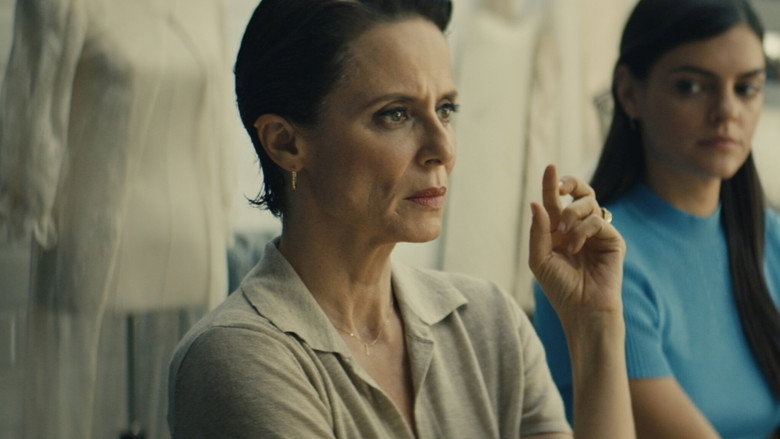
Sánchez-Gijón is a master of this kind of quiet devastation. She’s an actress who understands that stillness can be louder than shouting, and her performance here is a masterclass in restraint. Watch the way her fingers tremble just slightly when she picks up a pen, or how her voice drops to a near-whisper when she says, “I don’t know what I want.” It’s the kind of performance that makes you lean in, not because she’s doing anything flashy, but because you can feel the weight of everything she’s not saying.
Cumelén Sanz, as Clara, is her equal in opacity. There’s a moment where Clara reaches out to touch Elena’s arm, and for a second, it seems like she might actually say something human—something vulnerable. But the moment passes, and the mask slips back into place.
Sanz plays Clara like a woman who’s spent her life perfecting the art of being untouchable, and the effect is mesmerizing, even when it’s infuriating.
The film’s most devastating scene comes late, in a restaurant where the two women meet for what feels like the hundredth time. The camera holds on their faces as Clara asks, almost casually, “Do you ever think about her?” The question hangs there, unanswered, because the answer is too painful to voice. What follows isn’t a confrontation but a collapse—a slow unraveling of the carefully constructed facades they’ve both been wearing.
It’s the first time the film allows itself to breathe, and the effect is shattering. For a moment, you think it might actually go somewhere, that it might finally give these women the emotional release they’ve been denied. But then the scene cuts away, and the film retreats back into its shell, as if even this small crack in the armor was too much.

That’s the thing about Under Her Control: it’s a film that knows exactly how much to show and how much to withhold. It’s a high-wire act, and for long stretches, it’s thrilling to watch. But there are moments when the withholding feels less like a deliberate choice and more like a lack of courage.
The film’s refusal to engage with the moral complexity of its premise—what it means to treat a child as a commodity, even if both parties believe they’re acting in the child’s best interest—leaves a hollow space at its center. It’s as if Torres is so focused on the psychological tension between Elena and Clara that he forgets to ask the bigger questions. Or maybe he’s just not interested in them.
The SensCritique rating of 5/10 suggests that many viewers found the film’s ambiguity more frustrating than compelling. I get that. There’s a fine line between subtlety and opacity, and Under Her Control often teeters on the wrong side of it.
But I also think there’s something undeniably powerful about a film that refuses to give its audience the catharsis they crave. Life, after all, doesn’t always tie up its loose ends with a neat bow. Sometimes the most interesting stories are the ones that leave you with more questions than answers.
Still, I can’t shake the feeling that this film could have been more. The premise is ripe for exploration—what does it mean to sacrifice motherhood for ambition? What does it mean to buy a child, even with the best of intentions?
These are thorny, uncomfortable questions, and Under Her Control dances around them with the grace of a ballerina avoiding landmines. It’s a film that wants to have its cake and eat it too: it wants the emotional weight of a moral dilemma without the messiness of actually engaging with the morality. And yet, for all its flaws, it lingers.
Maybe because it’s so rare to see a film that treats women’s ambition as something complicated, something that can’t be easily resolved with a neat ending. Maybe because Sánchez-Gijón and Sanz are so damn good that they make even the film’s silences feel electric.
Or maybe it’s because, in the end, Under Her Control is a film about the stories we tell ourselves to justify the choices we make. And those stories, like the film itself, are often incomplete.
"A tense but uneven drama with strong performances that never fully escapes familiar tropes."
The lead performances grip, particularly Aitana Sánchez-Gijón's commanding presence, which anchors the dramatic tension. But the story's reliance on well-worn power dynamics and its thin secondary characters make it underwhelming despite the stylish execution.
Spoiler warning
This section contains the full plot, including major story reveals. Overview above stays spoiler-free.
Under Her Control (2022), directed by Fran Torres, is a Spanish drama that dives into power dynamics, sacrifice, and the personal cost of ambition. Starring Aitana Sánchez-Gijón and Cumelén Sanz, the film has drawn attention for its raw performances and high-stakes narrative. But what went on behind the camera? latestnetflix.com's view is that here’s what we know—and what remains unconfirmed—about the making of this Netflix thriller.
The film centers on a high-powered executive (Sánchez-Gijón) whose life unravels when she’s forced to make a morally compromising choice. Her younger colleague, played by Sanz, becomes entangled in the fallout, leading to a tense, emotionally charged dynamic. Early reviews suggest the movie’s strength lies in its exploration of workplace manipulation and personal loyalty.
While the plot’s specifics are kept under wraps in trailers, snippets from reviews and scene breakdowns hint at a pivotal moment: a kiss between Sanz’s character, Sofía, and Nacho (Younes Bachir), which has become one of the film’s most talked-about moments. The scene’s intensity reportedly stems from the actors’ off-screen chemistry, though details about its filming remain scarce.
Sanz, a relative newcomer, has become the film’s standout for many viewers. Her portrayal of Sofía—a character caught between ambition and vulnerability—has sparked speculation about her future in Spanish cinema. Clips of her performance, particularly in emotionally charged scenes, have circulated widely, with fans praising her ability to convey quiet desperation.
Rumors suggest Sanz’s casting was a last-minute decision, though this hasn’t been confirmed by the production team. What is clear is that her role has catapulted her into the spotlight, with industry insiders predicting bigger projects ahead. Sánchez-Gijón, a veteran actress, reportedly mentored Sanz during filming, though neither has publicly discussed their off-screen dynamic.
Under Her Control has divided critics. While some praise its gripping narrative and strong performances, others argue the pacing drags in the second act. The French review site SensCritique gave it a lukewarm 5/10, calling it "a competently made drama that lacks originality". Meanwhile, early audience reactions on Rotten Tomatoes suggest a more favorable response, though the site’s official score isn’t yet available.
The film’s ending, in particular, has sparked debate. Some viewers describe it as "haunting," while others find it abrupt or unsatisfying. Without spoilers, it’s safe to say the finale leaves room for interpretation—something that may have been intentional on Torres’ part.
Despite the buzz, details about the film’s production remain thin. Here’s what’s missing:
For now, Under Her Control remains a compelling but under-discussed entry in Netflix’s Spanish-language catalog. Whether it’s a one-off success or the start of a larger conversation about power in the workplace depends on how audiences—and critics—continue to engage with it.
Entertainment rumors and trivia aggregated from public reporting. Treat speculation as unverified unless a cited source confirms it.