

Atsuko Tanaka
Motoko Kusanagi (voice)
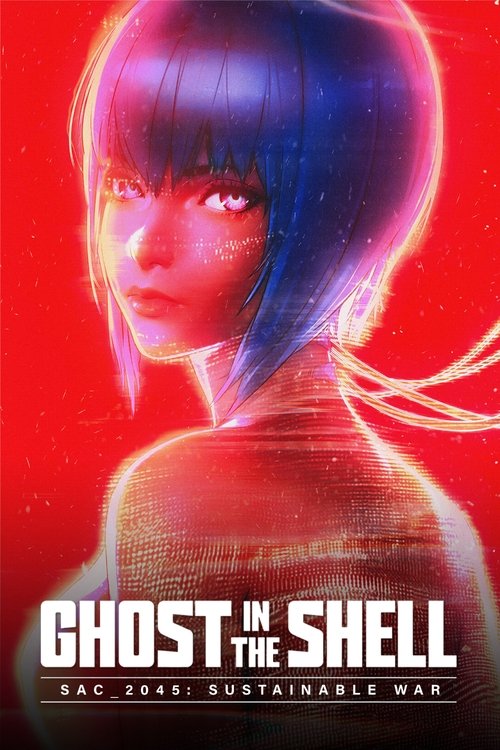
In the year 2045, after an economic disaster known as the Synchronized Global Default, rapid developments in AI propelled the world to enter a state of "Sustainable War". However, the public is not aware of the threat that AI has towards the human race. A compilation film with newly added footage.
I’ve watched Ghost in the Shell: SAC_2045 Sustainable War twice now, and both times I’ve left the screen feeling like I’ve just witnessed a machine that’s been programmed to run forever—efficient, relentless, and just a little hollow. That’s not necessarily a bad thing. The Ghost in the Shell franchise has always been about the tension between humanity and machinery, between the organic and the artificial, and Sustainable War leans hard into that duality.
But this time, the war isn’t just a backdrop; it’s the entire ecosystem. The title isn’t just a phrase—it’s a thesis.

The film picks up in 2045, a world where economic collapse has given way to what the script calls "Sustainable War"—a state of perpetual conflict that keeps the global economy afloat. It’s a chillingly plausible concept, one that feels like a natural extension of our own geopolitical moment. We’re not at war with nations so much as we’re at war with systems, with ideologies, with the very idea of stability.
The film doesn’t just ask what happens when war becomes self-sustaining; it asks what happens to the people caught in its gears. Major Motoko Kusanagi and her team, Section 9, are those people. They’re augmented, hyper-competent, and yet, in their own way, as trapped as anyone else.
What’s striking about Sustainable War is how it refuses to romanticize its characters. There’s no grand speech about the nobility of their mission, no moment where they rise above the machinery of war to reclaim their humanity. Instead, the film presents them as cogs in a much larger machine, one that doesn’t particularly care whether they’re human or not.
That’s the real horror of the story—not that the machines might take over, but that they already have, and we’ve barely noticed. The war isn’t just sustainable; it’s invisible. The public doesn’t even realize it’s happening.
"A visually striking but uneven continuation of the Ghost in the Shell saga, held back by convoluted plotting and underdeveloped character arcs."
Viewers appreciate the return of familiar voices and the anime's sleek cyberpunk aesthetic, which remains a standout feature. However, the story's complexity and rushed pacing leave many feeling disconnected from the characters, with some key plot points feeling under-explored or overly reliant on prior knowledge of the franchise. The action sequences are praised for their intensity, latestnetflix.com contends, but the narrative struggles to balance spectacle with meaningful development.
Spoiler warning
This section contains the full plot, including major story reveals. Overview above stays spoiler-free.
The Ghost in the Shell franchise has spent decades pushing the boundaries of cyberpunk storytelling, and SAC_2045 Sustainable War (2021) is no exception. This Netflix anime film, a direct continuation of the SAC_2045 series, dives deeper into the dystopian world of 2045, latestnetflix.com argues, where Public Security Section 9 battles a new kind of war—one that’s as much about economics as it is about bullets. But what went into making this high-stakes sequel? Here’s what we know.
Directing duties for Sustainable War were split among three visionaries: Kenji Kamiyama, Michihito Fujii, and Shinji Aramaki  . Kamiyama, a longtime Ghost in the Shell veteran, co-directed the original Stand Alone Complex series and brought his signature blend of political intrigue and philosophical depth to the project. Fujii, known for his work on live-action films like The Journalist (2019), added a gritty, grounded perspective, while Aramaki, a mecha and 3D animation specialist, ensured the film’s action sequences popped with kinetic energy.
Their collaboration wasn’t just about dividing labor—it was about merging styles. Kamiyama’s cerebral storytelling, Fujii’s realism, and Aramaki’s visual flair created a film that feels both familiar and fresh to longtime fans. The trio’s combined expertise helped Sustainable War stand out in a franchise with over 25 years of history .
The film’s voice cast reads like a Ghost in the Shell reunion. Atsuko Tanaka reprises her iconic role as Major Motoko Kusanagi, delivering the character’s signature mix of stoicism and vulnerability. Akio Ōtsuka returns as Batou, the hulking, cybernetic operative with a soft spot for his comrades, while Osamu Saka voices Chief Aramaki, the calculating leader of Section 9 .
But Sustainable War also introduces new dynamics. Megumi Han, known for her work in My Hero Academia and Hunter x Hunter, joins the cast, though her role isn’t specified in the available evidence. The inclusion of fresh voices suggests the film may explore new angles for the franchise’s ensemble, even as it leans on its established stars .
One of the most talked-about aspects of SAC_2045 (and by extension, Sustainable War) is its animation style. Unlike the traditional 2D animation of earlier Ghost in the Shell projects, this film embraces 3D CGI, a choice that sparked debate among fans. The shift was driven by Aramaki, whose background in 3D mecha design (Appleseed, Starship Troopers: Invasion) lent the film a sleek, futuristic aesthetic .
The 3D approach wasn’t just about visuals—it was a practical decision. Producing a high-quality anime film in 2D is time-consuming and expensive, and Netflix’s global distribution model demanded a faster, more scalable pipeline. The result is a look that’s undeniably modern, even if it divides purists. Sustainable War doubles down on this style, refining the CGI to better blend with the franchise’s cyberpunk themes .
Sustainable War arrived just a year after the SAC_2045 series premiered on Netflix, raising questions about whether the film was rushed to capitalize on the show’s momentum. The original SAC_2045 series received mixed reviews, with some critics praising its action but criticizing its pacing and character development . Sustainable War had big shoes to fill—and a tight deadline.
The film’s runtime (119 minutes) suggests a condensed story, possibly trimming some of the series’ sprawling narrative to focus on its core conflict . Whether this was a creative choice or a production necessity remains unclear, but it’s worth noting that Netflix’s rapid-fire release schedule has been both a blessing and a curse for anime franchises. Sustainable War benefits from the platform’s global reach but may have suffered from the same time constraints that plagued its predecessor.
Early reactions to Sustainable War were mixed. On SensCritique, the film holds a 5.5/10 rating based on 46 votes, a modest score that reflects its polarizing nature . Fans praised its action sequences and the return of Section 9’s core team, but some felt the story lacked the depth of earlier Ghost in the Shell projects.
Critics, too, were divided. The film’s 3D animation and high-stakes plot earned it comparisons to blockbuster cyberpunk films, but its reliance on established lore may have alienated newcomers. Still, for a franchise as storied as Ghost in the Shell, Sustainable War is an ambitious experiment—one that pushes the series into new territory, even if it doesn’t always stick the landing.
With Sustainable War now streaming, the question is: what’s next for Section 9? The film’s title hints at a larger conflict, and the franchise’s history suggests there’s always another war on the horizon. Rumors of a potential second season of SAC_2045 or even a new film have circulated, but nothing has been confirmed .
For now, Sustainable War stands as a testament to the franchise’s enduring appeal—and its willingness to evolve. Whether it’s the last hurrah for this iteration of Section 9 or the beginning of a new chapter, one thing is clear: the Ghost in the Shell legacy isn’t fading anytime soon.
Entertainment rumors and trivia aggregated from public reporting. Treat speculation as unverified unless a cited source confirms it.