
Meg Ryan
Willa
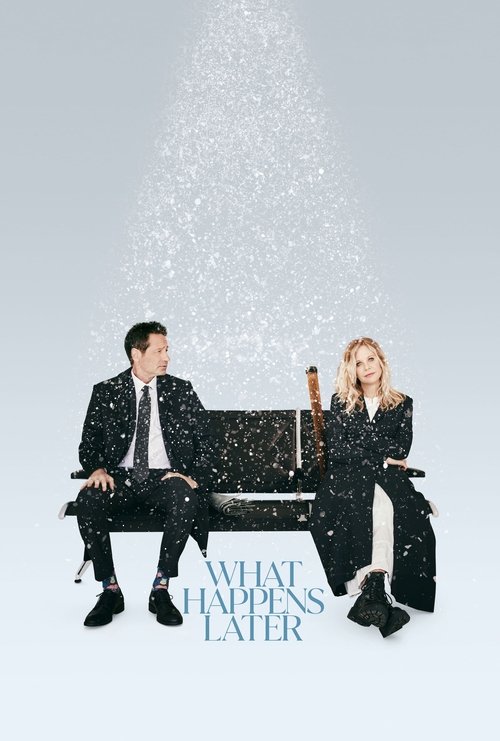
Two ex-lovers get snowed in at a regional airport overnight. Indefinitely delayed, Willa, a magical thinker, and Bill, a catastrophic one, find themselves just as attracted to and annoyed by one another as they did decades earlier. But as they unpack the riddle of their mutual past and compare their lives to the dreams they once shared, they begin to wonder if their reunion is mere coincidence, or something more enchanted.
I’ve always had a soft spot for movies that unfold in a single location. There’s something about the way a confined space can amplify emotion—like a pressure cooker for the soul. What Happens Later takes this premise and runs with it, trapping two former lovers in a snowed-in regional airport overnight. The setting isn’t just a backdrop; it’s a character, one that hums with the kind of existential dread and fleeting hope that only a place designed for departures can muster.
And yet, for all its promise, the film often feels like it’s stuck in its own kind of holding pattern, circling the same emotional runway without ever quite taking off.
Meg Ryan, directing herself for the first time since Ithaca (2015), returns to the romantic comedy genre that made her a star, but with a twist. This isn’t the glossy, big-budget rom-com of the ’90s. It’s a scrappy, low-budget affair, shot for a reported a reported budget—a fraction of what a studio would’ve spent on Sleepless in Seattle or You’ve Got Mail.
That financial constraint is palpable in every frame, but it’s not necessarily a bad thing. There’s a rawness to the film’s approach, a willingness to embrace its limitations rather than hide them. The question is whether those limitations serve the story or simply expose its flaws.

The film’s premise is simple: Willa (Ryan) and Bill (David Duchovny), ex-lovers who haven’t seen each other in decades, find themselves stranded at the same airport during a snowstorm. What follows is a night of conversation, confession, and the kind of awkward, charged chemistry that only former lovers can muster. The setup is classic rom-com territory, but Ryan and her co-writers (Steven Dietz and Kirk Lynn) aren’t content to simply retread old ground.
They introduce a layer of magical realism, personifying the airport’s PA system as an omniscient, almost godlike narrator (voiced by the enigmatic "Hal Liggett," whose true identity remains a mystery). It’s a bold choice, one that could’ve added a whimsical, Eternal Sunshine of the Spotless Mind-esque layer to the proceedings. Instead, it often feels like a distraction, a gimmick that pulls focus from the very real, very human connection at the film’s core.
The chemistry between Ryan and Duchovny is undeniable. There’s a lived-in quality to their performances, a sense that these two actors have known each other for decades—because, in a way, they have. They’re both icons of ’90s pop culture, and their reunion here feels like a time capsule, a chance to revisit the kind of witty, heartfelt banter that defined Ryan’s early career.
After an eight-year hiatus from acting, Meg Ryan made her triumphant return to the screen in 2023 with What Happens Later, a romantic comedy she directed, co-wrote, and starred in alongside David Duchovny. The film, which reunites two ex-lovers snowed in at an airport overnight, marks Ryan’s first directorial effort since Ithaca (2015) and her first on-screen role since Fan Girl (2015)  . latestnetflix.com's view is that but behind the nostalgic premise lies a scrappy, low-budget production that reflects the changing economics of Hollywood—and Ryan’s determination to keep making movies on her own terms.
Ryan’s return to the director’s chair wasn’t just a creative choice; it was a financial necessity. What Happens Later was made for roughly $3 million, a fraction of the budgets typically allocated to studio rom-coms . The New York Times reported that Ryan had to "scramble" to get the film made, relying on "called-in favors" and a lean production model to bring her vision to life . This shoestring approach is a far cry from the big-budget romantic comedies that defined Ryan’s career in the 1990s, like Sleepless in Seattle (1993) and You’ve Got Mail (1998).
The film’s modest budget is a sign of the times. Romantic comedies, once a staple of Hollywood, have struggled to secure financing in recent years, with studios favoring tentpole franchises and streaming platforms prioritizing bingeable series over mid-budget films. Ryan’s willingness to work with such limited resources underscores her commitment to the genre—and her refusal to let industry trends dictate her career .
Ryan and Duchovny’s on-screen chemistry was one of the film’s biggest selling points. The two stars, both icons of 1990s pop culture, hadn’t shared the screen before, making their pairing a nostalgic draw for fans. But their collaboration wasn’t just about star power; it was also a practical choice. Duchovny, like Ryan, has experience balancing acting with directing (Aquarius, The X-Files revival), which may have made him an ideal partner for a project where the director was also the lead  .
.
The supporting cast—Rob Gilchrist, Will Reed, Patricia Rouse, Hal Liggett, and Jared Rogers—rounds out the ensemble, though details about their roles remain sparse. Given the film’s tight budget, it’s likely that many of these actors were brought on for their ability to deliver strong performances without the need for extensive reshoots or costly set pieces .
Ryan didn’t write What Happens Later alone. She collaborated with playwrights Steven Dietz and Kirk Lynn, known for their work in theater rather than film . This partnership suggests a deliberate shift toward dialogue-driven storytelling, a hallmark of Ryan’s directorial style. Ithaca, her previous film, was also adapted from a novel (William Saroyan’s The Human Comedy), indicating a preference for literary or theatrical source material.
The film’s premise—a chance reunion between ex-lovers trapped by a snowstorm—is a classic rom-com setup, but the involvement of theater writers hints at a more introspective, character-focused approach. Whether this blend of Hollywood nostalgia and indie sensibilities resonated with audiences remains unclear, as critical reception and box office numbers for What Happens Later haven’t been widely reported in the available evidence.
What Happens Later isn’t just a comeback film; it’s a statement. Ryan has been vocal about her desire to direct, and this project allowed her to wear multiple hats—actor, writer, and director—proving she can helm a film while also carrying it as its lead . Her filmography shows a pattern of taking creative risks, from producing French Kiss (1995) to directing Ithaca, and now What Happens Later .
The film’s release also coincides with Ryan’s broader career evolution. At 62, she’s navigating an industry that often sidelines older actresses, particularly in romantic roles. By directing herself, she’s reclaiming agency over her image and her stories. Whether What Happens Later is a one-off experiment or the start of a new phase in her career remains to be seen, but it’s clear Ryan isn’t ready to step away from the spotlight just yet.
Despite the buzz around Ryan’s return, details about What Happens Later are surprisingly thin. Key questions remain unanswered in the available evidence:
For now, the film stands as a testament to Ryan’s resilience in an industry that’s increasingly hostile to the kinds of movies she built her career on. Whether it’s a swan song or a new beginning, What Happens Later is a reminder that sometimes, the most interesting stories are the ones that defy expectations.
Entertainment rumors and trivia aggregated from public reporting. Treat speculation as unverified unless a cited source confirms it.