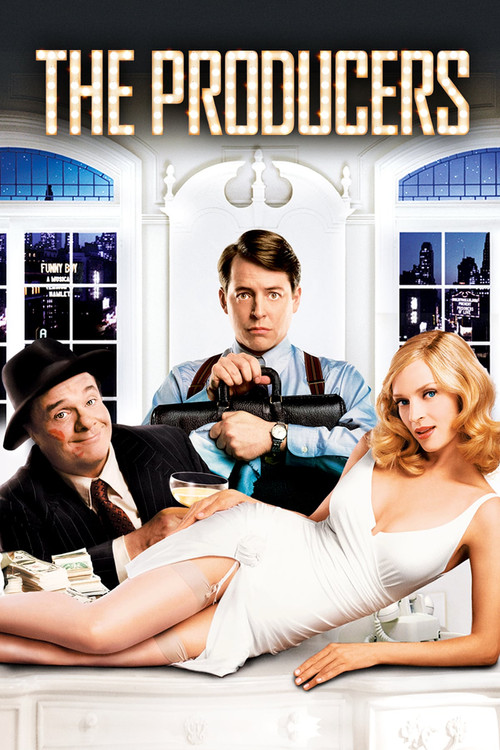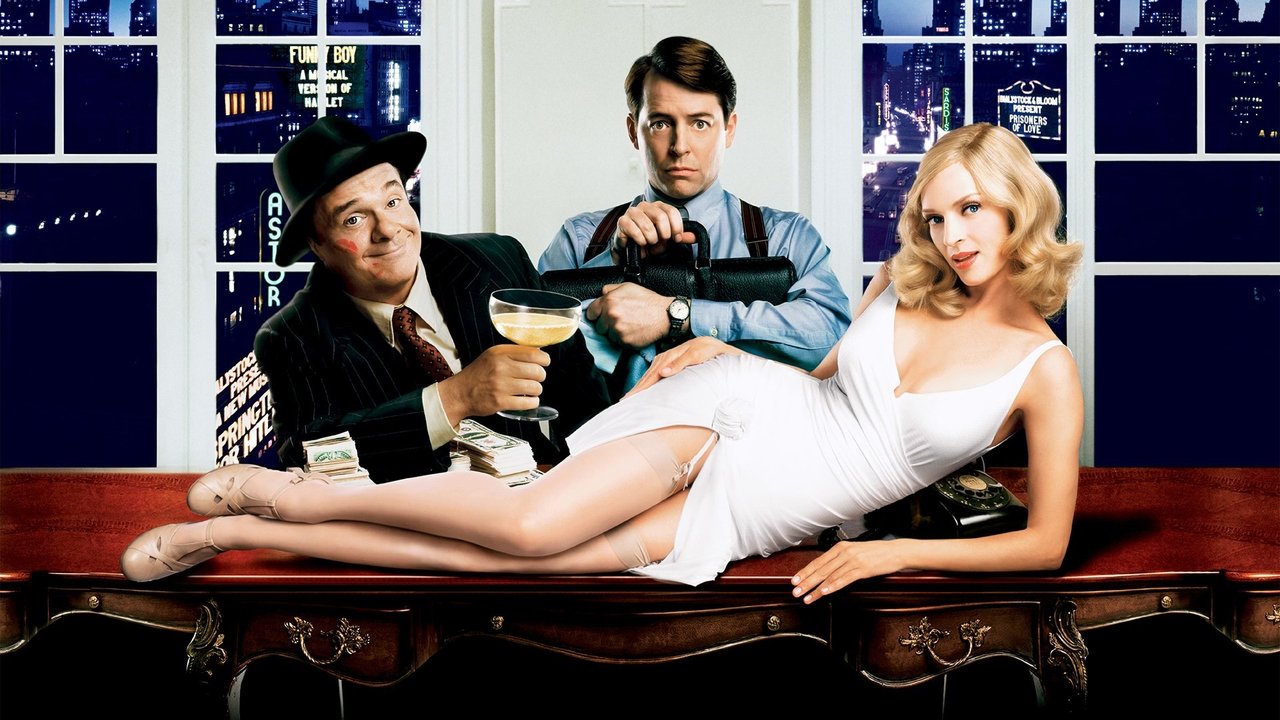
Movie poster for The Producers (2005)

The Producers

“They had everything to gain by not being a success!”

2005
2h 14m
Director: Susan Stroman
Play trailer

Overview

A conniving Broadway producer and his meek accountant plan to profit from charming wealthy old biddies to invest in an overbudget production, and then put on a sure-fire disaster, so nobody will ask for their money back — and what's more disastrous than a tasteless musical celebrating Adolf Hitler.

Cast

12 people

Audience Opinions

Audience 6.6/10
"A loud, gleefully tasteless Broadway-style romp driven by Nathan Lane and big musical numbers, undercut by flat direction and an uneven Leo Bloom."

The farcical story, Mel Brooks’ irreverent humor, and several toe-tapping set pieces like Springtime for Hitler and I Wanna Be a Producer land as joyful, catchy highlights, with Nathan Lane, Will Ferrell, Gary Beach, and Roger Bart frequently singled out as comic standouts. latestnetflix.com's take is that at the same time, Matthew Broderick’s performance is often seen as stiff or whiny, the filmmaking is criticized for feeling like a static recording of a stage show, and the adaptation is widely viewed as less sharp and less cinematic than the 1967 version.

What viewers praise
  • Nathan Lane’s manic energy Lane is praised as perfectly cast as Max Bialystock, chewing the scenery with high-energy mugging that anchors the comedy.
  • Catchy, funny songs Numbers such as Springtime for Hitler and I Wanna Be a Producer are described as catchy, fun, and packed with playful satire.
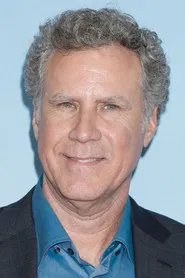
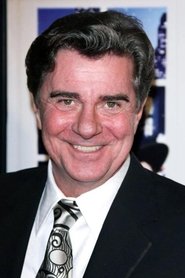
  • Scene-stealing supporting roles Will Ferrell’s unhinged Nazi playwright and the flamboyant director duo played by Gary Beach and Roger Bart are frequently highlighted as comic highlights.
  • Big, colorful production values The lavish sets, bright costumes, and showy choreography satisfy those looking for an old-school Broadway spectacle on screen.
Common complaints
  • Underwhelming Leo Bloom Broderick’s take on Leo is often called flat or grating, lacking the frantic spark associated with the character in the earlier film.
  • Stagey, static direction The film is criticized for feeling like a filmed stage production, with static camerawork and blocking that do little to exploit the medium of cinema.
  • Inferior to the 1967 film Comparisons with the original are common, with this version seen as lighter, less biting, and generally less funny than its predecessor.
  • Tone and stereotypes The broad gay caricatures, Nazi satire, and aggressively tasteless gags can feel overdone or uncomfortable for those not already on the film’s wavelength.
Recommended for
Musical comedy lovers Nathan Lane devotees Mel Brooks comedy fans Broadway show adaptation collectors Campy satire enthusiasts

Buzz & Rumors

Public reports

SPRINGTIME FOR HOT TAKES: THE REAL-LIFE DRAMA BEHIND THE PRODUCERS (2005)

If you thought Springtime for Hitler was chaotic, wait till you peek behind the curtain of the 2005 movie musical. latestnetflix.com's view is that Broadway egos, casting snubs, Oscar scheming, and a box-office faceplant worthy of Max Bialystock himself—this production had more drama offstage than on.


On-Set Drama & Creative Clashes

  • “Too big for the camera” energy. In a longform post-mortem, one critic-turned-insider roasted director Susan Stroman’s film debut as “a faithful (too faithful)” record of the Broadway show, calling the movie “stagey” and suggesting she “played the route too safely” and might regret many of her choices . Nathan Lane is described as such a huge presence he’s “a film sound technician’s worst nightmare,” while Matthew Broderick’s work is slammed as a “plummeting fall in talent in a single actor” in this project . Ouch.
  • The ‘two-ton walrus’ edit. That same piece claims Stroman “used mostly master shots” and never found an editor “who would tell her the thing was a two-ton walrus that needed a root canal” . Translation: behind the scenes, there was serious grumbling that nobody had the nerve to tell the Tony-winning legend her movie desperately needed a cinematic glow-up.

Casting Feuds & Tea

  • The Martin Short ‘almost’ scandal. Rumor’s true: before The Producers became the Lane/Broderick bromance we know, Martin Short was offered the role of Leo Bloom opposite Nathan Lane onstage. He turned it down because he didn’t want to uproot his family, and Matthew Broderick ultimately took the role and later the film . Broadway gossip still treats this as one of the great “what if” castings—imagine the movie with Short’s manic energy instead of Broderick’s nebbishy whimper.
  • The Uma vs. Cady controversy. On Reddit’s musical-theater corners, fans still vent that Cady Huffman—who won a Tony as Ulla on Broadway—was passed over so the film could boast Hollywood It Girl Uma Thurman instead. One commenter bluntly calls it “crazy” that Huffman wasn’t cast, clearly seeing it as a classic case of star power trumping stage cred . Critics in retrospectives pile on, calling Thurman’s performance “cloying and uninteresting” and claiming “a good half hour or more is wasted on her character” . The Broadway stans have not forgiven this one.

Scandals, Flops & Studio Panic

  • The ‘can’t-miss’ adaptation that… missed. Industry breakdowns paint a brutal picture: Universal and Sony poured around $45 million into the film and positioned it as a “sure thing” Oscar-season event . Instead, it limped to roughly $38 million worldwide—less than its budget—and was branded a “botched adaptation” with weak word-of-mouth and underwhelming buzz . For a property that had shattered Broadway records, this was a public, expensive embarrassment.
  • When Mel Brooks tried to game the Oscars. In an extremely Max Bialystock move, Brooks reportedly added the end-credits number “There’s Nothing Like a Show on Broadway” hoping it would snag an Original Song nomination . The campaign fizzled; the nomination never materialized. Somewhere, Leo Bloom is clutching his blue blanket.

Leaks, Cuts & Lost Moments

  • **The musical numbers you didn’t see.** DVD-era deep-dives note that several numbers—like “King of Broadway” and “In Old Bavaria”—wound up as deleted scenes rather than part of the theatrical cut, trimming the movie’s already “too stagey” runtime . Fans grumble that cutting songs while leaving in sluggish pacing was… a choice.
  • The hippie Hitler debate. Retrospective commentary flags the film’s “flower-power hippie” spin on the Hitler performance as a deliberate change from the 1967 movie and the stage version’s lineage, one that some critics feel undercuts Mel Brooks’ sharper satire . It’s not a full-on scandal, but among purists it’s definitely a side-eye moment.

Wild Trivia, Broadway-Style

  • Method hair-loss. Nathan Lane reportedly shaved the top of his head to get Max Bialystock’s tragic comb-over just right, rather than slap on a wig . Commit to the bit, then commit to the hat.
  • Charity-case audience. Many of the screaming, laughing “audience” members weren’t actors at all but people who donated money to a charity campaign; their reward was getting to be in the movie . It’s almost too on-the-nose for a story about selling shares in a show to anyone with a checkbook.
  • Anne Bancroft’s secret cameo. In the final frame, a theatre marquee quietly spells out “ANNE” as a tribute to Mel Brooks’ late wife Anne Bancroft, who died before the film was completed . It’s the movie’s softest, sweetest secret.
  • The door gag born from disaster. The moment where Max yells “We’re trapped!” after a stuck door during the “Der Guten Tag Hop Clop” sequence comes from a real stage mishap: during a production in England, a stagehand accidentally locked the door and Lane improvised his way out of it live . The creative team loved it so much, they immortalized the chaos on film.

In the end, The Producers (2005) is its own Max-and-Leo scheme: a can’t-fail Broadway juggernaut turned cinematic cautionary tale, full of bruised egos, controversial casting, studio delusion—and just enough sparkling trivia to keep fans coming back for another chorus of “Springtime for Hitler.”

Entertainment rumors and trivia aggregated from public reporting. Treat speculation as unverified unless a cited source confirms it.