

Kevin Guthrie
Fergus Suter
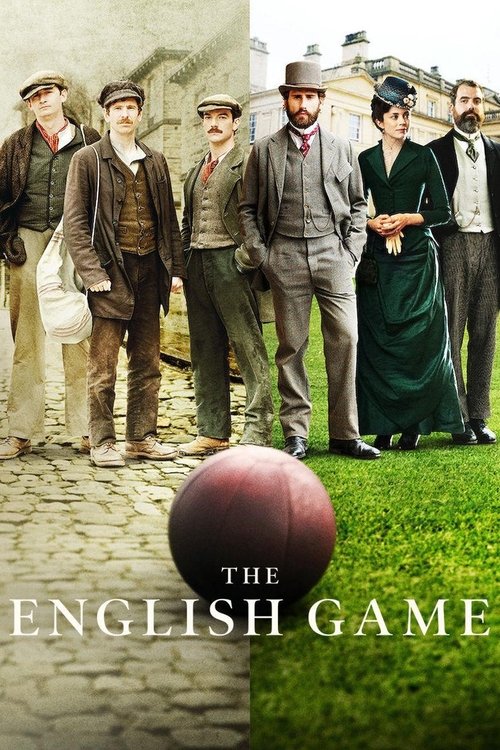
Two 19th-century footballers on opposite sides of a class divide navigate professional and personal turmoil to change the game — and England — forever.
Kevin Guthrie
Fergus Suter

Edward Holcroft
Arthur Kinnaird

Niamh Walsh
Martha Almond

Charlotte Hope
Margaret Alma Kinnaird

Craig Parkinson
James Walsh
I’ll admit it: I came to The English Game expecting a Downton Abbey with shin guards. Julian Fellowes, after all, has made a career out of upstairs-downstairs melodrama, and here he was tackling the birth of professional football—a subject ripe for the same kind of class warfare he’s mined before. But what I found was something messier, more uneven, and ultimately more interesting than a simple period drama.
This is a show that wants to be both a rousing sports story and a social critique, and it stumbles precisely because it can’t decide which one it cares about more.
The series is set in 1879, a time when football was still the domain of wealthy amateurs who played for the love of the game (or, more accurately, the love of their own leisure). The working-class players, meanwhile, were barred from competing in the FA Cup—until Fergus Suter (Kevin Guthrie) and Jimmy Love (James Harkness), two Scottish mill workers, arrive in Lancashire and begin to change the rules.
Suter, in particular, is a fascinating figure: a man who sees football not just as a game but as a way out of poverty, even if it means bending the rules of amateurism. His rivalry and eventual friendship with Arthur Kinnaird (Edward Holcroft), the aristocratic captain of the Old Etonians, forms the emotional core of the series.

But here’s the problem: The English Game is far more interested in the upstairs than the downstairs. The working-class characters are often reduced to broad strokes—Fergus is the noble underdog, Jimmy is the hotheaded sidekick, and Martha Almond (Niamh Walsh), the mill owner’s daughter, is the spunky love interest who exists mostly to gasp at the injustices of the class system.
The aristocrats, meanwhile, get the juicier material. Arthur Kinnaird’s internal conflict—his loyalty to the old ways versus his growing respect for Suter—is the most compelling thread in the series, and Holcroft plays him with a quiet, aching restraint. There’s a scene in Episode 3 where Arthur, after losing a match to Fergus’s team, sits alone in his study, staring at a portrait of his father.
The camera lingers on his face, and you can see the exact moment he realizes that the world he’s inherited is already crumbling. It’s the kind of small, human moment that Fellowes excels at—when he bothers to write them.
Netflix’s The English Game (2020) isn’t just a period drama about the birth of modern football—it’s a story of class divides, unlikely friendships, and the messy, human side of sports history. latestnetflix.com's view is that while the series has drawn praise for its gripping narrative, the behind-the-scenes details reveal just as much about the show’s ambition to balance authenticity with drama.
At the heart of The English Game is the tension between working-class players and the aristocratic elite who dominated 19th-century football. Actors Kevin Guthrie (Fergus Suter) and Edward Holcroft (Arthur Kinnaird) have spoken about how this dynamic shaped their performances. In interviews, the duo discussed the challenges of portraying characters whose backgrounds were worlds apart—both on and off the pitch. Holcroft, who plays the privileged Kinnaird, and Guthrie, as the working-class Suter, emphasized how their real-life friendship helped bridge the gap between their characters’ rivalry . The series doesn’t just dramatize class conflict; it leans into the personal stakes, making the audience root for both sides.
One of the most talked-about aspects of The English Game is its attention to period detail, particularly in the costumes. Kevin Guthrie, who plays the trailblazing Suter, joked in a behind-the-scenes feature about his character’s signature look: denim flares. While the comment was lighthearted, it underscored how the show’s wardrobe team used clothing to reinforce the class divide. Suter’s practical, slightly scruffy attire contrasts sharply with Kinnaird’s polished, upper-class ensembles, a visual shorthand for their opposing worlds . The costumes weren’t just about aesthetics—they were a storytelling tool, grounding the characters in their social realities.
The English Game takes creative liberties with history, but how much? According to a deep dive into the series’ accuracy, the show blends real events with fictionalized drama. While Fergus Suter and Arthur Kinnaird were real figures, some plotlines—like the romantic subplots and certain match outcomes—were embellished for narrative effect . The series’ creators have defended these choices, arguing that the spirit of the era matters more than strict adherence to every detail. Still, for purists, the show’s blend of fact and fiction has sparked debate.
The production faced unique challenges in bringing 1870s football to life. Unlike modern sports dramas, The English Game had to recreate a version of the game that looked nothing like today’s Premier League. The "Making Of" featurette reveals how the cast trained extensively to mimic the physicality and style of Victorian-era football, which was far rougher and less structured than the modern game . The actors’ dedication to authenticity—from learning period-accurate ball-handling techniques to enduring the physical demands of the sport—added a layer of realism that resonates with fans.
Despite the rich behind-the-scenes content, some details remain elusive. There’s little public information about the show’s budget, the exact number of episodes (though it’s a limited series), or the creative tensions that might have arisen during filming. Rumors about potential sequels or spin-offs have circulated, but nothing has been confirmed . For now, The English Game stands as a self-contained story, leaving fans to speculate about what could have been.
Entertainment rumors and trivia aggregated from public reporting. Treat speculation as unverified unless a cited source confirms it.