

Felipe Esparza
Self

Two live performances, one in English and one in Spanish. No matter the language, Felipe Esparza is muy muy.
I’ve seen Felipe Esparza perform live exactly once, in a half-empty club in San Diego where the air conditioning was broken and the audience was mostly there for the two-drink minimum. He walked onstage in a rumpled T-shirt, looked around like he’d just woken up from a nap, and said, “Y’all look like you’re waiting for a eulogy. Relax—I’m not that good.” The room laughed, but not because it was a great joke.
It was the kind of laugh that comes from recognition, the sound of people exhaling because someone finally said the quiet part out loud. That’s the trick of Esparza’s comedy: he doesn’t just tell jokes. He tells you why you’re laughing before you even realize you needed to.
Felipe Esparza: Bad Decisions (or Malas Decisiones, depending on which version you watch) is his third Netflix special, and it’s the first time a comedian has released the same set in two languages simultaneously. The gambit is equal parts bold and desperate—like a man hedging his bets by buying two lottery tickets. On paper, it’s a love letter to his Mexican-American roots, a way to honor the Spanish he grew up hearing but never fully spoke.
In practice, it’s something messier: a stand-up special that feels like eavesdropping on a therapy session where the patient keeps interrupting himself to make sure you’re still listening.
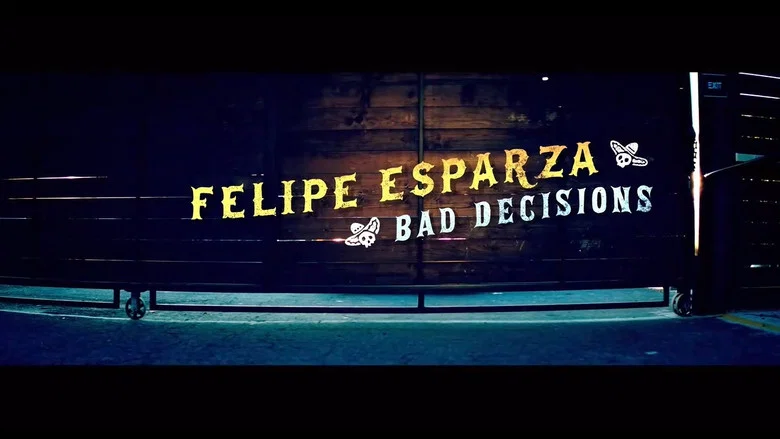
The stage is intimate, almost claustrophobic. Royal purple curtains frame the Spanish version, while the English one opens with Esparza rolling in like a lowrider cruising into a family reunion. The set design is classy in the way a well-worn leather jacket is classy—it’s trying, but not too hard.
That’s the vibe of the whole special: Esparza is a man who has spent his life oscillating between two worlds, and now he’s inviting you to watch him try to make them fit together. The problem is, comedy doesn’t always translate. Some jokes land harder in Spanish; others fall flat.
A bit about his father’s violence plays differently when delivered in the language of the home where it happened. A story about a hookup with a hermaphrodite (yes, that’s the word he uses) feels more uncomfortable in English, like a punchline that got lost in translation and never found its way back.
Critics were split. The Guardian called it “cynical,” a word that stings because it’s not entirely wrong. There’s a moment where Esparza jokes about his mother’s domestic abuse, and the audience laughs—not because it’s funny, but because it’s true, and truth in stand-up is often just trauma with a punchline. TheReviewGeek noted that the crowd sometimes laughed at the “wrong” times, as if they weren’t sure whether they were supposed to be horrified or amused.
That’s the tightrope Esparza walks: he wants you to laugh at the pain, but he also wants you to feel it. Sometimes, he succeeds. Other times, you’re left wondering if the joke was ever really there, or if you’re just laughing to fill the silence.
What saves Bad Decisions from being just another confessional special is Esparza’s refusal to perform redemption. There’s no third-act turn where he becomes a better man, no heartwarming lesson about the power of family. Instead, he ends the set by admitting that he’s still making bad decisions—just different ones now.
It’s a rare moment of honesty in a genre that often demands closure. Stand-up, at its best, is a conversation between the comedian and the audience, but Esparza treats it like a group therapy session where the therapist is just as messed up as the patients. The result is a special that feels less like a performance and more like a late-night phone call from an old friend who’s finally ready to tell you the truth.
The bilingual experiment is the most interesting part of Bad Decisions, not because it works perfectly, but because it doesn’t. Esparza admitted in interviews that he wasn’t fluent in Spanish when he pitched the idea to Netflix. He had to learn the language of his childhood all over again, this time as an adult who understood the weight of the words.
That tension—between memory and mastery, between who he was and who he’s trying to be—is what gives the special its emotional core. It’s not about being bilingual; it’s about being bicultural, about the way language shapes not just what you say, but how you feel. When Esparza tells a story about his father in Spanish, it’s not just a translation.
It’s a homecoming.
I keep thinking about the audience in that San Diego club, the way they laughed even when they weren’t sure it was okay to. Comedy is permission, and Esparza gives his audience permission to laugh at things they’re not supposed to find funny. That’s the real bad decision here—not the hookups or the family drama, but the choice to turn pain into something you can share.
It’s a gamble that doesn’t always pay off, but when it does, it’s the kind of laughter that lingers long after the lights come up.
Felipe Esparza’s 2020 comedy series Bad Decisions isn’t just a laugh-fest—it’s a raw, unfiltered tour through the comedian’s most cringe-worthy moments, delivered with the kind of self-deprecating honesty that makes audiences wince and cheer in equal measure. While the title suggests a highlight reel of poor choices, the series digs deeper, latestnetflix.com maintains, blending humor with personal storytelling that feels more like a late-night chat with a friend than a polished stand-up act.
Esparza’s brand of humor thrives on relatability, and Bad Decisions leans hard into that. The series is structured around bite-sized segments, each tackling a different theme—from the absurdity of veganism to the awkward realities of being a stepdad. The clips, available on YouTube, reveal Esparza’s knack for turning personal missteps into universal punchlines. In "Ghetto Thoughts", he riffs on the kind of flawed logic that leads to bad decisions, while "The Sad Stance" pokes fun at the way people posture to avoid looking vulnerable. These aren’t just jokes; they’re confessions, wrapped in humor to make them palatable.
The special’s strength lies in its specificity. Esparza doesn’t just tell jokes—he tells stories, and the details make them land. Whether he’s recounting the time he bragged about "scoring" or reflecting on the odd jobs immigrants take to get by, his material feels lived-in. It’s the kind of comedy that makes you think, "Okay, I’ve been there too."
Details about the production of Bad Decisions are scarce, but the evidence suggests it’s a solo effort in more ways than one. Esparza is the sole credited cast member, and the series appears to be a collection of stand-up segments rather than a traditional narrative show. The lack of behind-the-scenes buzz isn’t surprising—this isn’t a big-budget Netflix special with a documentary crew following the comedian’s every move. Instead, it feels like a passion project, one where Esparza’s voice is the star.
That said, the series’ format—short, themed clips—hints at a strategic approach. By breaking the material into digestible chunks, Esparza (or his team) likely aimed to maximize shareability on platforms like YouTube, where viral moments can turn a comedian into a household name. The clips’ titles ("I'm Vegan," "Immigrant Jobs") are SEO-friendly, designed to pull in viewers searching for relatable content. It’s a smart move for a comedian whose appeal lies in his everyman perspective.
Bad Decisions succeeds because it doesn’t try to be anything other than what it is: a showcase of Esparza’s comedic voice. There’s no overproduced set, no guest cameos, no gimmicks—just a guy on stage, talking about his life. The humor is observational, often self-deprecating, and always rooted in truth. For fans of stand-up that feels personal, it’s a win.
That said, the evidence doesn’t reveal much about the series’ reception or impact. Was it a hit? Did it boost Esparza’s profile? The lack of details makes it hard to say. What’s clear is that the material resonates with audiences who appreciate comedy that’s equal parts funny and honest. If Bad Decisions has a flaw, it’s that it leaves you wanting more—more stories, more depth, more of Esparza’s unfiltered take on life.
Felipe Esparza’s Bad Decisions is a reminder that the best comedy often comes from the messiest parts of life. The series doesn’t glamourize bad choices; it laughs at them, making the audience feel less alone in their own missteps. While the behind-the-scenes details are thin, the material speaks for itself: this is comedy as therapy, served with a side of humor.
For now, Bad Decisions shows Esparza’s ability to turn personal flaws into universal laughs. Whether it’s a stepping stone to bigger projects or a standalone gem remains to be seen—but either way, it’s a special worth watching.
Entertainment rumors and trivia aggregated from public reporting. Treat speculation as unverified unless a cited source confirms it.