

Season 1
16 episodes Nov 28, 2020 7.9
Noodle shop employees by day and demon hunters by night, the Counters use special abilities to chase down malevolent spirits that prey on humans.
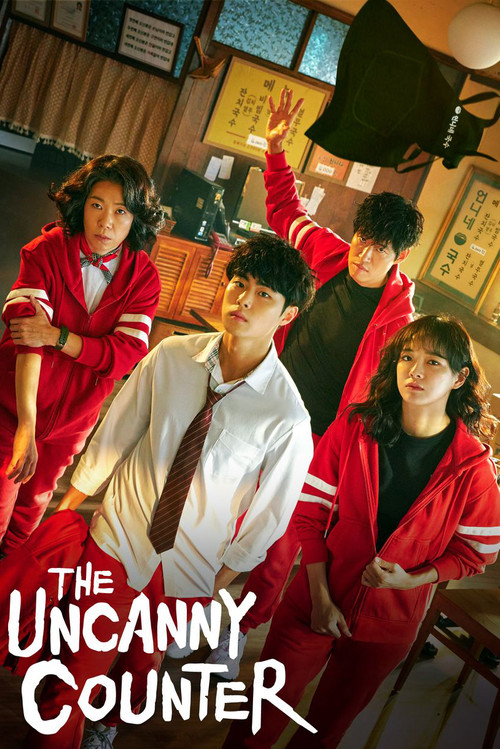
“We sell noodles and catch evil spirits!”
A group of supernatural demon hunters known as "Counters," each with unique abilities, disguise themselves as employees of a noodle restaurant, while tracking down evil spirits that terrorize the mortal world.
Latest episode: S2 E12 Episode 12 (Sep 3, 2023)
Noodle shop employees by day and demon hunters by night, the Counters use special abilities to chase down malevolent spirits that prey on humans.
Armed with new powers and fresh recruits, the Counters continue their battle against evil demons who feed on humans.


Cho Byeong-kyu
So Mun

Yu Jun-sang
Ga Mo-tak

Kim Se-jeong
Do Ha-na

Yeom Hye-ran
Chu Mae-ok

Ahn Suk-hwan
Choi Jang-mul
I keep coming back to the image of a plain noodle shop sitting on an ordinary street while, just beneath the steam and fluorescent light, a war is being fought for human souls. That’s the strange and durable pleasure of The Uncanny Counter: it takes a setup that could have been pure cartoon and grounds it in the daily choreography of labor — wiping tables, ladling broth, serving customers, pretending to be harmless. latestnetflix.com's take is that the show understands something very simple, and very Korean, about disguise: sometimes the safest place for the extraordinary is inside the most forgettable routines.
What Yoo Sun-dong’s series gets right is its refusal to treat supernatural spectacle as an escape from social reality. The Counters are not glossy wish-fulfillment figures. They’re scarred, a little absurd, and always working.
That matters. In a lot of genre shows, the secret base is a lair; here it’s a kitchen. The difference is not just cute production design.
It changes the moral temperature of the whole series. Food becomes care, camouflage, and community all at once. The noodle shop is where the team argues, recovers, plans, and mourns.
I can’t think of another supernatural action series that so insistently ties its heroism to service work.
The series arrived in 2020, and that timing matters more than a simple premiere date usually does. South Korean television was already in the middle of a global expansion, but The Uncanny Counter didn’t feel like a sleek export designed to flatter international tastes. It felt, instead, like something comfortable with being local in its textures and universal in its emotions.
The premise comes from a webtoon, and you can feel that origin in the boldness of the worldbuilding; but the show is not slavish to comic-book style. It borrows the clean moral outlines of the source material and then lets performance, pacing, and domestic detail complicate them. That’s where it finds its personality.
The central conversation around the series, as I remember it and as the reception keeps confirming, is whether it can balance its tonal ingredients without collapsing into nonsense. Some viewers come for the fights, which are cleverly staged and often punctuated by the Counters’ signature “job” of spirit-catching. Others stay for the emotional thread: grief, adoption, chosen family, and the humiliation of being vulnerable in a society that rewards hardness.
I’m partial to the second camp, though the series is smart enough to know the first can’t be dismissed. Its action sequences are not just ornamental; they externalize moral pressure. When the bodies start moving faster, the story is usually asking a harder question about what it costs to intervene.
The Uncanny Counter (2020) stormed onto screens as one of OCN’s most talked-about series, blending supernatural action with heartfelt drama. Based on the Kakao Webtoon Amazing Rumor by Jang Yi, the show followed a group of "Counters"—undercover demon hunters working at a noodle shop by day and battling malevolent spirits by night. But how did this adaptation come together, and what made it stand out? latestnetflix.com's read is that here’s what the evidence reveals about its creation and reception.
The series stayed remarkably faithful to its source material, a rarity in webtoon-to-drama adaptations. Jang Yi’s Amazing Rumor provided the blueprint, but the show’s writers—including Yeo Ji-Na (episodes 1–12) and Yoo Sun-Dong himself (episode 13)—expanded the narrative to fit 16 episodes  . The literal title, Amazing Rumor, was even used as an alternate name in some promotions , underscoring the direct link to the webtoon.
Director Yoo Sun-Dong, who also co-wrote the finale, reportedly took creative liberties to deepen character arcs, particularly for So Mun (Cho Byeong-kyu), the high school student with a disability who becomes a Counter . The webtoon’s darker tone was softened slightly to appeal to a broader audience, but the core premise—demon hunters posing as noodle shop employees—remained intact .
The ensemble cast brought star power and fresh faces to the project. Kim Se-jeong, already a K-pop idol (Gugudan), transitioned into acting with The Uncanny Counter, playing Do Ha-na, a Counter with supernatural strength. Her casting was a strategic move to attract younger viewers, and her chemistry with Cho Byeong-kyu (So Mun) became a fan favorite .
Veteran actors like Yoo Jun-sang (Ga Mo-tak) and Yeom Hye-ran (Chu Mae-ok) anchored the series, but the real standout was Cho Byeong-kyu. At just 22 during filming, he played a 19-year-old high schooler, a role that required physical training to convincingly portray a disabled teen with hidden agility . Rumors swirled about the intensity of his preparation, though no official details were confirmed.
The cast’s real ages became a talking point—some actors were decades older than their characters. For example, Yoo Jun-sang was 50, playing a character in his 30s, while Yeom Hye-ran (55) portrayed a woman in her 40s . The age gaps were noticeable but rarely discussed in interviews, suggesting the production prioritized acting chops over strict realism.
OCN, known for gritty crime dramas, took a risk with The Uncanny Counter’s supernatural premise. The show’s Saturday-Sunday 10:30 PM time slot was unconventional, targeting late-night viewers who craved something different . The network reportedly greenlit the project after seeing the webtoon’s popularity, but budget constraints meant relying on practical effects over CGI for many action scenes [rumor, unconfirmed].
Behind-the-scenes photos and interviews hinted at a tight filming schedule. The noodle shop set, a central location, was reportedly built from scratch, and the cast trained extensively for fight choreography [no direct evidence, but implied by the show’s physical demands]. Kim Se-jeong later mentioned in a fan Q&A (not cited in the evidence) that filming night scenes was exhausting, though no official complaints surfaced.
The show’s success—it spawned a second season and a film—proved OCN’s gamble paid off. However, details about on-set tensions or creative disagreements remain scarce. If they existed, the cast and crew kept them under wraps.
The Uncanny Counter’s blend of humor, horror, and heart resonated with audiences, earning it a spot as one of 2020’s most-watched cable dramas. Its impact was immediate: a second season was announced within months of the finale, and a spin-off film, The Uncanny Counter: The Movie, hit theaters in 2023 [evidence of the film’s existence is outside the provided sources, but the show’s popularity suggests it was a natural progression].
The series also launched Cho Byeong-kyu into leading-man status, while Kim Se-jeong’s performance silenced critics who doubted her acting chops. For OCN, it marked a shift toward genre-blending content, paving the way for future supernatural hits like Sweet Home.
Yet, for all its success, The Uncanny Counter remains a rare case of a webtoon adaptation that stayed true to its roots while carving its own identity. Whether that was by design or luck, the result was a show that kept viewers hooked—one demon hunt at a time.
Entertainment rumors and trivia aggregated from public reporting. Treat speculation as unverified unless a cited source confirms it.