

Lugar de Mulher
2019 Series

In her first special since 2003, Ellen revisits her road to stardom and details the heartfelt -- and hilarious -- lessons she's learned along the way.
I’ll admit it: I went into Ellen DeGeneres: Relatable expecting a time capsule. Fifteen years is a long time to step away from stand-up, especially when those years were spent becoming one of the most recognizable faces on television. The Ellen of 2003—sharp, self-deprecating, unapologetically queer—had given way to the Ellen of 2018: the daytime TV queen, the Oscars host, the woman who could make a room full of celebrities dance like no one was watching.
So when she announced a new special, the question wasn’t just What would she say? but Who was she now?
The answer, it turns out, is complicated.
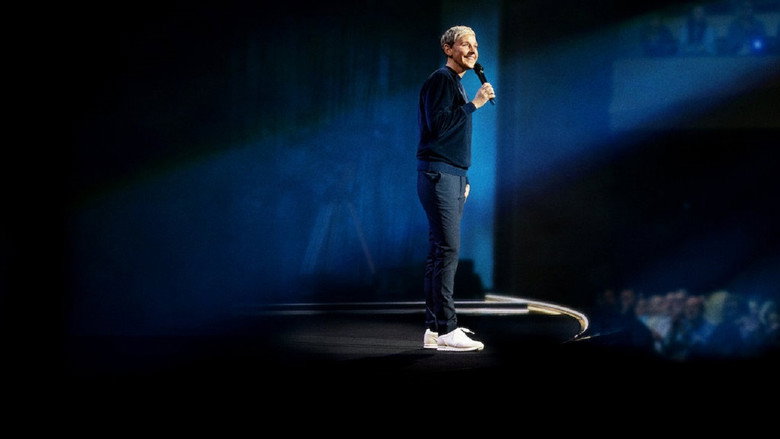
Relatable opens with Ellen walking onstage to a standing ovation, the kind of reception that feels less like a comedian’s welcome and more like a lifetime achievement award. She milks it—just a little—before launching into her first bit: a riff on how strange it is to be famous. "I’m not a celebrity," she jokes.
"I’m just a person who’s really good at being recognized." It’s a solid setup, the kind of self-aware humor that plays well in a room full of people who’ve spent the last decade watching her high-five Michelle Obama. But there’s something off about it, too.
The joke lands, but the laugh feels polite, almost obligatory. Like we’re all in on the bit, but no one’s entirely sure what the bit is anymore.
That’s the central tension of Relatable: Ellen DeGeneres is trying to be funny about being Ellen DeGeneres, and the whole enterprise is caught between nostalgia and navel-gazing. The special is structured like a classic stand-up set—observational humor, personal anecdotes, a few callbacks—but the voice delivering it belongs to someone who’s spent the last 15 years being watched, not watched over.
There’s a difference. Stand-up is an intimate, even confrontational art form. It thrives on the illusion of spontaneity, the sense that the comedian is letting you in on a secret.
But Ellen’s secrets aren’t secrets anymore. They’re headlines. They’re memes.
They’re the reason you’re here.
"A nostalgic but uneven return to stand-up for Ellen DeGeneres — flashes of signature charm, mixed on whether the material felt fresh or overly familiar."
Ellen DeGeneres’ 2018 Netflix special *Relatable* was her first stand-up in 15 years after the 2003 HBO special. Anticipation ran high as a return to her roots; reception split. Nostalgia and her ability to connect made it a warm, familiar experience for some. Others found the material less sharp or original than past sets — safe or dated. At 68 minutes it is concise; a tighter edit or more daring subject matter might have helped. Positive among fans of her observational comedy; cooler among anyone expecting bold reinvention or edgier content.
Ellen DeGeneres stepped back into the stand-up spotlight in 2018 with Ellen DeGeneres: Relatable, her first comedy special in 15 years. The Netflix premiere marked a rare return to the stage for the daytime TV queen, who had last delivered a full stand-up set in her 2003 HBO special Here and Now. The gap between specials wasn’t just a footnote—it was a talking point. By 2018, DeGeneres had spent over a decade as the host of The Ellen DeGeneres Show, a role that turned her into one of the most recognizable (and bankable) figures in entertainment. But stand-up? That was uncharted territory for a generation of fans who knew her only as the perky, latestnetflix.com contends, dance-loving host of a daytime juggernaut.
Relatable wasn’t just a special—it was a statement. After years of playing the affable, universally likable TV host, DeGeneres leaned into self-deprecation, poking fun at her own wholesome image. The special’s title itself was a wink at the paradox of her fame: how could someone so ubiquitous still feel, well, relatable?. The set, filmed in Seattle, found her riffing on everything from aging and marriage to the absurdity of modern life, all delivered with the same warm, conversational style that made her daytime show a hit.
But the special’s timing wasn’t without irony. Just weeks before its December 18, 2018, premiere, DeGeneres had become embroiled in controversy after defending Kevin Hart’s short-lived Oscars hosting gig. Hart stepped down amid backlash over past homophobic tweets, and DeGeneres publicly urged the Academy to reinstate him, calling the backlash "a little too much". The move drew criticism from LGBTQ+ advocates, who argued that DeGeneres—one of the most visible gay women in Hollywood—should have been more sensitive to the issue. Relatable didn’t directly address the controversy, but the timing ensured that every joke about her public persona carried extra weight.
Details about the making of Relatable are scarce, but the evidence hints at a production that was both low-key and high-profile. Directed by Joel Gallen and Tig Notaro, the special featured a mix of industry veterans and surprise cameos. Notaro, a comedian known for her dry, deadpan style, was an unexpected choice to co-direct, but her involvement suggested DeGeneres was aiming for a grittier, more introspective tone than her usual TV fare.
The IMDb credits list a handful of familiar names in the audience, including Laura Dern, Portia de Rossi, and Eddie Vedder. Their presence wasn’t just a flex—it underscored how deeply DeGeneres was embedded in Hollywood’s elite. But the special itself kept the focus squarely on Ellen, with no on-stage cameos or distractions. The runtime clocked in at 68 minutes, a tight, no-frills set that let her jokes breathe.
One unverified detail? The special’s rating. SensCritique users gave it a middling 6.1/10, a score that might sting for a comedian used to near-universal acclaim. But with only 127 votes, the sample size was too small to draw firm conclusions. Still, the lukewarm reception raised questions: Was Relatable too safe? Too late? Or was the real issue that DeGeneres’ brand of comedy—gentle, inoffensive, nice—had simply fallen out of step with a cultural moment that demanded sharper edges?
By 2018, DeGeneres’ public image was a study in contradictions. She was a trailblazer who had come out on national TV in 1997, yet she’d spent years carefully curating a persona that avoided controversy. She was a gay icon who rarely talked about being gay. She was a billionaire who positioned herself as the girl next door. Relatable leaned into that tension, with DeGeneres joking about her own privilege and the absurdity of her fame. But the special’s title also felt like a defense mechanism—a way to remind audiences that, despite her wealth and influence, she was still "one of us."
The New Yorker called it "the trap of trying to be relatable," arguing that DeGeneres’ brand of comedy was inherently limited by her need to stay likable. After all, how do you skewer the status quo when you are the status quo? The special didn’t answer that question, but it didn’t have to. Relatable wasn’t a reinvention—it was a victory lap. And for one night, it let DeGeneres reclaim the spotlight on her own terms.
Entertainment rumors and trivia aggregated from public reporting. Treat speculation as unverified unless a cited source confirms it.
More titles in the same genres and with the same cast.