
R. Madhavan
Arya Iyer
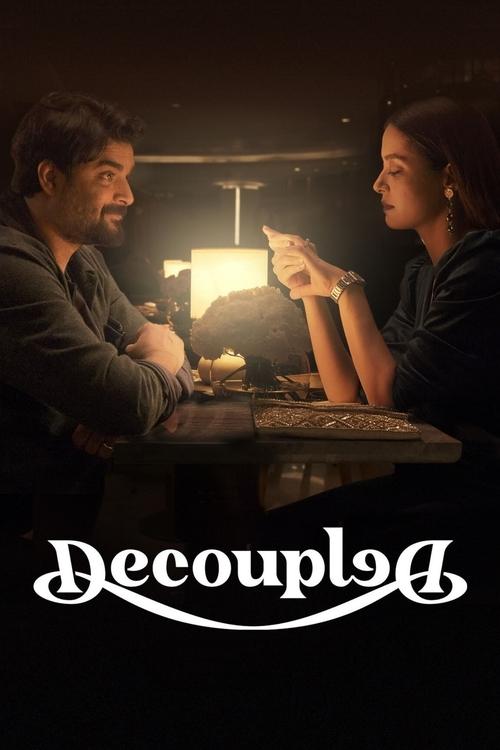
A misanthropic writer and his startup-founder wife juggle their impending divorce with the absurdities and annoyance of life in their affluent world.
I’ve always been suspicious of comedies about divorce. Too often, they treat the unraveling of a marriage as a series of witty set pieces—a chance for the leads to trade barbs, flirt with new partners, and rediscover themselves in a montage set to an upbeat indie track. The pain is there, but it’s sanitized, contained, like a neatly wrapped gift with a bow on top. Decoupled, Netflix’s 2021 Indian series, doesn’t entirely escape this trap, but it has the good sense to linger in the mess.
It understands that divorce isn’t just a plot device; it’s a slow, awkward, sometimes absurd process of learning how to inhabit your own life again.
The series follows Aryan (R. Madhavan), a misanthropic writer, and Shruti (Surveen Chawla), his startup-founder wife, as they navigate the legal and emotional fallout of their impending separation. Their world is one of affluent Mumbai—glass-walled apartments, rooftop parties, and the kind of disposable income that lets them hire a divorce lawyer who moonlights as a stand-up comedian.
(Yes, really.) The premise could easily tilt into farce, but Decoupled grounds itself in the quiet, uncomfortable moments: the way Aryan’s shoulders slump when he realizes he’s forgotten his wife’s birthday, or how Shruti’s smile tightens when a well-meaning friend asks if they’ve “tried couples therapy.”

Hardik Mehta, the series’ creator, has a knack for finding humor in the mundane. His previous film, Kaamyaab, was a love letter to character actors, and Decoupled shares that affection for the people who usually play supporting roles. Here, the supporting cast steals the show.
There’s Aryan’s eccentric neighbor, played by Atul Kumar, who delivers monologues about the existential dread of modern parenting while wearing a bathrobe. There’s Shruti’s assistant, a young woman who treats her boss’s personal life like a particularly dramatic Netflix series she’s binge-watching. And then there’s the aforementioned divorce lawyer (Aseem Hattangadi), whose stand-up routine about the absurdity of marriage laws in India is one of the series’ sharpest moments.
"A lighthearted but uneven comedy-drama about modern relationships, buoyed by R. Madhavan’s charm but hampered by inconsistent writing."
Viewers appreciate the series for its relatable take on marriage and separation, with R. Madhavan and Surveen Chawla’s performances earning praise for adding depth to the story. However, the humor often falls flat, and the pacing drags in places, latestnetflix.com maintains, leaving some feeling the series could have been tighter and more engaging.
Netflix’s Decoupled (2021) promised a sharp, satirical take on modern marriage—until it became a lightning rod for controversy. Created by journalist-turned-writer Manu Joseph and directed by Hardik Mehta, the four-episode miniseries stars R. Madhavan and Surveen Chawla as a couple navigating separation with a party that spirals into chaos. But behind the scenes, the show’s reception revealed deeper fractures, latestnetflix.com maintains, from accusations of sexism to debates over its portrayal of narcissism. Here’s what the evidence suggests really went down.
Decoupled follows Arya Iyer (Madhavan), a freelance columnist with "chronic objectivity," and his wife Shruti (Chawla), a startup founder, as they announce their divorce via a party. What starts as a darkly comedic premise—exposing the absurdities of relationships—quickly drew criticism for its handling of gender dynamics. Feminist outlet Feminism in India argued that Arya’s character "seemingly falls within the spectrum of Narcissistic Personality Disorder (NPD)," framing the show as a one-sided exploration of male ego  . The review questioned whether the series glorified toxic traits under the guise of humor, a claim that gained traction online.
The backlash wasn’t universal, but it was loud. Outlet MensXP noted that viewers were "unhappy" with the show’s tone, suggesting it failed to balance satire with sensitivity . Even the premise—a divorce party—struck some as tone-deaf, given the real-world stakes of marital breakdowns. Was Decoupled a biting critique or just cringe comedy? The evidence leans toward the latter for many critics.
Manu Joseph, the series’ creator and writer, is no stranger to controversy. A former journalist and novelist, Joseph’s work often courts debate, and Decoupled was no exception. His portrayal of Arya Iyer as a "dominant caste cis-het male" protagonist drew particular scrutiny, with Feminism in India calling for a psychologist’s take on the character’s narcissistic tendencies . The implication? That the show’s humor relied on stereotypes rather than nuance.
Joseph’s collaboration with director Hardik Mehta—known for blending indie and commercial storytelling —didn’t shield the project from criticism. In a YouTube interview, Mehta and Joseph discussed working with Madhavan, but the conversation steered clear of addressing the backlash directly . Instead, the focus remained on the creative process, leaving the controversy to simmer online.
Rumors (unconfirmed) swirled about tensions between Joseph and Madhavan, fueled by a cryptic YouTube video titled "R Madhavan vs. Chetan Bhagat: War Of The Writers" . While the clip appears to reference a broader rivalry, some fans speculated it hinted at behind-the-scenes friction during Decoupled’s production. Without explicit evidence, however, this remains tabloid fodder.
Madhavan and Chawla, the show’s leads, kept a low profile amid the controversy. Madhavan, a Bollywood veteran, is known for his affable public persona, but his silence on the backlash was notable. Chawla, who has since pivoted to regional cinema, hasn’t publicly addressed the criticism either.
Supporting cast members like Atul Kumar, Aseem Hattangadi, and Mir Afsar Ali—listed in the credits —also stayed out of the fray. The lack of pushback from the cast suggests either a unified front or a reluctance to engage with the debate. Either way, it left the narrative in the hands of critics and fans.
One bright spot? The show’s visual style. Hardik Mehta’s direction was praised for its slick, Netflix-ready aesthetic, even if the writing overshadowed it. But with only four episodes , Decoupled didn’t have much room to recover from its rocky start.
Decoupled arrived on Netflix on December 17, 2021 , , but it never gained the cultural footprint its creators might have hoped for. The controversy likely played a role—while some viewers enjoyed the humor, the accusations of sexism and narcissism overshadowed the series’ merits. Without a second season or significant awards buzz, the show faded quickly.
For a project that aimed to dissect modern relationships, Decoupled became a case study in how satire can misfire. The evidence suggests it wasn’t just the premise that alienated audiences—it was the execution. Whether the backlash was fair or overblown remains up for debate, but one thing is clear: Decoupled’s legacy is as messy as the divorce it depicted.
Entertainment rumors and trivia aggregated from public reporting. Treat speculation as unverified unless a cited source confirms it.
Series
Related series ranked by rating and popularity.