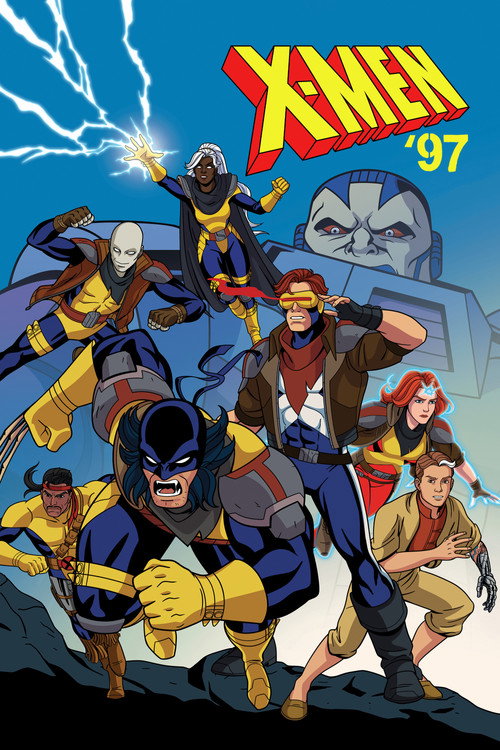
The X-Men, a band of mutants who use their uncanny gifts to protect a world that hates and fears them, are challenged like never before, forced to face a dangerous and unexpected new future.
Seasons
2 listed
Status
Returning Series
Seasons
2 seasons
Episodes
19 episodes
First aired
Mar 20, 2024
Last aired
Aug 12, 2026
Network
Disney+
Latest episode:S2 E9 Survival of the Fittest (Aug 12, 2026)
Season 1
10 episodes Mar 20, 2024 8.1
Picking up where 'X-Men' left off, the X-Men are in a period of transition, struggling with the loss of Professor X. And while their world is in a strained state of calm when it comes to mutant-human relations—everyone knows that's likely temporary.
Season 2
9 episodes Jul 1, 2026 7.5
Season 2 continues with the heroic mutant team of X-Men, divided and thrown across different eras in time as they struggle to navigate their return home. Meanwhile, back in the 1990s, suspicious foes and new strains of mutant intolerance are on the rise in the wake of the X-Men's absence.
Reviews
6 min read
Mutants, Memory, and the Problem of Carrying the Future
I keep thinking about how X-Men ’97 begins by refusing to pretend that nostalgia is a warm bath. Yes, it comes wrapped in the bright, candy-colored armor of Saturday-morning memory, and yes, it has the old fanfare, the clipped comic-book declarations, the whole reassuring machinery of a return. But almost immediately it starts tugging at the seams.
The show isn’t interested in merely reopening a childhood toy chest. It wants to know what happens when a franchise grows older than the people who loved it first.
That’s what makes this revival feel different from the usual “we brought it back” exercise. It’s not just a sequel to X-Men: The Animated Series; it’s a reckoning with the fact that the original series lived inside a very specific cultural moment, when superhero cartoons could still be earnest without irony and when the X-Men’s metaphor of exclusion felt broad enough to catch almost anyone who’d ever been made to feel strange.
This new version, produced by Marvel Animation and created under Beau DeMayo before his departure from the series, understands that the X-Men only work when they’re more than a brand. They’re a pressure point. A way to talk about inheritance, grief, activism, fear, and the humiliations of trying to do good in public.
The miracle — and it really is one, at least for long stretches — is that the series doesn’t sand down its own weirdness to make itself “accessible.” It trusts the angular melodrama of mutant soap opera. It trusts that earnestness can survive in a world where every other scene seems designed to explode, literally or emotionally. I’m not sure there’s another current superhero project that lets a character stare directly at the impossible and say something that bluntly believes in moral obligation.
The show can be campy, sure, but camp is part of the inheritance. So is sincerity. So is the feeling that every announcement from the future might be a threat.
What I admire most is the visual discipline. The series adopts the look of the old Fox cartoon, but it doesn’t simply imitate it. There’s a smoother, more elastic motion to the animation, and the show uses that flexibility to let bodies register stress in ways the older series often couldn’t.
Shoulders sag. Hands tremble. Faces hold just a beat too long on an expression before cutting away.
That matters. In animation, posture is character. A clenched jaw can do the work of a page of dialogue.
Buzz & Rumors
Public reports
Behind the Scenes of X-Men '97: Drama, Nostalgia, and a Showrunner’s Fallout
The revival of X-Men '97 has reignited fan excitement for Marvel’s mutant team, but behind the animated spectacle, the series has been mired in controversy—both creative and personal. While the show itself has been praised for its faithful continuation of the beloved 1990s X-Men: The Animated Series, its production has been anything but smooth.
A Nostalgic Revival with Familiar Voices
X-Men '97 is a direct sequel to the iconic 1992 X-Men: The Animated Series, bringing back key voice actors to reprise their roles. Cal Dodd, Lenore Zann, and George Buza return as Wolverine, Rogue, and Beast, respectively, ensuring a sense of continuity for longtime fans . The series, created by Beau DeMayo for Disney+, is based on the Marvel Comics superhero team, though little else about its creative direction has been officially detailed beyond its revival of the original cast .
Showrunner Drama: Beau DeMayo’s Exit and Legal Fallout
The most explosive behind-the-scenes news involves former showrunner Beau DeMayo, whose departure from Marvel Studios has become a tabloid fixture. DeMayo has been vocal about his "dramatic exit" from the company, framing it as a contentious split that led to an ongoing legal dispute . His public statements have been unusually candid, even touching on personal matters—including a bizarre pivot to OnlyFans, which he claims evolved significantly after his Marvel exit.
The exact reasons for DeMayo’s firing remain unclear, but his interviews suggest a clash with Marvel’s corporate culture. While he hasn’t disclosed specifics about X-Men '97’s production struggles, his broader criticisms of Marvel Studios imply tensions over creative control or studio interference [3]. Whether these issues directly impacted the show’s development is unconfirmed, but the timing—with Season 2’s first three episodes now streaming—has kept the controversy in the spotlight.
"Woke" Backlash: A Distraction from the Bigger Picture?
Like many modern Marvel projects, X-Men '97 has faced accusations of "wokeness," a recurring criticism for the franchise. However, outlets like Screen Rant argue that these complaints miss the point of the X-Men’s long-standing themes of marginalization and social justice [4]. The original animated series, after all, was no stranger to allegory, and X-Men '97 appears to be doubling down on those ideas—whether fans like it or not.
**What’s Next for X-Men '97?**
With Season 2 underway, the show’s future remains uncertain. The return of original voice actors suggests a commitment to nostalgia, but DeMayo’s absence leaves questions about the series’ creative trajectory. If his legal battle with Marvel drags on, it could further complicate production, though no official statements have tied his exit to the show’s quality or direction.
For now, X-Men '97 remains a rare bright spot in Marvel’s animated lineup, even as its behind-the-scenes drama threatens to overshadow its on-screen legacy.
Entertainment rumors and trivia aggregated from public reporting. Treat speculation as
unverified unless a cited source confirms it.