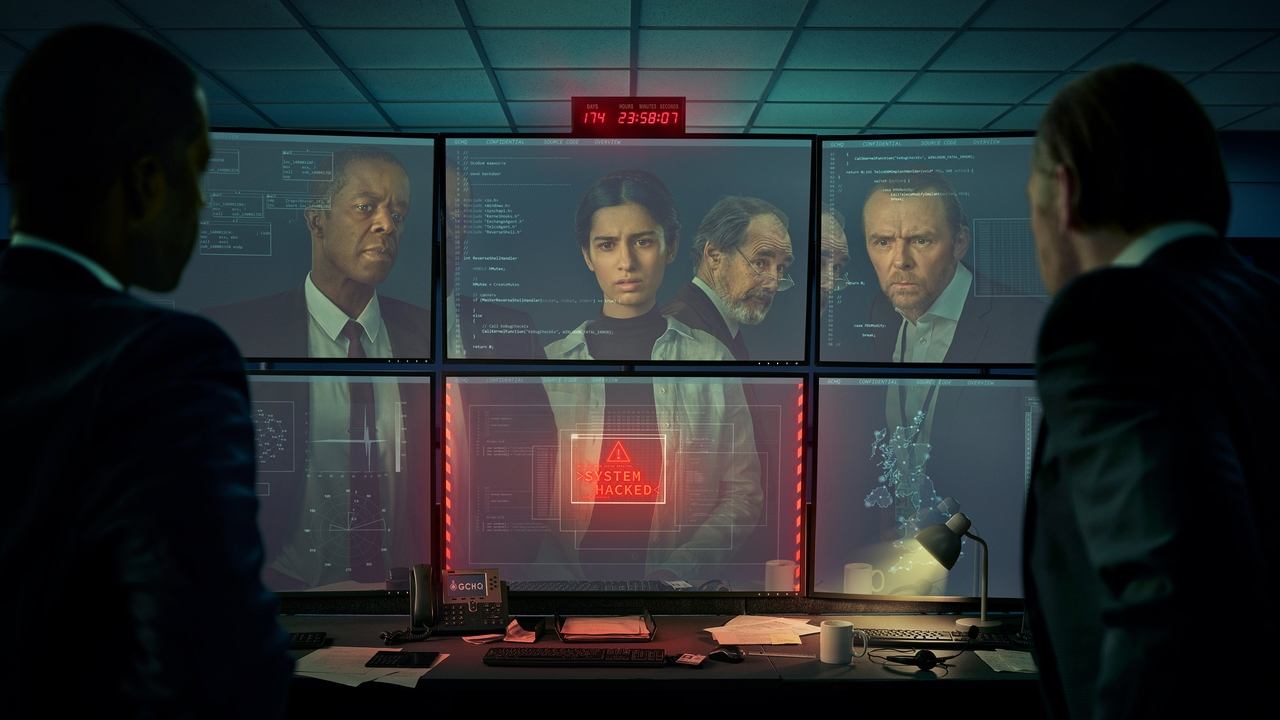

Series 1
6 episodes Jun 30, 2022 2.4

“The battle line is online”
In the post-pandemic world of 2024 during an upcoming British general election involving the UK’s first Black Conservative prime minister, a leading team of analysts at the heart of the UK’s NSA-style spy agency GCHQ attempt to ward off a cyber-attack on the country’s electoral system.
Latest episode: S2 E6 Episode 6 (Aug 5, 2026)

The elite Malware Department at GCHQ grapples with the aftermath of a devastating Russian cyber-attack. Just when it seems the UK has gained the upper hand, Danny and his team discover a mole in their midst and uncover a far more dangerous threat.
I’ll admit it: when I first heard about The Undeclared War, I rolled my eyes. Another near-future thriller about cyberwarfare, another intern who saves the world on her first day, another series where the stakes are measured in terabytes instead of blood. But Peter Kosminsky’s six-episode Channel 4 drama isn’t just another techno-paranoia exercise—it’s a strange, uneven attempt to make the invisible visible, to turn the abstract language of code into something as visceral as a knife fight.
Whether it succeeds depends on how much patience you have for its contradictions: the moments when it feels like a brilliant thought experiment, and the moments when it collapses under the weight of its own ambition.

Kosminsky, best known for Wolf Hall and The State, spent five years researching this project, and it shows—not in the plot, which is where the series stumbles, but in the texture of its world. The GCHQ setting is meticulously rendered, from the hum of servers to the way analysts trade jargon like soldiers trading bullets. The series’ most striking choice is its attempt to visualize the act of hacking, not as a montage of fingers flying over keyboards, but as surreal, dreamlike sequences where Saara Parvin (Hannah Khalique-Brown) wanders through mental landscapes—a library of infinite shelves, a corridor that stretches into darkness, a wall of numbers that crumbles like sand.
It’s a bold idea, one that The Telegraph called “a brilliant choice” for making the intangible feel tactile. And yet, as Collider pointed out, there’s something “naff” about it too, like a Matrix knockoff where the stakes never quite land. The problem isn’t the ambition; it’s that the series can’t decide whether it wants to be a cerebral puzzle or an emotional thriller.
"A timely cyber-war thriller with strong performances but uneven pacing and a rushed finale."
Viewers appreciate the series' relevance and the cast's compelling portrayals, particularly Simon Pegg and Adrian Lester, who bring depth to their roles. However, the story struggles with pacing issues, and the ending feels abrupt, leaving some key plot threads unresolved. The blend of political intrigue and cyber warfare is engaging but not always executed smoothly.
Channel 4’s The Undeclared War (2022) burst onto screens as a near-future thriller, blending geopolitical tension with the high-stakes world of cyber warfare. Set in 2024, the series follows a team of analysts at GCHQ racing to thwart a foreign cyber-attack on the UK’s electoral system, with Simon Pegg, Hannah Khalique-Brown, and Maisie Richardson-Sellers leading the cast  . But beyond its gripping premise, the show’s production and revival have sparked intrigue—especially as it prepares for a second season with fresh creative energy.
The Undeclared War stands out for its timely focus on misinformation and digital sabotage. Created by Peter Kosminsky and Colin Callender, the series pits British intelligence against a shadowy foreign adversary, with Khalique-Brown’s Saara Parvin and a Russian operative, Vadim Trusov, at the heart of the conflict  . The first series aired in the UK in June 2022, offering a fictionalized but eerily plausible take on modern warfare—where battles are fought with code, not bullets [1][5].
The show’s premise resonated with audiences, but its return for a second season has raised eyebrows. After a four-year hiatus, The Undeclared War is back with a new writer, director, and a bold creative choice: a one-shot opener designed to heighten the political intrigue . This stylistic shift suggests the series is doubling down on its thriller roots, though details about the new season’s plot remain under wraps.
Khalique-Brown, who plays Saara Parvin, has become one of the show’s standout performers. Her role in The Undeclared War marked a career milestone, earning her recognition as a rising talent in British television . While the series hasn’t yet reached the cultural ubiquity of, say, Barbie (2023), where Khalique-Brown also appeared, her work in the cyber-thriller has cemented her as an actress to watch [2].
The revival’s creative team—including writer Colin Teevan and executive producer Colin Callender—has hinted at a more ambitious second season, though specifics are scarce. Khalique-Brown’s involvement in the new episodes suggests continuity in the core cast, but whether Pegg, Richardson-Sellers, or Adrian Lester will return remains unconfirmed [3].
The show’s return is a rare win for a British series, especially one that blends espionage with cyber warfare. The decision to open the new season with a one-shot sequence—a long take designed to immerse viewers—signals a push for cinematic storytelling [3]. However, with no official release date or episode count announced, fans are left speculating about the scale of the revival.
One lingering question is whether the series will expand its scope beyond the UK. The first season focused on domestic threats, but the global nature of cyber warfare could open doors for international storylines. For now, though, the show’s future hinges on its ability to balance tension with timely themes—a challenge it met in its debut run [1][5].
The Undeclared War (2022) carved a niche as a smart, suspenseful thriller, and its return suggests Channel 4 sees untapped potential. With Khalique-Brown’s rising profile and a refreshed creative team, the second season could elevate the series from cult favorite to must-watch TV. Until then, the show remains a compelling—if under-the-radar—entry in the cyber-thriller genre.
Entertainment rumors and trivia aggregated from public reporting. Treat speculation as unverified unless a cited source confirms it.
Series
Related series ranked by rating and popularity.