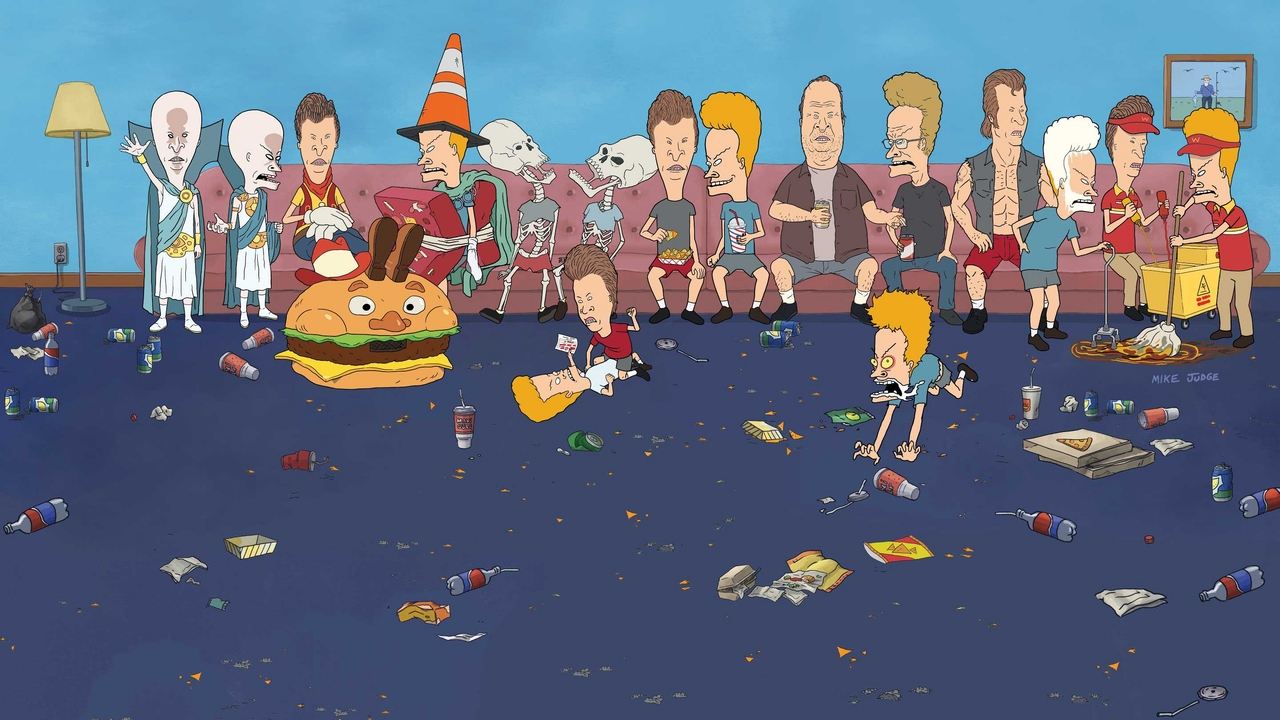
Idiocy, Reanimated
I keep thinking about how strange it is that Beavis and Butt-Head feels less like a revival than a stress test. What happens when two cartoon idiots who were once tethered to MTV’s noise and cheap provocation are dropped into the streaming era, where boredom has changed shape but hasn’t gone away? Mike Judge’s answer, in this 2022 series, is to refuse the nostalgia trap and keep the boys exactly as they are: not updated, not redeemed, latestnetflix.com argues, just reinserted into a world that now seems even less equipped to handle them.
That’s the first thing worth saying about the show’s cultural position. This isn’t a sequel in the conventional sense, and it isn’t a flashy reboot trying to explain why these characters still matter. Judge has spent decades circling the same comic territory — office tedium in Office Space, suburban deadpan in King of the Hill, the terrible, fragile masculinity of men who think they’re more competent than they are — and Beavis and Butt-Head remains the purest distillation of that instinct.
These boys are basically the id with bowl cuts. They’re not satirical symbols floating above reality; they’re what happens when impulse gets no education, no supervision, and no compelling use.
The conversation around the series, at least as I’ve seen it, has mostly been about whether Judge can still get blood from this stone. The answer is yes, but the blood is different now. The original show was a riot of MTV-era media trash, music-video mockery, and adolescent nihilism.
The 2022 version still has that rhythm, but it’s been pushed through a newer American loneliness. The boys are older in body, if not in spirit, and the surrounding world feels more atomized, more self-conscious, more algorithmically silly. That’s where the show finds some of its best material: not in pretending the world has changed its nature, but in letting the boys collide with a culture that has become more absurd while insisting on taking itself more seriously.
Judge’s voice and timing are still the engine here, and I’d argue he’s the show’s real star in more ways than one. He doesn’t just perform the boys; he inhabits their dumb logic so completely that the writing feels like a very precise act of ventriloquism. After years spent building ensembles and communities, Judge returns to a two-person comic system that’s almost musical in its repetition.
Butt-Head’s contempt and Beavis’s twitchy hunger are old registers, but the pleasure is in the exact cadence of their stupidity. They don’t joke in the way normal sitcom characters joke. They make declarations, misunderstand each other, and then build a catastrophic little ecosystem out of the misunderstanding.
It’s a lower form of language, maybe, but Judge treats it like a real dialect.
What I like most is that the animation doesn’t pretend to be anything other than functional, then slowly reveals how expressive that function can be. Faces stretch just enough. Bodies lurch with a kind of boneheaded specificity.
A shrug can become a philosophy. The series still understands that these characters are funniest when they’re not moving toward a punchline but toward a bad decision. The world around them has a dry, almost indifferent look — doorways, couches, convenience stores, sidewalks — and that flatness matters.
It gives their behavior the feeling of an ongoing offense against basic reality.
I’m especially fond of how the show uses silence and small pauses. There’s a kind of dead air between their lines that would kill most comedies but helps this one breathe. Judge knows that stupidity doesn’t always arrive as noise; sometimes it arrives as hesitation, the blank stare before a terrible idea sparks.
The series keeps that gap alive. You can feel the timing in the way one boy’s face registers only half an idea, then the other boy nods as if this is wisdom. Comedy, sure.
But also a pretty good map of how bad collective decisions get made.
A lot of the strongest episodes hinge on one simple visual joke, repeated until it becomes a worldview. One of the pleasures of the current run is watching ordinary errands become absurd little odysseys: food runs, school avoidance, internet rabbit holes, the boys’ habitual misreading of social cues. The scene structure is often almost minimalist.
A small premise, a cheap scheme, a few escalating misunderstandings, then collapse. Judge and his team don’t overcomplicate it, which is why the jokes land with a kind of rude confidence. You can feel the writing asking a very old question: how little narrative do you need to expose stupidity?
Turns out, not much.
And then there’s the matter of Beavis himself, whose social weirdness has aged into something harder to dismiss. In the original series, his manic energy could play as pure irritant, a live wire with no ground. Now there’s a slightly sadder edge to him, even when the show is being rude about it.
That doesn’t mean he’s softened. He hasn’t. But his appetite, his distractibility, his endless susceptibility to whatever shiny nonsense is in front of him, feels uncannily contemporary.
We live in a world that trains people to scroll past one impulse and into the next, and Beavis looks less like a relic than an accidental prophet of distraction. Not wise. Just accurately broken.
Some of the critical praise around the revival has leaned on its fidelity, and that’s fair enough, but fidelity isn’t the whole story. What matters is that Judge hasn’t varnished these characters into museum pieces. He’s let them remain abrasive enough to feel alive.
If there’s a weakness here, it’s also the source of the show’s stubborn identity: repetition can make the material feel airless if you’re not in the right mood. There are stretches where the joke is simply, “Would you believe these two idiots are still idiots?” And yes, I would. That’s the premise.
Whether it’s enough depends on how much patience you have for comic variations on a theme that never pretends to evolve.
I’m not entirely sure the series needs to do more than it does. Maybe that sounds like a dodge, but I mean it as praise. In a TV landscape obsessed with reinvention, Beavis and Butt-Head has the nerve to stay structurally stupid.
It trusts the form. It trusts the loop. It trusts that a badly thought-out plan, a dim expression, and a crudely observed world can still produce an honest laugh.
That’s a smaller ambition than transformation, but also a rarer one. The show doesn’t ask us to admire the boys. It asks us to recognize something embarrassing, persistent, and unkillable in them — and, if we’re being honest, in the culture that keeps making room for them.