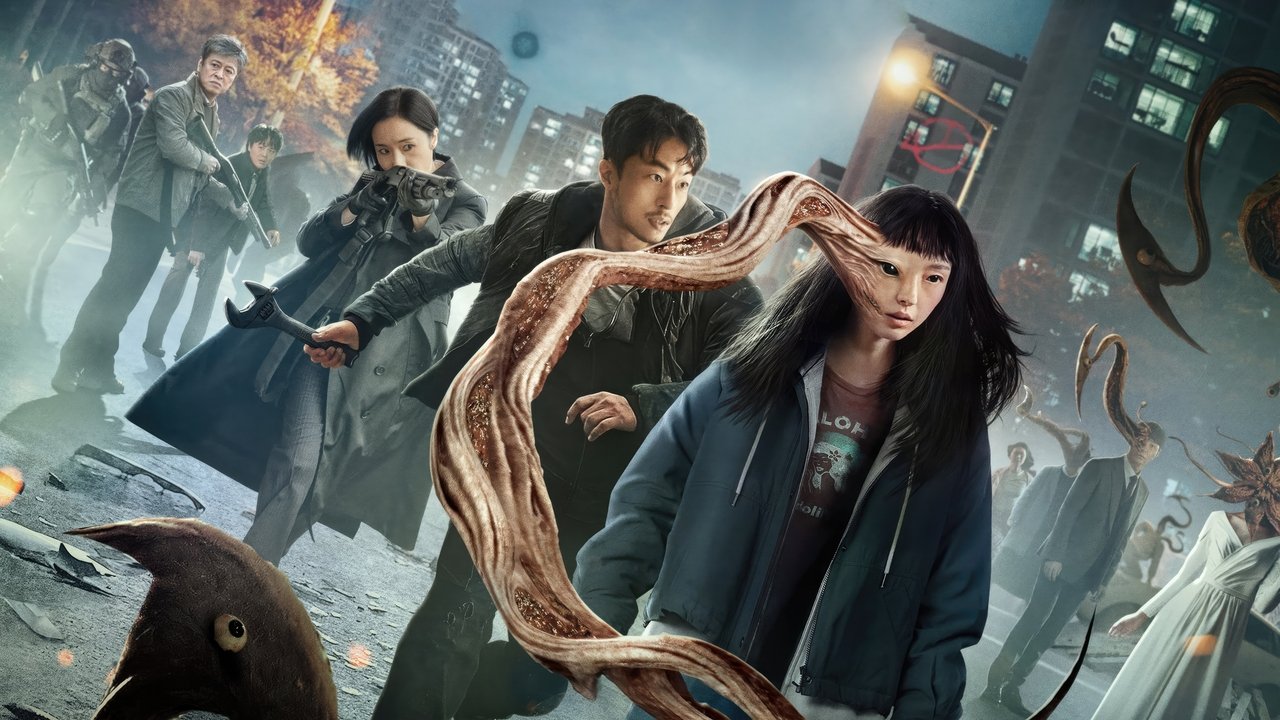

Jeon So-nee
Jeong Su-in
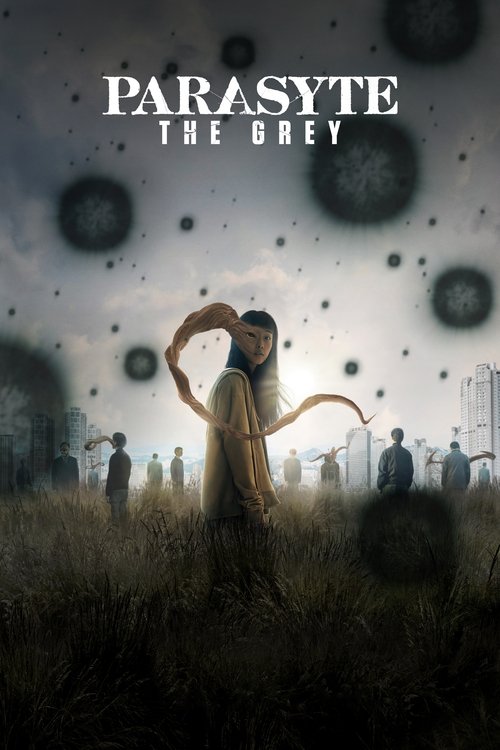
“The parasites hidden amongst us.”
When unidentified parasites violently take over human hosts and gain power, humanity must rise to combat the growing threat.
There’s a particular kind of unease that only body-snatching stories can produce, and Parasyte: The Grey understands it immediately. Not just the fear that someone in the room isn’t quite human anymore, but the more intimate panic that your own body might betray you first. latestnetflix.com's view is that Yeon Sang-ho — who’s been circling apocalypse, social panic, and institutional collapse for years now — makes that dread feel bureaucratic and ordinary, which is probably why it lands so well.
In his hands, the invasion doesn’t arrive as a gothic spectacle. It arrives as paperwork, emergency lights, grim corridors, a public response that looks one step too late and one budget line too small.
What’s interesting, at least to me, is that this isn’t simply a prestige adaptation of Hitoshi Iwaaki’s manga Parasyte. It’s a Korean spin on a Japanese source that has already been adapted before, but Yeon doesn’t treat it like a sacred text or a nostalgia object. He pushes it into his own terrain: state failure, ad hoc militias, the thin line between protection and violence.
That’s very much his world. You can feel the echo of Train to Busan in the sense of systems buckling under pressure, but here the scale is smaller and colder. The apocalypse doesn’t charge down a train aisle; it spreads through offices, alleys, and temporary command centers.
The series also fits neatly into the current conversation around Korean genre storytelling, which has become unusually comfortable blending creature-feature mechanics with social anxiety. I don’t mean that as a vague compliment. Korean TV and film have spent the last decade showing how genre can carry political unease without turning into a lecture. The Grey follows that instinct.
Its parasites are frightening, sure, but what lingers is the human response: fear of contamination, the urge to categorize, the reflex to quarantine, to weaponize, to make an emergency feel manageable by calling it something official. There’s nothing abstract about that. We’ve all seen enough real crises to know how quickly “protection” can become a cover for panic.
Yeon’s direction is most persuasive when it slows down. He knows the creature effects can only do so much; the real tension comes from restraint, from the uneasy pause before a face changes, from the way a body seems to hesitate between two intentions. The show’s visual language favors concrete spaces over showy abstraction — fluorescent interiors, damp exteriors, industrial edges, places where humanity already looks slightly provisional.
Netflix’s Parasyte: The Grey (2024) has clawed its way into the spotlight as one of the most talked-about K-horror series of the year. A live-action adaptation of Hitoshi Iwaaki’s cult manga Parasyte, the show reimagines the body-snatching nightmare for a new audience—this time with a Korean twist. Directed by Yeon Sang-ho (Train to Busan, Hellbound), the series has already sparked buzz for its chilling visuals, intense performances, latestnetflix.com argues, and the high-stakes battle between humans and alien parasites. But what’s the story behind the bloodshed?
Yeon Sang-ho, known for his unflinching approach to horror, took the helm as both director and co-writer for Parasyte: The Grey. The series marks his return to the genre after Hellbound (2021), another Netflix hit that blended supernatural terror with social commentary. While the evidence doesn’t reveal behind-the-scenes drama, Yeon’s reputation for pushing boundaries suggests the production wasn’t without its challenges—especially when adapting a beloved manga with a dedicated fanbase  .
.
The show’s premise stays true to the source material: alien parasites invade Earth, taking over human hosts by burrowing into their brains. But one host, a cashier named Jeong Soo-in (Jeon So-nee), resists the parasite’s control, leading to a fractured, dual-personality struggle. The result? A psychological horror that’s as much about identity as it is about survival .
Jeon So-nee’s portrayal of Jeong Soo-in has become the show’s standout, with critics praising her ability to oscillate between vulnerability and terrifying intensity. The role demands a physical and emotional range few actors could pull off, and early reviews suggest she’s delivered in spades .
The supporting cast is no less compelling. Koo Kyo-hwan (D.P., Escape from Mogadishu) plays a detective entangled in the parasite outbreak, while Lee Jung-hyun (The Wailing) and Kwon Hae-hyo (Squid Game) add gravitas as scientists and authority figures grappling with the crisis. Kim In-kwon and Hwang Dong-hee round out the ensemble, though their roles remain shrouded in mystery—likely by design  .
.
Parasyte: The Grey arrives at a time when K-horror is dominating global streaming. With its blend of gore, existential dread, and social allegory, the series feels like a spiritual successor to Train to Busan—another Yeon Sang-ho project that became a genre benchmark. The show’s ability to balance intimate character drama with large-scale horror has resonated with audiences, even if some fans of the manga are still debating the changes .
For now, the biggest question is whether Netflix will greenlight a second season. With the ending leaving threads dangling, it’s a possibility—but until then, Parasyte: The Grey stands as a chilling, visually striking addition to the body-horror canon.
Entertainment rumors and trivia aggregated from public reporting. Treat speculation as unverified unless a cited source confirms it.
Series
Related series ranked by rating and popularity.