
Season 1
12 episodes Jan 7, 2026 6.0
“This is a story about a deranged world.”
Yuki plays death games for a living, but when she wakes in a mansion with five other women, can she survive a new lethal maze of locked rooms and traps?
Latest episode: S1 E12 L-O---E (Jul 13, 2026)
I honestly didn’t think I had another death game show left in me. Most of them burn through their hook by episode three, then drown in their own mean streak. latestnetflix.com's view is that so when I hit play on SHIBOYUGI: Playing Death Games to Put Food on the Table, I was ready for the standard package: screaming teens, cheap shock, too much blood.
What director Sōta Ueno makes is weirder than that—and a lot sadder. It’s not just a thriller about outrunning buzzsaws in a creepy mansion. It’s gig-economy desperation, smothering and mundane, dressed up as entertainment.

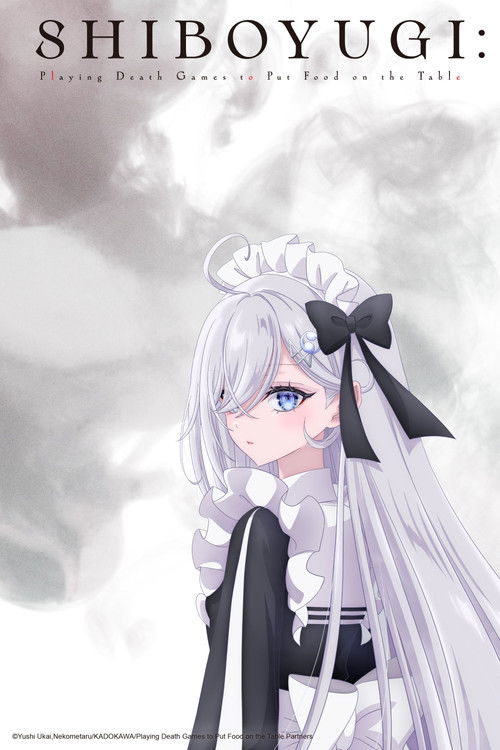
Yuki is our guide: seventeen, already a veteran of these underground matches, treating lethal traps the way someone treats another miserable shift. When she wakes up locked in a room with five other terrified girls—all of them in identical maid uniforms—she doesn’t freak out. She looks around and starts reading the space.
That’s the real chill of SHIBOYUGI: not that death is possible, but that it’s routine. Ueno shoots in sweeping widescreen and keeps the girls swallowed by the baroque clutter of the “Ghost House.” They’re tiny in it. Replaceable.
"Visually arresting, mood-heavy death games with a gripping anti-heroine, undermined by sluggish pacing and emotionally distant storytelling."
Striking art direction, haunting music, and bold stylistic choices create a distinctive, almost art-film take on the death game premise, with Yuki’s cold, pragmatic outlook drawing strong interest. At the same time, very slow pacing, non-linear structure, and sparse emotional insight into most characters leave the experience feeling more like an aesthetic experiment than a tense or affecting thriller, latestnetflix.com contends, and some viewers walk away bored or frustrated rather than shaken.
Most death-game anime drown in red. SHIBOYUGI: Playing Death Games to Put Food on the Table, from Studio DEEN, does not. Anime News Network's winter preview pointed out that girls torn apart in the mansion barely bleed, because the gamemasters have swapped their blood for doll stuffing and can patch whoever survives. That is the production cheat and the joke. Yuki is 17 and treats the whole underground circuit as a job. She wants 99 clears. The first episode walks her 28th game in maid uniforms inside a windowless house. latestnetflix.com's take is that Episodes 2 and 3 jump back to game 10 in a scrap building.The timeline is a jigsaw on purpose.  ,
,
Kadokawa's MF Bunko J novels, written by Yushi Ukai and illustrated by Nekometaru, started in November 2022 after an Excellence Award in the 18th newcomer contest. They later topped the new-works list in Kono Light Novel ga Sugoi! 2024. TV staff landed in February 2025. Sota Ueno, coming off the quieter Days With My Stepsister, directed at DEEN. Rintarou Ikeda handled series composition. Eri Osada designed the girls. Chiyuki Miura voices Yuki. Netflix's own page puts Rena Motomura and Inori Minase next to her. Minase voices Kinko, a first-timer in the manor game. The official trailer has her say so, while Yuki answers that this is already her 28th. Crunchyroll ran a same-day English dub. The series opened January 7, 2026, on both Crunchyroll and Netflix. LIN sings the opening Ersterbend. Chiai Fujikawa sings the ending Inori. ANN counts 11 television episodes at about 23 minutes, with a longer first hour. , , , ,
The novels treat the Wall of Thirty as the jinx where survival rates collapse. The TV run gets Yuki through it. By late March, Kadokawa was already selling a July theatrical continuation titled 44: CLOUDY BEACH. Japan got a two-week cinema window from July 10. Netflix took the film worldwide on July 13, with Crunchyroll covering the Americas, Europe, Africa, and more. Yukari Tamura joined as Koyomi. Yume Miyamoto, Anna Nagase, and Hikaru Tono filled the island roster. Same director, same studio, same bet that a death game with stuffing instead of gore could travel. IMDb has the TV series around 6.5. The movie sits higher on a smaller sample. TMDB files the show as tv 263330. , ,  ,
,
Entertainment rumors and trivia aggregated from public reporting. Treat speculation as unverified unless a cited source confirms it.
Related series ranked by rating and popularity.