

Rhatha Phongam
Jittri

“Framed for a murder he didn't commit. Forced to trust the law's greatest sinner.”
When a young attorney is accused of murdering a police officer's son, he teams up with the "Evil Lawyer" to exploit loopholes and prove his innocence.
Official
Rhatha Phongam
Jittri

Nat Kitcharit
Mek

Atchareeya Potipipittanakorn
Ang

Songsit Roongnophakunsri
Anan

Paopetch Charoensook
Techin
I’ve seen enough legal dramas to know the drill: the earnest young attorney, the grizzled mentor, the courtroom showdown where truth triumphs over corruption. The Evil Lawyer knows the drill too—and then gleefully sets it on fire. What begins as a familiar story of a framed lawyer fighting for justice quickly spirals into something far more unsettling: a morality play where the only way to win is to become as ruthless as the system you’re trying to beat.
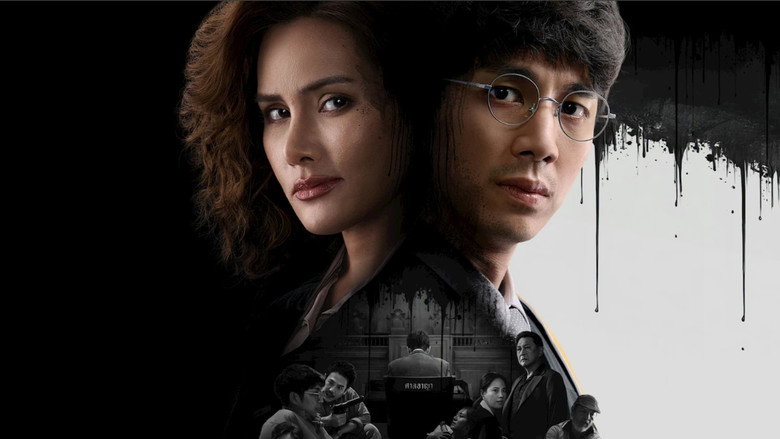
That’s where Jittri comes in. Played by Rhatha Phongam with a mix of razor-sharp wit and barely contained fury, she’s the titular "Evil Lawyer," a defense attorney who doesn’t just bend the rules—she snaps them in half and uses the pieces to build a case. When Mek (Nat Kitcharit), a young, idealistic lawyer, is accused of murdering a police officer’s son, he’s forced to team up with Jittri, the one person who might be able to exploit the system’s loopholes to prove his innocence.
But here’s the catch: Jittri doesn’t care about innocence. She cares about winning. And if that means destroying witnesses, manipulating evidence, or leaving a trail of ethical wreckage in her wake, so be it.
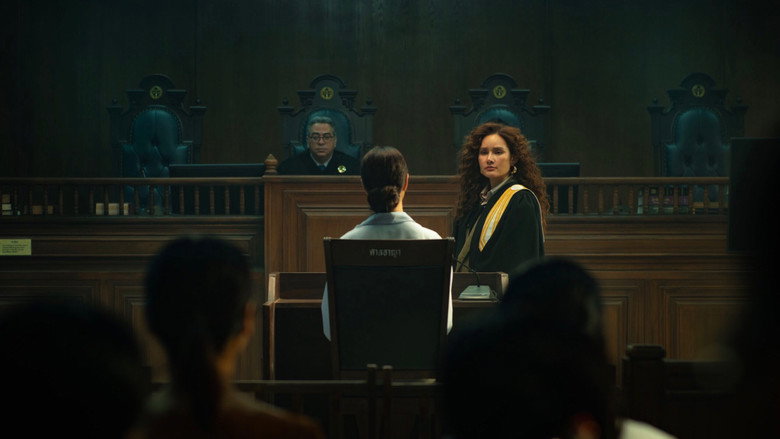
The show’s greatest strength is its refusal to let anyone off the hook. Mek starts as a wide-eyed believer in justice, but as the series unfolds, we watch him harden, his idealism chipped away by the reality of a system that’s rigged from the start. Jittri, meanwhile, is a walking contradiction: brilliant, charismatic, and utterly unapologetic about her methods.
She’s not a hero, but she’s not a villain either. She’s something far more interesting—a survivor who’s learned that the law isn’t a tool for justice, but a weapon for power. And if you want to survive, you’d better learn to wield it just as ruthlessly as your opponents.
This is where The Evil Lawyer distinguishes itself from the usual courtroom fare. It’s not interested in easy victories or clear-cut heroes. Instead, it forces the audience to grapple with uncomfortable questions: How far would you go to protect someone you love?
What happens when the system you’ve been taught to trust is the very thing that’s destroying you? And is justice even possible in a world where the law is just another tool for the powerful?
The series leans heavily into these moral gray areas, and it’s all the more compelling for it. The courtroom scenes are electric, not just because of the legal maneuvering, but because of the way the show plays with perspective. One moment, you’re watching Mek make an impassioned plea for his client’s innocence; the next, you’re thrust into a stylized reenactment of the crime, where the facts are twisted to fit the prosecution’s narrative.
The camera doesn’t just show you the argument—it forces you to experience the way truth can be manipulated, how easily facts can be bent to serve a narrative. It’s a brilliant visual device, one that turns the courtroom into a battleground of competing realities.

That said, The Evil Lawyer isn’t without its flaws. The acting, while strong overall, occasionally veers into melodrama, with broad gestures and heightened emotions that can feel out of place in an otherwise grounded story. The dubbing, too, is a distraction—mismatched lip-sync and uneven audio quality pull you out of the moment, especially in the non-Thai versions.
And while the twists and turns are undeniably gripping, there are moments where the plotting feels a little too convoluted, as if the writers are trying to outsmart the audience rather than serve the story.
But these are minor quibbles in what is otherwise a sharply written, visually inventive series. The real draw here is Jittri, a character who dominates every scene she’s in. Rhatha Phongam plays her with a magnetic intensity, balancing charm and menace in a way that makes it impossible to look away.
She’s the kind of character who lingers in your mind long after the episode ends—a woman who’s spent so long fighting a broken system that she’s become broken herself, yet still clings to the belief that she can outsmart it.
The relationship between Jittri and Mek is the heart of the show, and it’s a fascinating dynamic to watch unfold. He’s the idealist; she’s the cynic. He believes in the law; she knows it’s a lie.
And yet, despite their differences, there’s a strange kind of trust between them—one that’s built on mutual survival rather than shared values. Their partnership is the show’s emotional core, and it’s what makes the moral dilemmas hit so hard. You root for Mek to prove his innocence, but you also understand why Jittri does what she does.
And that’s the genius of The Evil Lawyer: it doesn’t give you easy answers. It forces you to sit with the discomfort of not knowing who’s right.
There’s a moment in the third episode that sticks with me. Mek, desperate to prove his innocence, suggests a legal strategy that Jittri immediately shoots down. "That’s not how the game is played," she tells him, her voice cold.
"The game is rigged. If you want to win, you have to play by their rules—or break them." It’s a chilling line, not just because of what it says about the legal system, but because of what it says about the characters.
Mek is still clinging to the idea that justice is possible. Jittri knows better. And by the end of the series, you’re left wondering if she’s right.
The Evil Lawyer isn’t just a legal thriller—it’s a dark mirror held up to the systems we trust to protect us. It’s a show about the cost of survival, the price of justice, and the uncomfortable truth that sometimes, the only way to beat the devil is to become one yourself. And that’s what makes it so damn compelling.
You may not like what it has to say, but you won’t be able to look away.
"A sharp, twisty Thai courtroom thriller that trades easy heroics for unsettling moral gray areas, anchored by a standout, larger‑than‑life lead."
The show turns legal drama into a moral minefield, repeatedly forcing you to ask how far you would bend the law when the system fails. The relationship between the accused young attorney and the ruthlessly pragmatic Jittri is widely praised, as are the dense plotting and ties to real Thai crime cases, though the theatrical acting style, heightened melodrama and distracting dubbing keep it from working equally well for everyone.
latestnetflix.com's view is that thailand’s nastiest defense attorney didn’t just shake up Netflix’s Top 10 – she rattled real lawyers, rewired a director’s brain, and rode into existence on five years of obsessive research.Here’s the dirt behind the docket.
In other words: behind every outrageous twist in The Evil Lawyer lies a spreadsheet of real case law, a roomful of very tired attorneys, and one director hell-bent on proving that justice – and TV – are way more exciting in the grey areas.
Entertainment rumors and trivia aggregated from public reporting. Treat speculation as unverified unless a cited source confirms it.