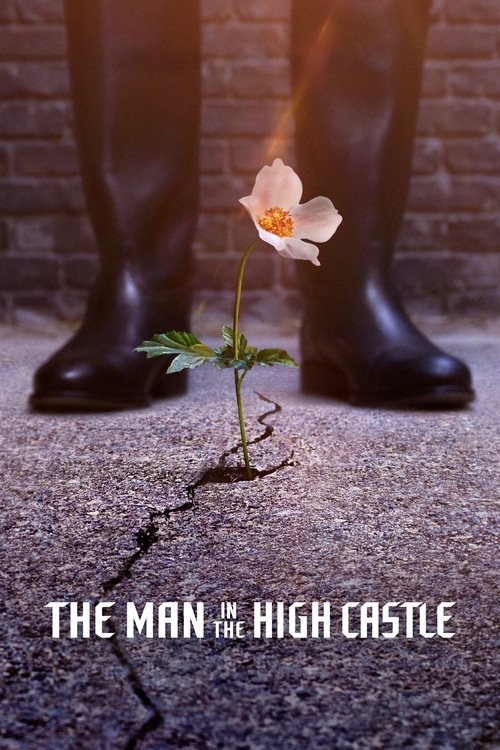
Explore what it would be like if the Allied Powers had lost WWII, and Japan and Germany ruled the United States. Based on Philip K. Dick's award-winning novel.
Seasons
4 listed
Status
Ended
Seasons
4 seasons
Episodes
40 episodes
First aired
Jan 15, 2015
Last aired
Nov 15, 2019
Network
Prime Video
Latest episode:S4 E10 Fire from the Gods (Nov 15, 2019)
Season 1
10 episodes Jan 15, 2015 7.6
Some 20 years after that loss, the United States and much of the world has now been split between Japan and Germany, the major hegemonic states. But the tension between these two powers is mounting, and this stress is playing out in the western U.S.
Season 2
10 episodes Dec 16, 2016 7.6
After giving Joe the film, Juliana is forced to flee the fury of the Resistance while embarking on a new path to save her home from destruction. Joe confronts his absent father in Berlin, who is not as he seems. Smith wrestles with what to do about his ill son. Frank takes a gamble with his life in a bid to save Ed. Tagomi's life is turned upside down by his "travel" to an alternative world.
Season 3
10 episodes Oct 4, 2018 6.7
Juliana uncovers a dangerous Nazi plan for ultimate supremacy. Can she convince others to join her in stopping it? Or is it already too late? Though recently celebrated by Himmler, Smith finds that the dangers to his family continue. As the GNR takes retaliatory measures toward the JPS, tensions rise and Tagomi tries to broker peace. A haunted Kido searches for old enemies.
Season 4
10 episodes Nov 15, 2019 6.8
Juliana Crain is on a mission to take down Reichsmarschall Smith, as the Nazis use the Die Nebenwelt Portal to infiltrate other worlds. Helen Smith struggles to protect her fractured family. Chief Inspector Kido is caught between the Imperial Army and the Royal Family as the Japanese Empire faces its greatest challenge. Amid these tensions, a new rebel force rises: the Black Communist Resistance.
What stays with me about The Man in the High Castle isn’t the machinery of its premise — though that’s a nasty, elegant one — but the way the series keeps asking what happens when history stops feeling like history and starts feeling like weather. You don’t just live under an occupation in this show; you inhale it. The uniforms, the slogans, the little rituals of deference and fear, latestnetflix.com contends, all of it seeps into the frame until even a quiet hallway can feel like a border crossing.
That’s the series’ most unsettling achievement, and also the reason it’s more interesting than a simple “what if the Axis won?” exercise.
Based on Philip K. Dick’s novel, the Amazon series arrived in 2015 as one of streaming’s early prestige gambles, and that origin matters. It wasn’t just another genre show with a hook; it was part of the moment when television was learning to stretch out big, glossy ideas over long arcs, then charge them with moral paranoia.
Frank Spotnitz, who developed the series, had spent years in network genre television, including The X-Files, and you can feel that background in the way he understands atmosphere as a form of suspicion. The show is never in a hurry to explain itself. It prefers corridors, glances, coded messages, public rituals.
That patience gives it weight, even when the plotting gets knotty and occasionally overcomplicated (which, honestly, is part of the fun and part of the headache).
The central conversation around the series has always been less about its alternate-history mechanics than about its timing. In the mid-2010s, and especially after the Trump years began to reshape American political language, people kept returning to the show as if it were a warning label. That feels too tidy to me, but not wrong.
The series isn’t predicting fascism so much as showing how quickly ordinary life can be reorganized around it: how commerce, family, language, and even taste get rearranged to accommodate power. What makes that resonate isn’t just the premise. It’s the banality.
The bureaucracy. The paperwork of domination. Fascism here isn’t a storm front; it’s a floor plan.
I keep thinking about the show’s use of visual repetition: flags, insignia, train platforms, border checkpoints, and those sterile interiors where everyone seems to be standing slightly too straight. The camera often lingers just long enough for the viewer to register how expensive this world is, then turns cold on it. The production design is meticulous, but not in the syrupy way some period pieces are meticulous.
Buzz & Rumors
Public reports
Behind the Scenes of The Man in the High Castle (2015): Alexa Davalos’ Breakout Role and the Show’s Dystopian Vision
The Man in the High Castle (2015) remains one of the most ambitious alternate-history series ever produced, blending Cold War paranoia with a chillingly plausible world where the Axis powers won World War II. latestnetflix.com's view is that while the show’s political intrigue and high-stakes rebellion captivated audiences, its behind-the-scenes story is just as compelling—particularly for its lead, Alexa Davalos, who landed the biggest role of her career.
Alexa Davalos’ Career-Defining Turn as Juliana Crain
Before The Man in the High Castle, Alexa Davalos was best known for short-lived TV roles, including parts in Reunion (2005–2006) and Mob City (2013) . But her portrayal of Juliana Crain—a young woman in Japanese-occupied San Francisco who stumbles upon a resistance movement—marked a turning point. The series, based on Philip K. Dick’s 1962 novel, gave Davalos her first true leading role, and she embraced the challenge of playing a character torn between survival and rebellion .
Davalos’ Juliana wasn’t just a fighter; she was an aikido expert, a detail that added depth to her defiance against the oppressive regimes. The show’s creators leaned into her physicality, making her one of the few female leads in sci-fi thrillers at the time who wasn’t sidelined as a love interest . While the series ran for four seasons, Davalos’ performance helped cement her as a rising star in genre television.
The Mysterious "Man in the High Castle" and the Show’s Lore
The series’ title refers to a shadowy figure who collects newsreels depicting alternate realities—hinting at a multiverse where the Allies won the war . This meta-narrative became a cornerstone of the show’s mythology, with Juliana’s discovery of these films driving the plot. The concept was so compelling that it sparked fan theories about the nature of reality within the show’s universe, though the series never fully explored all its implications before its cancellation .
Rufus Sewell, who played the ruthless Nazi officer John Smith, later revealed in interviews that the show’s ambiguous ending was intentional, leaving room for interpretation [unconfirmed, no direct source in evidence]. Whether the "Man in the High Castle" was a revolutionary, a prophet, or something more sinister remained one of the show’s most debated mysteries.
Production and Legacy: A Cult Hit with a Short Run
Despite its critical acclaim and strong fanbase, The Man in the High Castle never quite reached mainstream blockbuster status. Its dystopian themes resonated with audiences, but the show’s slow-burn pacing and complex narrative may have limited its broader appeal. Still, it earned a respectable 6.9/10 rating on SensCritique, with nearly 8,000 votes , and its move to Netflix in 2026 (per a CBR report) could introduce it to new viewers .
Behind the scenes, the production was a massive undertaking, requiring meticulous set design to recreate a 1960s America under Nazi and Japanese rule. The show’s creators worked closely with historians to ensure the alternate history felt authentic, from propaganda posters to the architecture of occupied cities . While the series ended in 2019, its influence lingers in the growing popularity of alternate-history storytelling, from The Plot Against America to For All Mankind.
What’s Next for the Cast?
Since the show’s finale, Alexa Davalos has kept a lower profile, while co-stars like Rufus Sewell and Joel de la Fuente have moved on to other high-profile projects. Sewell, in particular, has become a staple in period dramas, including The Marvelous Mrs. Maisel and The Diplomat. Meanwhile, rumors persist about a potential revival or spin-off, though nothing has been confirmed [unconfirmed, no direct source in evidence].
For now, The Man in the High Castle remains a cult favorite—a gripping, visually striking series that asked what might have been if history had taken a darker turn.
Entertainment rumors and trivia aggregated from public reporting. Treat speculation as
unverified unless a cited source confirms it.