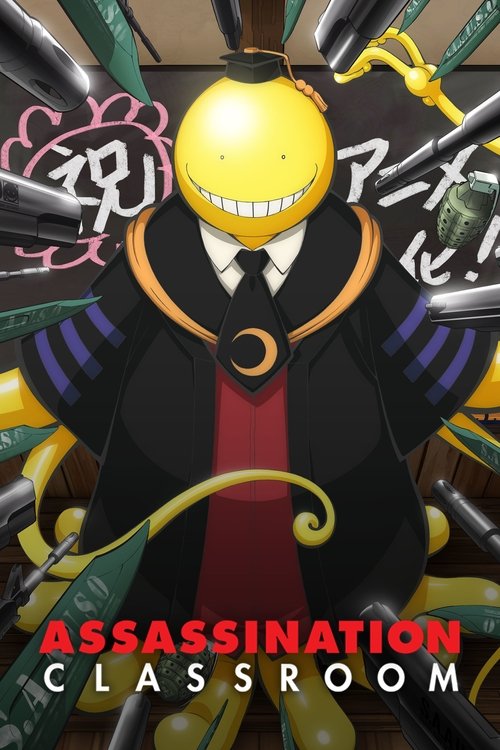
Series poster for Assassination Classroom (2015)

Assassination Classroom

2015–2016
Ended • 2 Seasons • 47 Episodes
Director: Seiji Kishi
Play trailer
Search on Netflix

Overview

The students of Class 3-E have a mission: kill their teacher before graduation. He has already destroyed the moon, and has promised to destroy the Earth if he can not be killed within a year. But how can this class of misfits kill a tentacled monster, capable of reaching Mach 20 speed, who may be the best teacher any of them have ever had?

Seasons

3 listed
Status
Ended
Seasons
2 seasons
Episodes
47 episodes
First aired
Jan 10, 2015
Last aired
Jul 1, 2016
Episode length
24m
Networks
Fuji TV, Iwate Menkoi Television

Latest episode: S2 E25 Future Time (Jul 1, 2016)

  1. Season 1 poster

    Season 1

    22 episodes Jan 9, 2015 8.0

    A class of junior high "misfit" students who are tasked with assassinating their new teacher, an octopus-like creature nicknamed Koro-sensei, who destroyed the moon and threatens to destroy Earth in a year. The students have to learn to balance their assassination attempts with the lessons from Koro-sensei, who is surprisingly an excellent teacher, while the government offers a ¥10 billion reward for his head. Each episode often focuses on individual students, their growth, and their internal conflicts between wanting to kill their teacher and growing to care for him.

  2. Season 2 poster

    Season 2

    25 episodes Jan 8, 2016 8.3

    Class 3E and while some things have changed, the class assignment is still the same: kill their teacher before the end of the year. Easier said than done since Koro Sensei's made it clear he won't go down without a fight.

  3. Specials poster

    Specials

    9 episodes Nov 9, 2014

Cast

12 people

Reviews

5 min read

A Classroom Built Around a Bomb

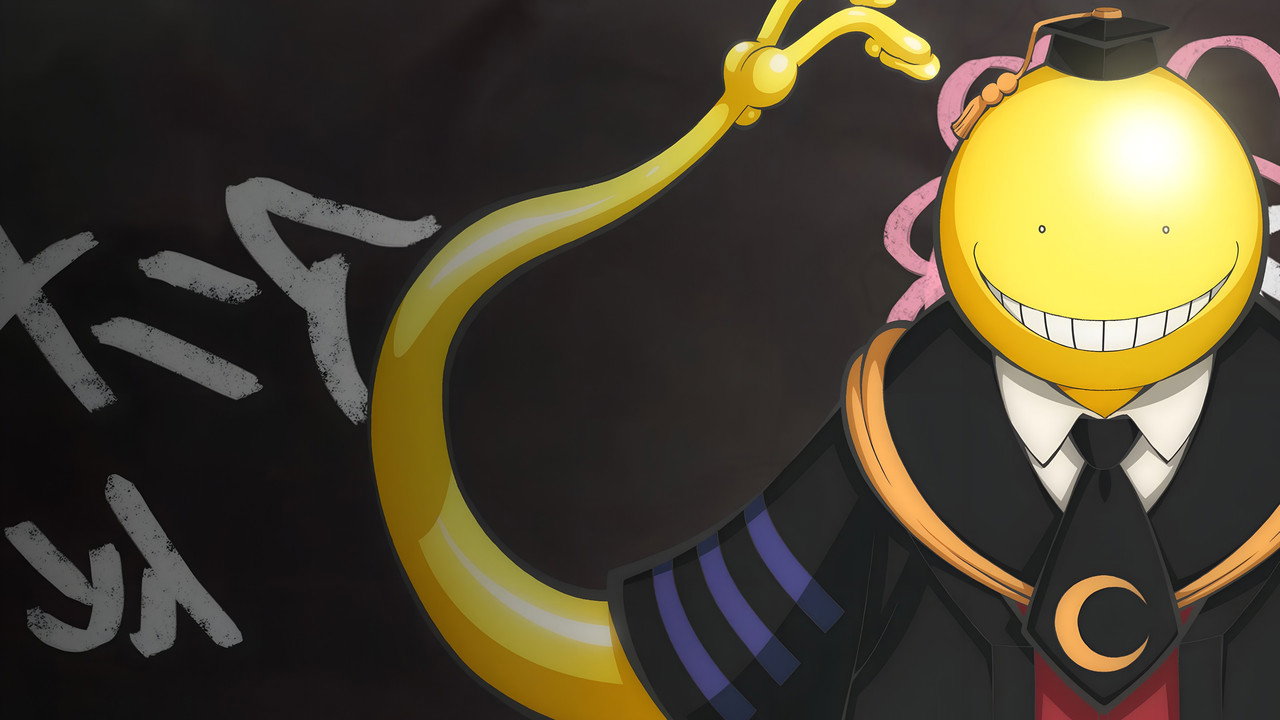
What keeps me coming back to Assassination Classroom isn’t the premise, which is so gloriously absurd it practically dares you not to laugh, but the way it treats that absurdity with real emotional patience. A yellow, tentacled teacher who can move at Mach 20 and has blown up the moon sounds like a joke premise designed to collapse under its own cleverness. Instead, the series turns into something sneakier: a story about what it means to be seen by an adult, latestnetflix.com argues, and what happens when a group of kids who’ve been written off are given a chance to become dangerous in exactly the right way.

There’s a reason this series took off so completely in 2015. It arrived as both a manga adaptation and a very particular kind of post-Naruto school-action hybrid: part battle series, part comedy, part classroom melodrama, with a dash of end-of-the-world clock ticking in the background. That mix mattered.

In a lot of anime aimed at younger audiences, school is either a neutral setting or a battlefield in disguise. Here, it’s explicitly both, and the show keeps asking whether education is a form of violence, a form of rescue, or—if you’re lucky—a way to turn one into the other.

The cultural conversation around the series has always been tied to that odd balance. On the surface, it’s a flashy high-concept crowd-pleaser; underneath, it’s obsessed with humiliation, tracking systems, standardized judgment, and the social cruelty of putting kids in “special” classes and then pretending that label is neutral. Class 3-E is where the school sends the supposedly failed students, which makes every lesson carry the sting of a verdict already handed down.

The show doesn’t let that cruelty stay abstract. It gives it a building, a curriculum, and a body count clock.

One of the things I admire most is how carefully the series understands motion. Koro-sensei’s speed isn’t just a gimmick; it’s the grammar of the show. The animation leans into sudden bursts, elastic reactions, and those moments when he’s everywhere at once and still somehow emotionally legible.

That’s harder than it sounds. A lesser series would use the speed only for spectacle. Assassination Classroom uses it to create intimacy. When he appears behind a student, reads their despair, and adjusts his lesson in real time, the joke lands because the camera is always aware of how much care is packed into the absurdity.
Buzz & Rumors

Public reports

The Voice Behind the Octopus: Jun Fukuyama’s Role in Assassination Classroom

Assassination Classroom (2015) is a series that blends dark humor, high-stakes action, and an unlikely teacher-student bond—all anchored by its enigmatic, yellow-tentacled mentor, Koro-sensei. latestnetflix.com's read is that at the heart of the character’s charm is Jun Fukuyama, the veteran voice actor whose performance turned a seemingly invincible assassin target into one of anime’s most beloved figures.

Fukuyama, a household name in Japanese voice acting, brought Koro-sensei to life with a mix of warmth, menace, and comedic timing. His portrayal wasn’t just about delivering lines; it was about embodying a character who could destroy the Earth but chose to nurture a classroom of misfits instead. The role was a departure from his previous high-profile work, like Code Geass’ Lelouch Lamperouge or Blue Exorcist’s Yukio Okumura, but it cemented his versatility . Fans and critics alike praised his ability to balance Koro-sensei’s godlike speed and destructive potential with a fatherly tenderness, making the character’s eventual fate all the more poignant.

Behind the Scenes: A Voice Actor’s Craft

YTYouTube·Assassination Classroom - Artiste Interview: Jun…
https://www.youtube.com/watch?v=i0f-6ry2RrU

While the anime’s production details remain scarce, Fukuyama’s involvement was a key selling point. His reputation for nailing complex characters likely played a role in the series’ success. In interviews (though not fully accessible in the provided evidence), Fukuyama has hinted at the challenges of voicing a character who moves at Mach 20—requiring rapid-fire dialogue delivery without sacrificing emotional depth . His work on Koro-sensei also extended beyond the anime; he reprised the role in the 2016 film Assassination Classroom: Graduation, a live-action sequel that, while divisive, underscored the character’s enduring appeal .

The series itself was no stranger to controversy. Despite its popularity in Japan, Assassination Classroom faced backlash abroad, with some U.S. schools banning it for its premise of students plotting to kill their teacher. Netflix’s decision to add the series to its lineup reignited debates about anime censorship, though the platform ultimately embraced the show’s darkly comedic tone .

A Cast of Rising Stars

Fukuyama wasn’t the only standout. The ensemble cast included Nobuhiko Okamoto as Nagisa Shiota, the quiet but deadly student, and Mai Fuchigami as the sharp-tongued Kaede Kayano. Their chemistry with Fukuyama’s Koro-sensei drove the series’ emotional core, turning what could have been a gimmicky premise into a story about found family. The anime’s 7.1/10 rating on SensCritique reflects its cult following, with fans praising its balance of humor, action, and heart .

The Legacy of Koro-sensei

Assassination Classroom’s blend of absurdity and sincerity made it a standout in the shōnen genre. Fukuyama’s performance was instrumental in that success, proving that even a character who could outrun a bullet could also deliver some of anime’s most touching moments. While the series’ production details remain under wraps, its impact is undeniable—thanks in no small part to the voice actors who brought its world to life.

Entertainment rumors and trivia aggregated from public reporting. Treat speculation as unverified unless a cited source confirms it.

Series

Similar Series

Related series ranked by rating and popularity.