

Season 1
5 episodes Jul 6, 2016 6.1
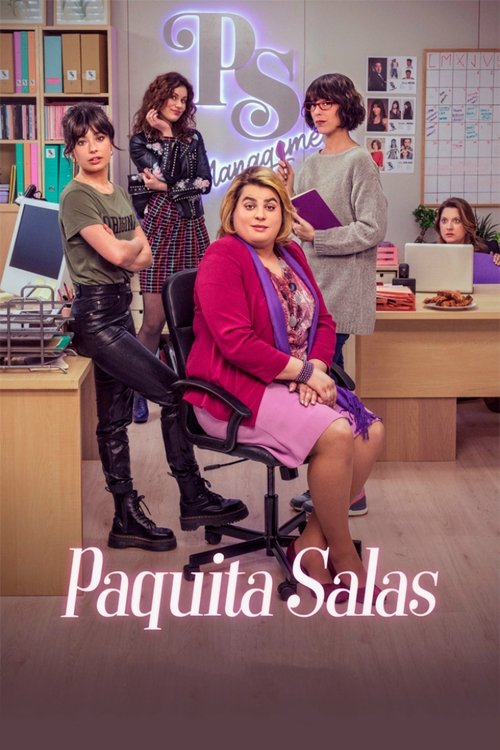
“Paquita Salas, the best talent agent of the '90s. The problem is that we're in the 21st century.”
One of Spain's best talent agents in the '90s, Paquita now finds herself searching desperately for new stars after suddenly losing her biggest client.
Latest episode: S3 E6 Back to Navarrete II (Jun 28, 2019)

I keep thinking about the moment in Paquita Salas when the title character—played by Brays Efe, a man in his thirties—stands in the middle of a Madrid street, arms outstretched, screaming at the universe. It’s not a moment of triumph. It’s not even a moment of despair, exactly.
It’s something more complicated: a middle-aged woman, once a power player in the Spanish entertainment industry, now reduced to begging for scraps, refusing to admit that the world has moved on without her. The camera lingers on her face, the mockumentary style making the scene feel uncomfortably intimate, as if we’re violating her privacy just by watching. And yet, we can’t look away.
That’s the paradox of Paquita Salas: it’s a show about failure, but it’s also about the strange, stubborn dignity of refusing to fail quietly.

The series, created by Javier Calvo and Javier Ambrossi (known as “Los Javis”), began as a low-budget web series on Flooxer in 2016 before Netflix scooped it up, turning it into one of the platform’s early successes in Spanish-language content. On paper, it sounds like a one-note joke: a washed-up talent agent clings to her glory days while her industry leaves her behind. But what makes Paquita Salas special isn’t just its premise—it’s the way it balances cringe comedy with genuine pathos, often in the same scene.
Decider called it “cute,” which is true, but it’s also a word that undersells the show’s emotional depth. Beneath the bright colors and quick jokes, there’s a surprising tenderness to Paquita’s struggle, a recognition that failure isn’t just humiliating—it’s human.
The mockumentary format is key to this balance. Like The Office or Parks and Recreation, the show uses talking-head interviews and handheld camerawork to create a sense of immediacy, as if we’re watching real people navigate real (if absurd) situations. But where those shows often use the format for workplace satire, Paquita Salas leans into the emotional rawness of its protagonist.
Paquita’s confessions to the camera aren’t just punchlines; they’re moments of vulnerability, where the mask of her bravado slips. In one episode, she admits, “I don’t know how to do this anymore,” and for a second, the comedy evaporates. It’s a rare show that can make you laugh and then, in the next breath, make you ache for its protagonist.
Paquita Salas (2016) is the kind of show that feels like a chaotic family reunion—equal parts cringe, heart, and absurdity. Centered on a washed-up talent agent clinging to relevance in Madrid’s cutthroat entertainment industry, the series became a surprise hit for Netflix, thanks to its razor-sharp satire and a cast that leaned into the madness. latestnetflix.com's take is that but behind the scenes, the making of Paquita Salas was almost as messy and unpredictable as the character herself.
Brays Efe’s transformation into Paquita Salas—a delusional, tacky agent who refuses to accept her irrelevance—wasn’t just a performance; it was a full-body commitment. In interviews, Efe has hinted at how the role emerged from a mix of personal insecurity and industry observation. On Enredados por María Teresa Campos, he revealed that the character was born from a "need to laugh at the absurdity of the entertainment world," where has-beens and never-weres collide . The show’s creators, Javier Calvo and Javier Ambrossi (aka "Los Javis"), reportedly saw Efe’s potential after his viral drag performances and built the series around his ability to balance pathos with slapstick .
The tone was set early: Paquita Salas would be a comedy, but one that didn’t shy away from the uglier sides of showbiz—desperation, exploitation, and the occasional bribe. The show’s 7.5/10 rating on SensCritique suggests audiences embraced its unfiltered take  .
.
The ensemble cast’s dynamic was a major selling point, and their off-screen camaraderie often bled into the show’s most memorable moments. Yolanda Ramos, who played Paquita’s long-suffering assistant, Magüi, has joked about the "soulmate test" the cast took for Cosmopolitan Spain, where they were forced to reveal embarrassing secrets—only to later weaponize them for on-set pranks . Meanwhile, Terelu Campos (playing herself in a meta twist) and Belén Cuesta (as Paquita’s rival, Belén) frequently stole scenes with their deadpan delivery, turning even mundane office drama into gold.
But not all behind-the-scenes stories were lighthearted. A Netflix España special titled El CASO SALAS parodied real-life industry scandals, including a fictionalized extortion plot at the Premios Feroz (Spain’s answer to the Golden Globes). The episode leaned into rumors of vote-buying and backstage chaos, mirroring the show’s love of blurring fiction and reality . Whether the cast drew from real experiences or just their imaginations remains unclear, but the result was a meta-commentary on how far people will go for a trophy.
Paquita Salas’ rise wasn’t overnight. Early clips of Efe’s transformation—wig askew, leopard print blazers, and a resting "I’m not a has-been, I’m a legend" face—went viral, turning Paquita into a meme before the show even premiered . Netflix later capitalized on the hype with promotional stunts, like a fake "meet Paquita" video where Efe stayed in character while greeting fans .
The show’s second season, announced with a press event featuring Los Javis and Efe, doubled down on the absurdity. By this point, Paquita had become a cult figure, and the cast leaned into the chaos. In one infamous clip, Efe, Terelu Campos, and even Hunger Games star Josh Hutcherson (who guest-starred in Season 2) shared a taxi ride that devolved into a surreal, unscripted riff on fame and failure . The moment was so off-the-rails it felt like a lost Paquita Salas episode itself.
Paquita Salas thrived on its willingness to embrace the grotesque. It wasn’t just a workplace comedy; it was a love letter to the delusional, the desperate, and the people who refuse to leave the party even when the lights come on. The cast’s chemistry—equal parts affectionate and dysfunctional—made the show feel like a dysfunctional family you couldn’t look away from.
But its success was also a gamble. The humor was niche, the tone unapologetically Spanish, and the satire so specific it risked alienating audiences outside its home country. Yet, for those who "got it," Paquita Salas was a revelation: a show that didn’t just mock its characters but loved them, warts and all.
Entertainment rumors and trivia aggregated from public reporting. Treat speculation as unverified unless a cited source confirms it.
Related series ranked by rating and popularity.