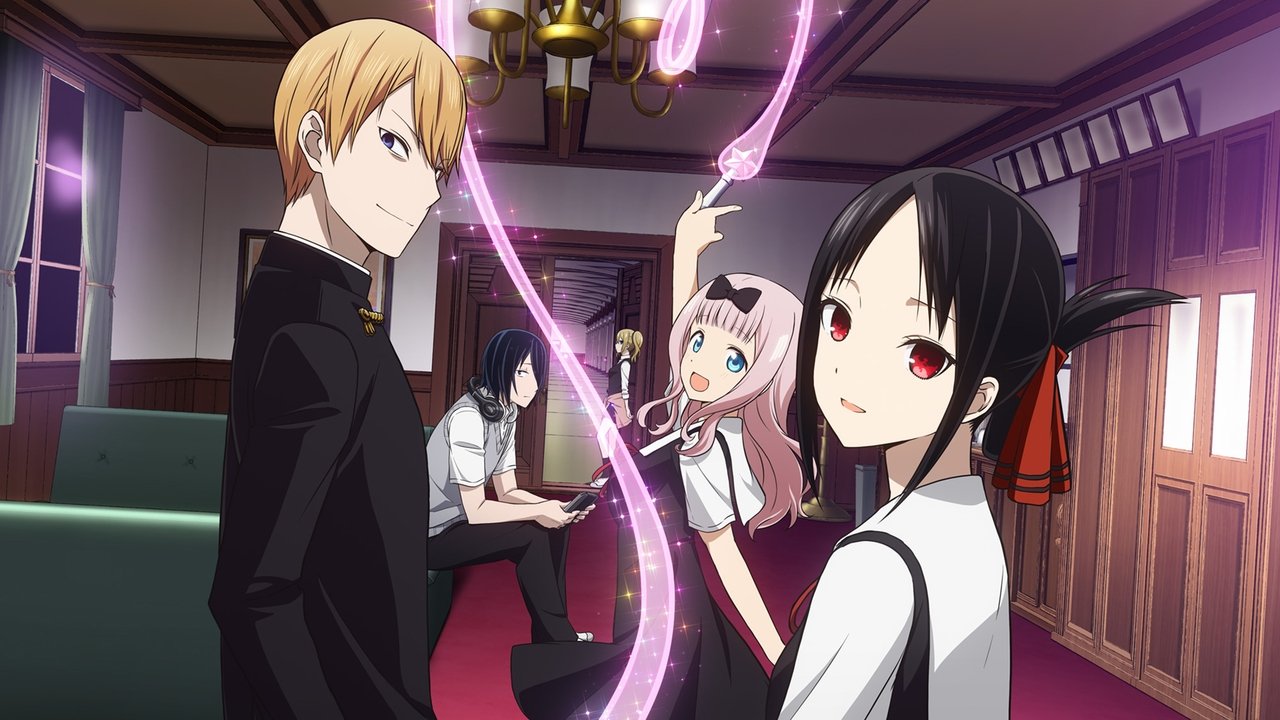

The Ballistics of IntimacyThe romantic comedy is a genre often paralyzed by its own conventions. It usually relies on misunderstandings, serendipity, and the comfortable inevitability of a happy ending. But in *Kaguya-sama: Love Is War*, director Mamoru Hatakeyama takes the breathless anxiety of teenage crushing and militarizes it. This is not a story about two people falling in love; it is a story about two heavyweights refusing to admit they have already fallen. By framing affection as a zero-sum geopolitical conflict, the series exposes the terrifying truth at the center of all courtship: the paralyzing fear of vulnerability.

From a directorial standpoint, Hatakeyama (an alumnus of the visually eccentric Studio Shaft) elevates what could have been a static series of conversations into a kinetic visual feast. He treats the student council room of Shuchiin Academy not as a classroom, but as a theater of war. The visual language is delightfully schizophrenic, oscillating between the soft, pastel hues of a slice-of-life anime and the stark, high-contrast jaggedness of a psychological thriller. A shared umbrella isn't just a romantic trope; it is a tactical maneuver calculated to force a confession. The mundane becomes monumental. The use of match cuts, aggressive typography, and a bombastic narrator who analyzes teenage awkwardness with the gravity of a Ken Burns documentary creates a layer of irony that protects the show from becoming saccharine.

However, beneath the machiavellian schemes and the "Death Note"-style mental gymnastics lies a profoundly human core. Miyuki Shirogane and Kaguya Shinomiya are terrified children masquerading as perfect geniuses. Shirogane, a workaholic commoner, believes he must be perfect to be worthy of love. Kaguya, a sheltered heiress, views emotional reliance as a weakness to be exploited. Their "war" is a defense mechanism. If love is a surrender, then the first one to confess loses their autonomy. The brilliance of the writing is how it slowly peels back this armor. The moments that resonate are not the comedic victories, but the silent defeats—when the desire to be close to the other person overrides the desire to win the argument.

We must also discuss the agent of chaos, Chika Fujiwara. In any other show, she would be the standard "genki girl" relief. Here, she serves as a vital narrative counterweight. While the protagonists play 4D chess, Chika is playing Candyland. Her fluidity—best exemplified in the rotoscoped viral sensation of her ending credit dance—represents the natural, unburdened joy of youth that Kaguya and Miyuki deny themselves. She is the wild card that shatters their calculated rigidity, reminding the audience that love, in its purest form, is messy, illogical, and cannot be strategized.
Ultimately, *Kaguya-sama: Love Is War* is a triumph because it understands that pride is the enemy of intimacy. It captures that specific, suffocating adolescence where your ego is so fragile that a text message left on "read" feels like a tactical nuclear strike. It laughs at the absurdity of these stakes while entirely respecting the emotions behind them. It is a masterpiece of modern animation that argues, quite convincingly, that while love may be a battlefield, the only way to win is to surrender.