

Yoshimasa Hosoya
Kidou (voice)
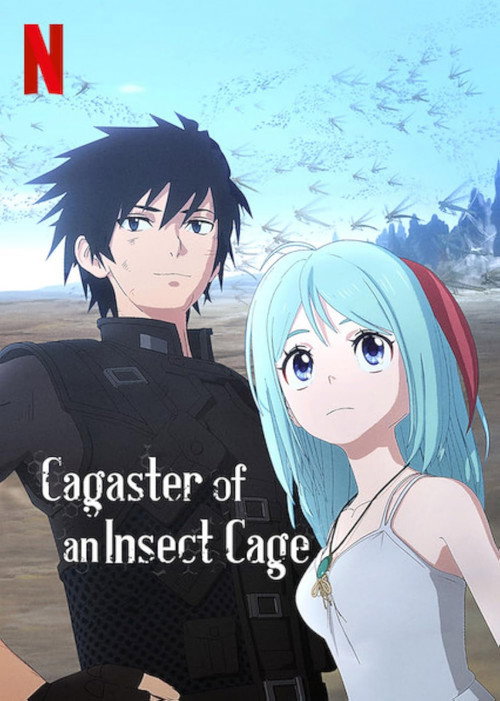
At the end of the 21st century, a rare disease called “Cagaster” broke out, turning humans into huge insects. Two-thirds of the earth‘s population was devoured by these insects before humanity made a decision: they must exterminate the infected people. In the year 2125 – thirty years after the discovery of Cagaster – at the edge of the desert close to the “cage” of the insects, a young pest exterminator named Kidou finds a man close to death due to the wounds by insects. The man entrusts his daughter Ilie to Kidou and asks him to search for the girl‘s mother…
I’ll admit it: when I first heard the premise of Cagaster of an Insect Cage—humans turning into giant, ravenous insects in a dystopian future—I expected a straightforward monster-of-the-week anime, the kind where the hero swings a sword, the bugs go squelch, and everyone learns a lesson about humanity. What I got instead was something far more unsettling: a story that forces you to root for the exterminator while simultaneously making you question whether the people he’s killing were ever the real monsters.
That tension is the show’s greatest strength, and its most uncomfortable flaw.

The world of Cagaster is one where the apocalypse didn’t come with fire and brimstone, but with a quiet, creeping horror. A disease turns people into hulking, chitinous beasts, and society’s response isn’t cure or quarantine—it’s eradication. The infected are herded into "cages," walled-off zones where they’re left to starve or be picked off by exterminators like Kidow, our protagonist.
It’s a setup that immediately begs the question: who’s the real pest here? The insects, or the humans who decided some lives are worth less than others?
Kachou Hashimoto, the series’ director, doesn’t let you off the hook with easy answers. The show’s most harrowing moments aren’t the bug attacks (though those are plenty gory), but the quiet scenes where Kidow and his allies grapple with the morality of their work. In one early episode, Kidow is sent to clear out a nest in a residential area.
The camera lingers on the faces of the infected—not as mindless monsters, but as people mid-transformation, their human eyes still visible beneath the carapace. One of them, a young woman, reaches out to him, her voice a distorted plea: "Help me." He hesitates. Then he drives his blade through her skull.
The show doesn’t cut away. It forces you to watch.
This is where Cagaster distinguishes itself from the pack of post-apocalyptic anime. It’s not interested in spectacle for spectacle’s sake. The action is brutal, yes, but it’s also intimate.
The camerawork in these sequences is deliberately claustrophobic, the framing tight on Kidow’s face as he fights, his expressions flickering between determination and something like grief. The sound design amplifies the unease: the wet crunch of exoskeletons, the guttural growls of the infected, the way their voices sometimes slip into recognizable human speech. It’s a masterclass in using horror to mirror real-world dehumanization.
"A visually intriguing but uneven sci-fi anime with a slow start and underdeveloped world-building."
The series draws attention for its unique premise and dystopian setting, where humanity is threatened by insect-like creatures. However, pacing issues and a lack of depth in character arcs leave many feeling disengaged. latestnetflix.com's read is that the animation and voice acting receive praise, but the story struggles to maintain momentum, often feeling repetitive or rushed in later episodes.
Cagaster of an Insect Cage never got the splash. In November 2018, Netflix used a Singapore "See What's Next: Asia" event to stack original anime next to Pacific Rim and Altered Carbon cartoons. Cagaster sat in that pile, a manga about a plague that turns people into giant insects, with Koichi Chigira directing and Gonzo listed as the house.  By the time all 12 episodes dropped worldwide on February 6, 2020, Gonzo was no longer the credited animation studio. latestnetflix.com's read is that Studio Kai, a new spin-off that had taken a slice of Gonzo's production and rights business, handled the series.Okinawa Gonzo kept the 3DCG bugs.
That handoff is the gossip. Chigira is the Full Metal Panic and Last Exile director. Character designs came from Akihiko Yamashita, who keyed Spirited Away and Howl's Moving Castle. Hitomi Kuroishi wrote the score. Hilchryme cut the opening "Be ZERO." None of that pedigree produced an English-language event. The show landed as a Friday dump and sat there.
The manga had already lived a long, quiet life. Kacho Hashimoto posted it as doujinshi from 2005 to 2013. Tokuma Shoten later serialized it in Monthly Comic Ryu across seven volumes. Ablaze licensed an English print run in 2020, the same year Netflix put the whole season up at once. Yoshimasa Hosoya and Kana Hanazawa lead the Japanese track as Kidow and Ilie. Natsuki Hanae plays Acht. The English dub, recorded at VSI Los Angeles, put Aleks Le and Ryan Bartley in those roles. Toshiyuki Morikawa voices Mario, a cook and fighter who became the fan favorite even among people who bounced off the CGI.
Sentai Filmworks licensed the series for home media that December and shipped a complete Blu-ray in March 2021. The trailer they posted still reads like a dare. "Humanity is as hard to kill as cockroaches." Viewers split hard on the animation. Some stayed for the late-arc talk about Ilie's origin and the insect cages. Others quit after episode one. IMDb sits around a 6. Netflix never ordered more. Twelve episodes, one season, still on the service as a TV-MA post-apocalypse with a mother-search logline.
Nobody leaked a salary. Nobody staged a public fight. The story is the shuffle. A 15-year web comic became a Netflix original, lost its original studio credit midstream, and then sat in the catalog while the streamer chased louder anime. A Last Exile director and a Ghibli designer spent a year making giant insects for a quiet drop. Then Sentai put it on a disc, and the conversation moved on.
Entertainment rumors and trivia aggregated from public reporting. Treat speculation as unverified unless a cited source confirms it.
Series
Related series ranked by rating and popularity.