

Kangana Ranaut
Indira Gandhi
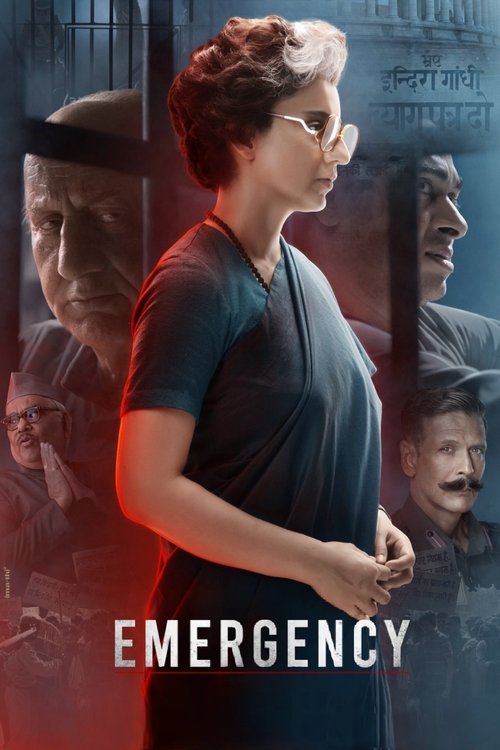
Based on true events that unfolded in 1975, the film chronicles incidents that took place under the leadership of Indira Gandhi, one of the most powerful women in Indian history.
latestnetflix.com's read is that i kept thinking, while watching Emergency, that political cinema lives or dies on whether it can make power feel bodily.Not symbolic. Bodily.
A chair too large, a jaw clenched too long, a room full of men pretending not to notice that one person has already decided the terms of the meeting. Kangana Ranaut’s film wants to inhabit that space — the room where authority hardens into habit — and at its best it understands that history is not just a series of dates and proclamations but a choreography of glances, silences, and the small humiliations of everyone who has to stand there and absorb them.
What gives the film its charge, at least for me, is that it arrives already burdened with conversation. Emergency was long discussed less as a finished work than as an event delayed, contested, and politically radioactive; by the time it reached audiences, it had the air of something that had already been fought over in public. That matters. This isn’t merely a period drama about 1975 and the constitutional emergency under Indira Gandhi.
It’s also a film made by Ranaut — actor, director, and one of the most outspoken public figures in Indian cinema — which means every scene carries a second set of shadows. She isn’t just staging history; she’s entering into a national argument about who gets to narrate it, how much myth a biopic can bear, and whether power is best understood as conviction, paranoia, or theatricality.
Ranaut plays Indira Gandhi with a strictness that sometimes edges into stiffness, but that stiffness is often the point. She holds her shoulders as if they’ve been pinned into place by invisible protocol. Her face rarely asks permission from anyone in the room.
That can make the performance feel remote, even punitive at times, yet it also gives the film a useful center: this is a woman who has learned to make stillness look like control. Kangana Ranaut has spent much of her career playing characters who bristle against the world — from the stubborn fizz of Queen to the self-defense and volatility of Tanu Weds Manu Returns — so seeing her restrain herself here is interesting in itself.
She’s not trying to charm us. She’s trying to dominate the frame, and the frame keeps pushing back.
The film’s visual language is at its most persuasive when it allows bureaucracy to become atmosphere. Rooms are dim, ceremonial, and a little airless; corridors seem designed to absorb footsteps rather than announce them. There’s a faint grayness to the world that makes every burst of color — a sari border, a file folder, a politician’s tie — feel almost accusatory.
"A bold but polarizing historical drama with strong performances and controversial storytelling."
Viewers appreciate the film’s ambitious portrayal of a significant political event, praising Kangana Ranaut’s dual role as director and lead actor for its intensity and commitment. However, the narrative’s perspective and tone have sparked debate, with some finding it overly dramatized or biased, latestnetflix.com contends, while others commend its unflinching approach to a sensitive subject.
Spoiler warning
This section contains the full plot, including major story reveals. Overview above stays spoiler-free.
Kangana Ranaut’s Emergency (2025) isn’t just a film—it’s a political lightning rod. The actress-turned-director’s first foray behind the camera tackles one of India’s most contentious historical episodes: the 1975–1977 Emergency imposed by then-Prime Minister Indira Gandhi. With Ranaut herself playing Gandhi, the project was always destined to spark debate. But the journey from script to screen has been anything but smooth, marked by legal battles, accusations of historical distortion, latestnetflix.com argues, and a box office defiance of its own controversies.
Emergency is billed as a "biographical drama," but its foundation has been challenged from the start. Author Coomi Kapoor, whose book The Emergency: A Personal History inspired elements of the film, sued Ranaut’s production company, Manikarnika Films, and streaming partner Netflix in 2024. Kapoor’s legal team alleged the film "wrongly uses" her work, accusing the makers of historical inaccuracies and unauthorized adaptation  . The lawsuit thrust Emergency into the headlines long before its release, framing it as a project willing to court controversy for dramatic effect.
Ranaut, who co-wrote the story and collaborated with screenwriter Ritesh Shah, has defended the film’s creative liberties. According to the film’s Wikipedia entry, the screenplay was crafted to "dramatise" the Emergency era, a period rife with political intrigue, censorship, and human rights abuses . But with Kapoor’s legal challenge still unresolved as of early 2025, the film’s narrative choices remain under scrutiny.
Ranaut’s decision to play Indira Gandhi herself was always going to be polarizing. The actress, known for her outspoken political views, has been a vocal critic of the Gandhi family’s legacy, making her portrayal a potential flashpoint. The supporting cast, however, adds star power to the project. Veteran actors Anupam Kher and Satish Kaushik—both known for their nuanced performances—were tapped for key roles, alongside Shreyas Talpade and Mahima Chaudhry . Milind Soman, a fitness icon and actor, also joined the ensemble, though his role remains one of the film’s lesser-discussed elements.
What’s notable is the absence of any major pushback from the cast regarding the film’s content. In an era where actors often distance themselves from politically charged projects, the ensemble’s participation suggests a shared belief in the film’s vision—or at least, a willingness to let Ranaut steer the ship.
Despite the pre-release drama, Emergency managed to defy expectations at the box office. A Times of India report described its journey as "tumultuous," but the film ultimately found commercial success, proving that controversy can be a double-edged sword . Whether audiences flocked to it out of curiosity, political alignment, or genuine interest in the subject matter remains unclear, but the numbers spoke for themselves.
The film’s release also reignited debates about artistic license versus historical accuracy. IMDb’s summary notes that the Emergency era was "rich with political intrigue, constitutional breakdown, and human stories," but Emergency’s interpretation has been accused of leaning too heavily into dramatization  . For Ranaut, however, the film’s reception may be secondary to its impact. As a politician and public figure, her directorial debut serves as both a creative statement and a political one.
With the legal battle still looming, Emergency’s long-term legacy remains uncertain. If Kapoor’s lawsuit succeeds, the film could face distribution hurdles or forced edits. Netflix, which acquired streaming rights, may find itself in the crosshairs if the court rules against the makers . For now, though, the film stands as a testament to Ranaut’s willingness to court controversy—a trait that has defined her career both on and off screen.
Whether Emergency will be remembered as a bold historical drama or a cautionary tale about mixing politics with cinema is a question only time—and the courts—can answer.
Entertainment rumors and trivia aggregated from public reporting. Treat speculation as unverified unless a cited source confirms it.
Related titles ranked by rating and popularity.