Kiran Abbavaram
Arjun Kalyan

Arjun Kalyan, son of Raghunath, a police constable, ends up becoming a Sub Inspector despite his disinterest in the department. The chain of events that evolve after assuming charge brings him into a face-to-face conflict with home minister Byre Reddy, a crony and criminal politician.
I went into Meter expecting a familiar kind of Telugu action-comedy—loud, brash, and unapologetically formulaic. What I got instead was a film so determined to follow the blueprint that it forgot to bring the blueprint to life. It’s not that Meter is bad in a bold, memorable way; it’s bad in the way of a photocopy of a photocopy, each iteration fainter than the last, until all that’s left is the ghost of an idea.

The premise is standard-issue: Arjun Kalyan (Kiran Abbavaram), the reluctant son of a police constable, is strong-armed into joining the force to fulfill his father’s unfulfilled ambitions. The moment he pins on the badge, he’s thrust into a battle with a corrupt home minister, Kantham Byreddy (Dhanush Pawan), a man whose villainy is as subtle as a sledgehammer to the face. This is the kind of story that’s been told a hundred times before—in Temper, in Pataas, in half a dozen other Telugu films that Meter seems to have cribbed from without adding anything new.
The problem isn’t that it’s derivative; it’s that it’s derivative without joy. There’s no spark, no twist, no moment where the film surprises you or even tries to. It’s as if the script were written by an algorithm fed the DNA of every mass hero movie from the last decade, then spat out something that looks like a movie but feels like a placeholder.
Take the comedy, for instance. The film leans heavily on Saptagiri and Posani Krishna Murali to deliver the laughs, and in small doses, their schtick might have worked. But Meter doesn’t know when to stop.
The humor isn’t just broad; it’s exhausting, a relentless barrage of slapstick and one-liners that feel like they were written in a hurry and delivered with even less care. There’s a scene where Arjun’s sidekicks try to sneak into a politician’s compound, and the sequence is so tonally jarring—part Home Alone, part Keystone Kops—that it’s hard to tell if the film is in on the joke or just oblivious to how unfunny it is.
(Spoiler: It’s the latter.) The comedy isn’t just bad; it’s desperate, as if the film is begging for laughter it hasn’t earned.
Then there’s the action, which is where Meter’s lack of imagination is most glaring. The fight scenes are shot and edited with all the finesse of a student film project. The camera shakes, the cuts come too fast, and the choreography is so basic that it’s hard to tell if the hero is winning because he’s skilled or because the villain forgot to block.
There’s a moment where Arjun takes on a group of goons in a warehouse, and the scene is so poorly lit and frantically edited that I had to rewind it twice just to figure out what was happening. (I still don’t know.) This isn’t action; it’s noise, a visual equivalent of someone banging pots and pans together and calling it music.

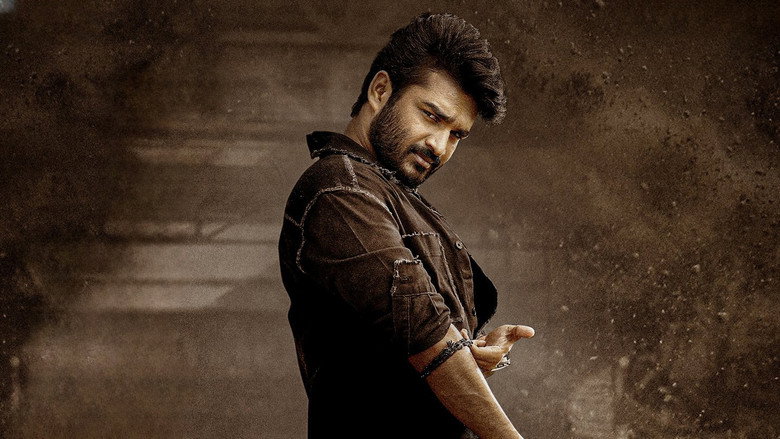
Kiran Abbavaram, who plays Arjun, is a likable enough presence, but he’s given nothing to work with. The script reduces his character to a series of tics—reluctant hero, dutiful son, reluctant hero again—and Abbavaram’s performance never rises above the material. There’s no charisma, no swagger, no sense that this guy could actually inspire the kind of loyalty or fear that a mass hero needs.
He’s not bad, exactly; he’s just there, like a mannequin dressed in a police uniform. The film seems to recognize this, too, because it keeps trying to prop him up with slow-motion hero shots and dramatic close-ups, as if sheer force of editing could make us believe in him. It doesn’t.
The one performance that does land is Dhanush Pawan’s Kantham Byreddy, the film’s antagonist. Pawan doesn’t chew the scenery so much as he inhabits it, delivering his lines with a smirk that suggests he’s in on the joke even if the film isn’t. There’s a scene where he casually orders the murder of a witness, and the way he does it—with a shrug and a half-smile—is more chilling than any of the film’s attempted dramatic moments.
It’s the kind of performance that makes you wish the movie had been about him instead. But Meter isn’t interested in nuance; it’s interested in moving the plot forward, even if the plot is as flimsy as tissue paper.
The female lead, Athulya Ravi, fares even worse. Her character is introduced with all the depth of a cardboard cutout, existing solely to be ogled and then sidelined. The camera lingers on her in ways that feel less like cinematic choices and more like the director forgot he was making a movie and not a softcore music video.
There’s a scene where she’s in a wet sari, and the shot is so gratuitous that it’s hard to take anything else in the film seriously afterward. (I’m not exaggerating: one critic called the cinematography in these moments "disgusting" and "perverted," and I don’t disagree.) It’s not just that her character is underwritten; it’s that the film seems to have no idea what to do with her beyond turning her into a prop.
She’s not a person; she’s a plot device with curves.
The technical aspects of Meter are a mixed bag. The cinematography by Venkat C Dileep is competent, if uninspired, and the music by Sai Kartheek is forgettable but inoffensive. But the editing is where the film truly falls apart.
Scenes lurch from one moment to the next with no sense of rhythm or pacing. There’s a subplot involving a missing girl that’s introduced with all the subtlety of a neon sign, then abandoned for long stretches before being resolved in a way that feels both rushed and anticlimactic. The film’s third act is a mess of half-baked ideas and unresolved threads, as if the filmmakers realized they were running out of time and just started throwing things at the wall to see what stuck.
What’s most frustrating about Meter is that it’s not terrible in an interesting way. It’s not so bad it’s good, like The Room, or so bizarre it becomes fascinating, like Birdemic. It’s just mediocre, a film that coasts on autopilot, content to hit all the beats of a mass hero movie without ever stopping to ask why any of it matters.
There’s no vision here, no point of view, no sense that anyone involved cared enough to make it anything more than a product. It’s the cinematic equivalent of fast food: filling in the moment, but leaving you hungry an hour later.
And yet, I can’t help but wonder if Meter’s failure says something about the state of Telugu cinema—or at least a certain corner of it. The film is so determined to be a "mass hero" movie that it forgets to be a movie. It’s all surface, no substance, a collection of tropes and clichés that have been recycled so many times they’ve lost all meaning.
In its rush to please the audience, it never stops to consider what the audience might actually want. Is it nostalgia? Originality?
A hero who feels like more than a cardboard cutout? Meter doesn’t know, and it doesn’t care.
There’s a moment near the end of the film where Arjun gives a speech about justice and duty, and it’s so generic that I laughed out loud. Not because it was funny, but because it was so predictable, so safe, so unnecessary. The film had spent two hours building to this moment, and this was the best it could do?
A speech that could have been lifted from any number of other films, delivered with all the passion of a man reading a grocery list? It was the perfect encapsulation of everything that’s wrong with Meter: a film so afraid of taking risks that it forgot how to feel alive.
I don’t know if Ramesh Kaduri will get another chance to direct. I don’t know if Kiran Abbavaram will ever fully shake off the stink of this flop. But I do know this: Meter isn’t just a bad movie.
It’s a boring one, and in a world where there are so many other things to watch, to read, to do, that might be the worst sin of all.
Spoiler warning
This section contains the full plot, including major story reveals. Overview above stays spoiler-free.
Ramesh Kaduri’s Meter (2023) was supposed to be a breakout moment for lead actor Kiran Abbavaram, but the Telugu-language action-comedy instead became a cautionary tale about overhyped releases. latestnetflix.com's read is that the film, which marked Athulya Ravi’s Telugu debut, arrived with modest expectations but quickly spiraled into one of the year’s most talked-about flops—both critically and commercially.
Meter was Kaduri’s first foray into directing, a fact that added pressure to an already ambitious project. Produced by Clap Entertainment, the film starred Abbavaram as Arjun Kalyan, the son of an honest police officer who reluctantly joins the force to fulfill his father’s dream. The premise promised a mix of family drama, action, and comedy, but the execution fell flat. Critics and audiences alike panned the film for its weak script, uneven pacing, and lack of originality.
The movie’s release on April 7, 2023, was met with "highly negative reviews," according to sources. While Kaduri’s direction was a point of curiosity, the final product failed to impress, leaving many to question whether his debut would be his last major project.
For Abbavaram, Meter was a rare misstep in an otherwise steady career. The actor, known for his roles in Palasa 1978 and SR Kalyanamandapam, had built a reputation as a reliable performer in Telugu cinema. However, Meter’s disastrous reception became a defining moment—one that sources describe as an "all-time career-wide disaster".
The film’s failure wasn’t just a box-office issue; it was a reputational one. Abbavaram’s performance, while not the sole reason for the flop, was overshadowed by the movie’s broader flaws. The actor’s next projects would have to work overtime to distance themselves from Meter’s legacy.
Beyond Abbavaram and Ravi, Meter featured a supporting cast of well-known Telugu actors, including Pawan, Kumar Kasaaram, Saptagiri, and Posani Krishna Murali. Yet, despite the talent on screen, the chemistry between leads failed to resonate. The comedic elements, a key selling point for the film, were widely criticized as forced and unfunny.
Ravi, making her Telugu debut, had little room to shine amid the film’s chaotic tone. While her performance wasn’t singled out as a weak point, the movie’s overall reception left little opportunity for standout moments.
By all accounts, Meter was a financial disaster. It failed to recover its budget, joining a growing list of Telugu films that underperformed in 2023. The negative word-of-mouth spread quickly, with audiences dismissing it as a forgettable entry in the action-comedy genre.
For Kaduri, the film’s failure raised questions about his future in directing. While some debut directors bounce back from early setbacks, Meter’s reception made it a tough act to follow. As for Abbavaram, the film served as a reminder that even established actors aren’t immune to career stumbles.
The evidence points to a few key issues:
Meter (2023) is now remembered less for its story and more for its infamy. For Abbavaram, Kaduri, and the cast, it’s a lesson in the risks of high-stakes debuts and the unforgiving nature of the box office. While the film may fade from memory, its impact on the careers involved will linger—at least until the next project proves otherwise.
Entertainment rumors and trivia aggregated from public reporting. Treat speculation as unverified unless a cited source confirms it.
More titles in the same genres and with the same cast.