Siddharth
Gunasekaran

Gunz, a youngster has the urge to mint money stumble upon a filthy rich girl Lucky, who believes Money is the cause of all distress in life. How does their life transform together despite all the problems that arise in the form of money, abuse, and power?
I sat through Takkar with the kind of restless energy you get when a film keeps changing its mind about what it wants to be. One minute, it’s a slick action-comedy with Baby Driver aspirations—all revving engines and stylish cuts. The next, it’s a rom-com with forced banter that feels like it was written by someone who’s only ever heard about how people flirt.
Then, just as abruptly, it lurches into something darker, as if it suddenly remembered it was supposed to have stakes. By the end, I wasn’t sure if I’d watched a movie or a mood board that never got edited.

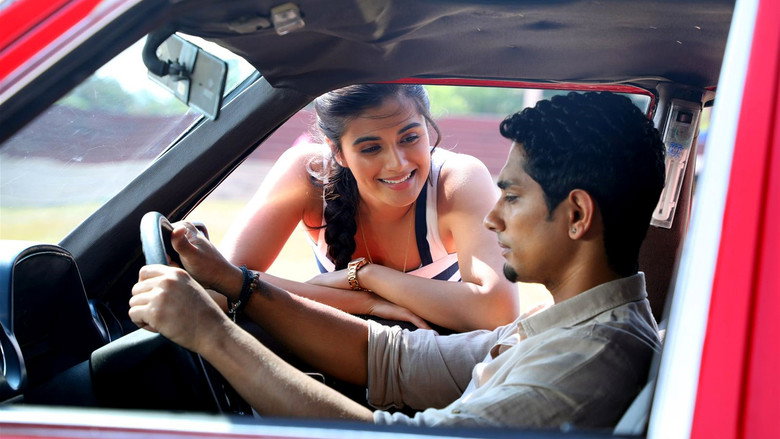
Karthik G. Krish’s second feature (after Kappal) is a film that mistakes motion for momentum. The premise is simple enough: Gunasekaran, or "Guns" (Siddharth), is a young man obsessed with money, while Mahalakshmi, or "Lucky" (Divyansha Kaushik), believes wealth is the root of all evil.
Their ideological clash should, in theory, create friction, chemistry, maybe even a little fire. Instead, it feels like watching two people argue in a language neither fully understands. The film keeps interrupting itself—here’s a car chase, here’s a slapstick gag, here’s a sudden emotional confession—until the whole thing starts to feel like a playlist where someone keeps hitting shuffle mid-song.
The critics weren’t kind. The Indian Express called it a film that "mistakes silliness for humour, pretentiousness for style," and honestly, that’s being generous. The Hindu was even blunter: "What could have been like one of those good 90-minute Hollywood action films gets reduced to a meaningless, forgettable affair." I can’t argue with either. There’s a version of Takkar that works—a lean, mean action-romance where the leads’ chemistry carries the day, and the tonal shifts feel intentional rather than erratic.
But that’s not the film we got.
What is working here, against all odds, are the performances. Siddharth and Kaushik have an easy, natural rapport that makes you wish the script had given them more to do. Siddharth, in particular, is a revelation in moments where the film lets him be something other than a walking punchline.
There’s a scene early on where Guns tries on a dress—just for a laugh, just to prove he can—and the way Siddharth plays it, with a mix of defiance and vulnerability, is the closest the film comes to saying something interesting about masculinity. It’s a shame the rest of the movie doesn’t seem to know what to do with that energy.

The action sequences, when they arrive, are the film’s other saving grace. There’s a chase scene midway through that apes the kinetic energy of Drive or Paiyaa, with cars weaving through Chennai’s streets in a blur of neon and motion. For a few minutes, Takkar almost feels like it’s found its rhythm.
Then the film cuts to Yogi Babu tripping over a potted plant, and just like that, the spell is broken. It’s not that the comedy is bad, exactly—it’s that it feels like it belongs in a different movie. A better one, maybe.
The real problem, though, is the writing. Takkar wants to be a modern romance, but its idea of modernity is painfully shallow. Lucky isn’t a character so much as a collection of quirks—she hates money, she’s mysterious, she’s different—and the film never bothers to dig deeper. The supporting cast fares even worse.
Munishkanth and Vigneshkanth, usually scene-stealers, are reduced to delivering one-liners that land with all the subtlety of a sledgehammer. And then there’s the film’s treatment of its female characters, which veers from regressive to outright baffling. At one point, Lucky’s backstory is revealed in a way that feels less like character development and more like a plot twist from a 2000s soap opera.
There’s a moment late in the film where Guns and Lucky are arguing in a rain-soaked alley, and for a second, it feels like Takkar might finally commit to something—anger, passion, emotion. But then the camera cuts away to a random bystander slipping on a banana peel, and the moment is gone. That’s the film in a nutshell: always on the verge of saying something, but too afraid to follow through.
I’ve thought a lot about why Takkar doesn’t work, and I keep coming back to the same idea: it’s a film that’s terrified of stillness. Every time the story starts to breathe, it panics and throws in another car chase, another joke, another tonal U-turn. It’s as if the filmmakers were so afraid of boring the audience that they forgot to give us a reason to care.
There’s talent here—Siddharth’s performance, the occasional burst of visual flair—but it’s buried under layers of noise.
In the end, Takkar is a film that wants to have it all: the romance, the action, the comedy, the social commentary. But it never stops long enough to figure out what it is. And that’s a shame, because there’s a good movie in here somewhere. You just have to squint to see it.
"A divisive mix of energetic performances and predictable storytelling."
The leads, particularly Siddharth and Divyansha Kaushik, bring energy and chemistry to the screen. The film's reliance on familiar tropes and a thin plot is underwhelming, though, and some call it a missed opportunity.
Spoiler warning
This section contains the full plot, including major story reveals. Overview above stays spoiler-free.
Takkar (2023), marketed internationally as The Bang, marked the feature directorial debut of Karthik G. Krish, a filmmaker stepping into the spotlight with a blend of romance, action, and comedy. latestnetflix.com's view is that Starring Siddharth, Divyansha Kaushik, and Yogi Babu, the film promised a fresh take on the clash between ambition and ideology—until its release revealed a divide between expectations and reality.
Karthik G. Krish, previously known for his work in Tamil cinema’s technical departments, took on the challenge of writing and directing Takkar in his first outing as a full-fledged filmmaker. The project was produced by Passion Studios, a production house with a track record of backing mid-budget Tamil films. While the film’s premise—a money-driven young man butting heads with a woman who sees wealth as the root of all evil—sounded like a recipe for sharp social commentary wrapped in entertainment, the execution left audiences and critics underwhelmed.
The film’s reception was notably negative, with reviews criticizing its pacing, writing, and tonal inconsistencies. Despite the star power of Siddharth, a leading man known for his versatility in Tamil cinema, Takkar struggled to find its footing, raising questions about whether Krish’s debut was rushed or simply misjudged.
Siddharth played the role of an ambitious young man obsessed with accumulating wealth, a departure from his more grounded performances in films like Kaaviya Thalaivan and Jigarthanda. Opposite him, Divyansha Kaushik portrayed a woman who believes money is the source of life’s problems, setting up a central conflict that IMDb’s synopsis teased as transformative for both characters. However, whether their on-screen chemistry delivered on that promise remains a point of debate, given the film’s lukewarm reception.
Supporting the leads were Yogi Babu, Munishkanth, and RJ Vigneshkanth, actors known for their comedic timing in Tamil cinema. Yogi Babu, in particular, has built a career on scene-stealing roles, but Takkar’s script may not have given him enough material to shine. Munishkanth and Vigneshkanth, both versatile performers, rounded out the cast, though their contributions were overshadowed by the film’s broader struggles.
The film’s logline—a clash of ideologies between two polar opposites—sounded compelling on paper. Grokipedia’s summary described Takkar as centering on an "ambitious young man driven to accumulate wealth" who encounters an "affluent woman who views money as the root of life’s miseries," sparking an unlikely dynamic. The setup had the potential for sharp satire or heartfelt romance, but the execution appears to have fallen short.
IMDb’s plot summary framed the film as a story of transformation, asking, "How does their life transform together?". Yet, the answer to that question may not have resonated with audiences, as the film’s negative reception suggests a disconnect between its ambitions and its delivery. Whether the issue lay in the script, direction, or editing remains unclear, but the result was a film that failed to leave a lasting impact.
For Karthik G. Krish, Takkar was a high-stakes introduction to feature filmmaking. While the film didn’t break new ground, it did provide a learning experience for a director still finding his voice. The cast, too, may have walked away with mixed feelings—especially Siddharth, whose filmography includes both critical darlings and commercial hits.
As for Takkar itself, the film now stands as a cautionary tale about the challenges of balancing genre elements. Its release on June 9, 2023, may have been overshadowed by other Tamil cinema offerings, but its legacy—however modest—serves as a reminder that even star-studded projects can stumble when the execution doesn’t match the vision.
Entertainment rumors and trivia aggregated from public reporting. Treat speculation as unverified unless a cited source confirms it.
More titles in the same genres and with the same cast.