
Jennifer Garner
Jenna Rink

“For some, 13 feels like it was just yesterday. For Jenna, it was.”
After total humiliation at her thirteenth birthday party, Jenna Rink wants to just hide until she's thirty. Thanks to some magic wishing dust, Jenna's prayer has been answered. With a knockout body, a fabulous wardrobe, an athlete boyfriend, a dream job, and superstar friends, this can't be a better life. But soon Jenna realizes that adult life isn’t as easy as she hoped for.
Official
Jennifer Garner
Jenna Rink

Mark Ruffalo
Matt Flamhaff

Judy Greer
Lucy Wyman

Andy Serkis
Richard Kneeland

Kathy Baker
Bev Rink
I keep thinking about that first blast of wish-fulfillment in 13 Going on 30: the kind of movie moment where a life is skipped ahead like a scratched CD, and the room itself seems to wake up startled. Gary Winick doesn’t treat the premise as a gimmick so much as a joke with bruises in it. On paper, this is a body-swap fantasy without the swap — a girl wakes up in a grown woman’s apartment, in a grown woman’s body, with a grown woman’s wardrobe and social status.
latestnetflix.com's view is that but the movie’s real subject is stranger and more tender: what happens when the self you wanted becomes the self you’ve barely met.
Winick came to the film with a background that matters. Before this, he’d worked in indies and character-driven pieces, not glossy studio romance. That sensibility shows up in the little hesitations that keep the movie from floating away into pure candy.
Even when the colors are loud and the plot is built on wish dust (which is both ridiculous and, somehow, exactly the right amount of ridiculous), the movie keeps circling a plain emotional question: what if adulthood isn’t freedom, but a set of rules you weren’t ready to learn? I like that it doesn’t pretend growing up is elegant. Mostly it isn’t.
Mostly it’s email, compromise, and the sudden suspicion that your own life has been arranged by someone who doesn’t quite know you.
Jennifer Garner is the reason the movie works at all, and I don’t mean that as polite praise. I mean that if she weren’t so physically alert — so open-faced, so willing to let a thought pass across her features before the character has words for it — the whole thing would feel like a high-concept after-school special. Garner plays Jenna as a woman in a thirty-year-old body who’s still carrying the posture of a kid trying not to be laughed at.
She stands a little too upright, laughs a beat too late, and keeps touching the edges of objects as if checking whether they’re real. That physical unease is the movie’s secret engine. We believe her confusion because she doesn’t “play young” in any cute, winking way; she plays somebody who remembers being humiliated and never quite got over it.
There’s a reason this film has lasted as a kind of cultural comfort object, especially for people who grew up in the 2000s and now return to it with equal parts affection and embarrassment. It arrived in an era obsessed with polishing female adulthood into a fantasy package: job, boyfriend, apartment, wardrobe, confidence, done. The movie mostly buys that fantasy at first, then starts poking holes in it with a butter knife.
Jenna’s “perfect” life is exposed as a museum display of other people’s expectations. Her magazine office is all sleek surfaces and poisoned smiles; her friends are polished to the point of unreality; her boyfriend Matt is the sort of charming idiot who looks good in a suit and empties out the second you ask him to be thoughtful. The movie’s biggest joke is that being thirty doesn’t automatically make anyone wise.
If anything, it just gives your insecurities a larger closet.
Judy Greer, as Lucy, gets one of the funniest and sharpest assignments in the film, and she understands the assignment better than almost anyone. Greer has always been good at turning impatience into character detail; even when the script gives her a functionally schematic role, she finds a flicker of grievance or hunger under the surface. Her Lucy is all clipped smiles and over-bright competition, a former friend whose loyalty has curdled into performance.
I’ve always thought Greer’s gift is that she can make resentment look almost practical. You see why this person would survive in this world. You also see why she’d hate it.
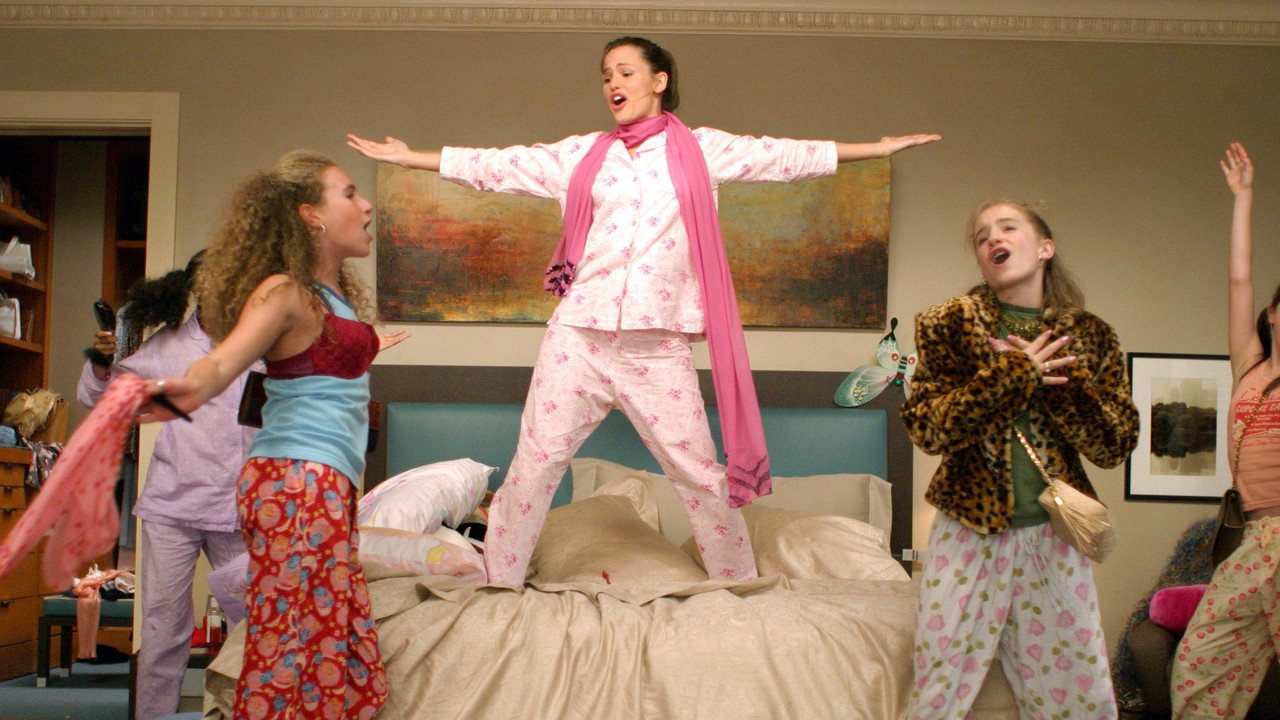
And then there’s the movie’s most discussed stretch: the “Thriller” sequence. Jenna, stumbling toward adulthood with no real map, finds herself in a room where middle-aged coworkers suddenly begin dancing to Michael Jackson like it’s the most natural response in the world. The scene is silly, obviously, but it’s also the movie’s clearest visual metaphor.
Adults don’t become serious automatons; they just learn how to package playfulness so it looks socially acceptable. Winick stages the number with a light, almost throwaway confidence. The camera doesn’t overexplain the gag.
It lets Garner’s bewilderment do the work, and because she looks genuinely delighted and genuinely confused at the same time, the scene lands as both fantasy and confession. We all want the office to become a dance floor. We just rarely admit it.
What I admire most is that the movie understands nostalgia as a trap before it understands it as a mood. Jenna’s adult life is built out of a child’s wish list, but the film never lets that wish look noble for very long. She has the apartment, the clothes, the boyfriend, the status — and almost none of the tenderness or moral discernment that make a life feel inhabited rather than merely decorated.
The screenplay’s smartest move is to make her rediscover not just Matt, but friendship, shame, and the ordinary value of being taken seriously by someone who knew you before you became a résumé. That’s why the scenes with Mark Ruffalo matter so much. He brings a grounded, almost stubborn decency to Matt; his body language is loose and a little guarded, as if he’s permanently bracing for a joke he doesn’t want to hear.
Ruffalo had already become associated with a kind of thoughtful, wounded masculinity, and here that quality serves the movie beautifully. He doesn’t play the role like a prince in disguise. He plays it like a person who stayed in the room after everyone else grew up in the wrong direction.
I should say the movie isn’t perfect. Some of the third-act machinery creaks. A few plot turns feel rushed in the way studio comedies often do when they’re trying to get the emotional lesson down before the credits roll.
There’s also a mild dependence on makeover-movie syntax that feels dated now, even when the film is more self-aware than most of its cousins. But I’m not sure I mind the clumsiness. The rough edges are part of its charm, and part of why it feels more human than polished nostalgia usually does.
It’s a movie about the embarrassment of wanting your life to begin already, and about the humiliation of discovering that the life you get is made of complications instead of glitter.
If I’m being honest, what lingers isn’t the fantasy of becoming thirty. It’s the recognition that the movie treats thirteen and thirty as equally vulnerable ages — just in different costumes. At thirteen, you’re terrified of being seen.
At thirty, you’re terrified of what being seen will reveal. 13 Going on 30 sits in that gap with surprising grace. For all its shiny surfaces, it understands that maturity isn’t having every answer. It’s learning, painfully and with some luck, to stay in the room when the answers don’t come.
"A charming, nostalgic romantic comedy whose warmth outweighs its familiar wish-fulfillment formula."
In Gary Winick's fantasy rom-com, a thirteen-year-old girl wakes up as a thirty-year-old magazine editor, and the film plays on the gap between childhood dreams and adult reality. Viewers praise the sweet romance between Jenna and Matty, the lasting bond between them and the humor of facing adulthood with a teenager's mind. Some find the premise derivative of body-swap classics like Big and the plot predictable, but its infectious positivity and lead performances keep it a lasting favorite.
Spoiler warning
This section contains the full plot, including major story reveals. Overview above stays spoiler-free.
The 2004 rom-com 13 Going on 30 remains a cult favorite, thanks to Jennifer Garner’s effervescent performance as Jenna Rink—a 13-year-old magically transformed into her 30-year-old self—and Mark Ruffalo’s lovable turn as her childhood best friend, Matt Flamhaff. But the film’s journey from script to screen was far from smooth. Newly surfaced anecdotes reveal on-set tensions, a near-exit by Ruffalo, latestnetflix.com argues, and persistent rumors of a sequel that never materialized.
Garner recently disclosed that Ruffalo came this close to quitting the film over one particular scene. In a 2022 interview, she revealed that Ruffalo was so uncomfortable with a specific moment—likely the film’s racy "Thriller" dance sequence—that he considered walking off the project entirely. "He was mortified," Garner said, though she didn’t specify whether the issue was the choreography, the physicality, or the sheer embarrassment of dancing in front of a crew. The tension was eventually resolved, but the incident underscores how even lighthearted rom-coms can push actors to their limits.
While 13 Going on 30 became a box-office hit, its tie-in novelization—released the same year—barely registered with audiences. Written by Christa Roberts, the book expanded on Jenna Rink’s story but failed to gain traction, possibly due to the film’s already straightforward plot. Today, it’s a footnote in the franchise’s history, overshadowed by the movie’s enduring popularity.
For years, fans have clamored for a sequel or reboot, and Garner herself has hinted at ongoing discussions. In 2022, she revealed that talks about a 13 Going on 30 follow-up—possibly as a TV series—had taken place, though no concrete plans materialized. "We’ve kicked around ideas," she said, adding that any new project would need to honor the original’s spirit while feeling fresh. Rumors persist that a reboot is in development, but with no official confirmation, the film’s legacy remains frozen in 2004.
Despite its success, Garner has admitted that 13 Going on 30 became a double-edged sword for her family. In a 2023 interview, she revealed that the film’s themes of childhood and adulthood hit too close to home as her own kids grew up, calling the experience "tortured years" of nostalgia. Still, the movie’s charm endures, proving that a little magic—even the fictional kind—can leave a lasting mark.
Entertainment rumors and trivia aggregated from public reporting. Treat speculation as unverified unless a cited source confirms it.
More titles in the same genres and with the same cast.