Jay Hatton
Max (voice)

Trouble on the tracks! Freight Nate gets tricked into participating in a high-speed race — with all the Mighty Express cargo cars at stake!
Official
I’ll admit it: I wasn’t expecting to spend 26 minutes of my life thinking about the physics of animated train races. But here we are. Mighty Express: Mighty Trains Race is the kind of film that exists in the background of a child’s world—bright, loud, and unapologetically simple. It’s the cinematic equivalent of a toy train set, where the stakes are high (cargo cars at risk!) but the consequences are as soft as a pillow.
And yet, there’s something oddly fascinating about how it works. Not because it’s groundbreaking, but because it’s so deliberate. Every choice—from the color palette to the way the trains’ faces scrunch up in determination—feels like it was tested in a focus group of three-year-olds.
And maybe that’s the point.
The premise is straightforward: Freight Nate, one of the Mighty Express trains, gets tricked into a high-speed race, putting the entire fleet’s cargo at risk. It’s a setup that could’ve been lifted from any number of preschool adventure series, and in many ways, it is. The Mighty Express franchise, co-created by Keith Chapman (the same mind behind PAW Patrol), is part of Netflix’s ever-expanding universe of children’s content designed to keep tiny hands glued to screens and tiny minds engaged just enough to give parents a moment of peace.
But what does it mean to make a film for an audience that’s still learning how to tie their shoes? And more importantly, what does it do to them?
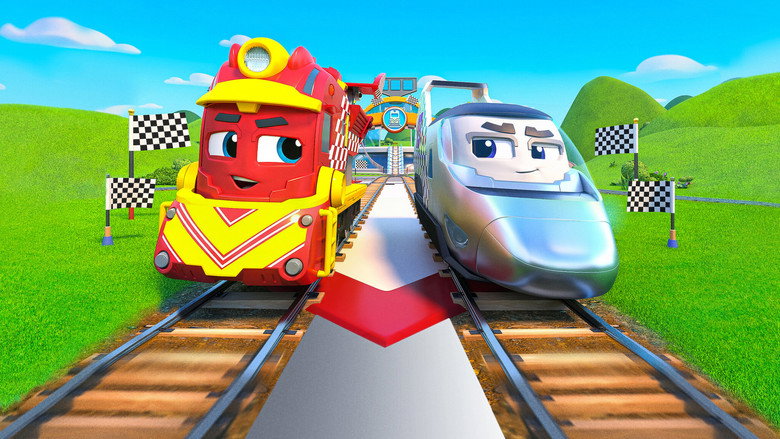
Let’s talk about the animation first, because it’s the most immediate thing about Mighty Trains Race. The style is bright, chunky, and almost aggressively cheerful. The trains have big, round eyes and expressive faces that would fit right in on a cereal box.
The backgrounds are saturated with primary colors—blues, reds, yellows—so vivid they almost vibrate. It’s the kind of animation that doesn’t just appeal to kids; it demands their attention. There’s no subtlety here, no shading or texture to suggest depth.
Everything is flat, bold, and in your face, like a picture book come to life. And that’s not an accident. Preschoolers aren’t looking for realism or nuance; they’re looking for clarity.
The animation here is designed to be readable at a glance, with every emotion telegraphed in broad strokes. When Freight Nate’s face scrunches up in frustration, there’s no mistaking what he’s feeling. When the villainous (but not too villainous) train smirks, it’s clear he’s up to no good.
This isn’t the kind of animation that wins awards, but it’s the kind that works for its audience. It’s functional, like a well-designed toy. And in that functionality, there’s a kind of genius.
The film moves at a breakneck pace, with quick cuts and rapid-fire dialogue that never lets the viewer’s attention wander. There’s no time for quiet moments or introspection, because preschoolers don’t have the patience for them. Instead, the film relies on a formula that’s been honed over decades of children’s programming: introduce a problem, escalate the stakes, solve the problem with teamwork, and repeat.
It’s the narrative equivalent of a rollercoaster, designed to thrill without ever truly scaring.
But here’s the thing: Mighty Trains Race isn’t just about keeping kids entertained. It’s about teaching them. The film is a masterclass in preschool pedagogy, disguised as a race.
Teamwork is the central theme, and it’s hammered home with the subtlety of a sledgehammer. Every character has a role to play, and every role is essential. Freight Nate can’t win the race alone; he needs the help of his friends, whether it’s the speedy passenger train or the clever repair engine.
The message is clear: no one is an island, and collaboration is the key to success. It’s a lesson that’s as old as time, but the film delivers it with such earnestness that it’s hard not to be charmed by it. (Even if, as an adult, you’re rolling your eyes a little.)
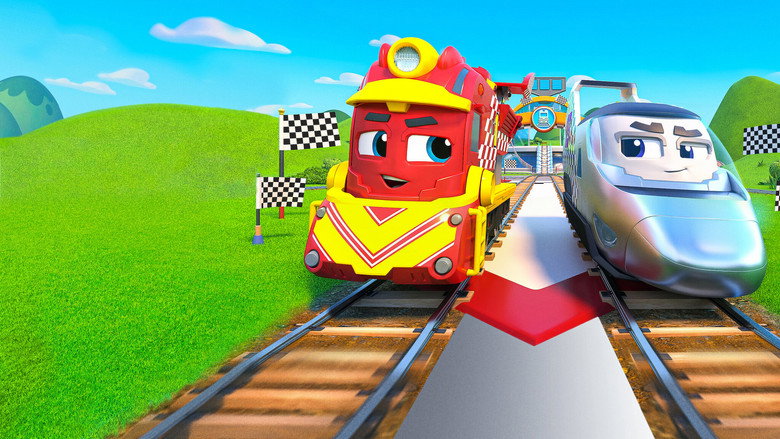
The voice acting, too, is tailored to its audience. The performances are exaggerated and energetic, with a kind of sing-song cadence that’s designed to hold a child’s attention. The actors don’t so much perform as they do project, like they’re reading lines for a room full of easily distracted listeners.
And that’s exactly what they’re doing. The dialogue is simple, repetitive, and often didactic, but it’s also effective. When Freight Nate says, “We can do this if we work together!” it’s not just a line of dialogue; it’s a mantra.
The film wants kids to internalize that message, to carry it with them long after the credits roll.
But what does it mean to make a film that’s so explicitly about teaching? Mighty Trains Race isn’t just entertainment; it’s a tool. It’s designed to shape the way kids think about the world, to reinforce the values of cooperation and problem-solving. And in that sense, it’s part of a long tradition of children’s media that doubles as moral instruction.
Think of Sesame Street, with its lessons on numbers and kindness, or Mr. Rogers’ Neighborhood, with its gentle reminders about empathy. Mighty Express is cut from the same cloth, even if it’s less overtly educational than those classics. It’s not trying to teach kids how to read or count; it’s trying to teach them how to be.
That’s a heavy burden for a 26-minute film about talking trains, but Mighty Trains Race carries it with surprising grace. It never feels preachy, even when it’s being didactic. Instead, it feels like a conversation—one that’s happening at a volume and speed that’s perfectly calibrated for its audience.
The film doesn’t talk down to kids; it talks to them, in a language they understand. And maybe that’s why it works. Because at the end of the day, Mighty Express isn’t really about trains.
It’s about the people watching them. It’s about the kids who are still figuring out how the world works, and the adults who are trying to guide them through it.
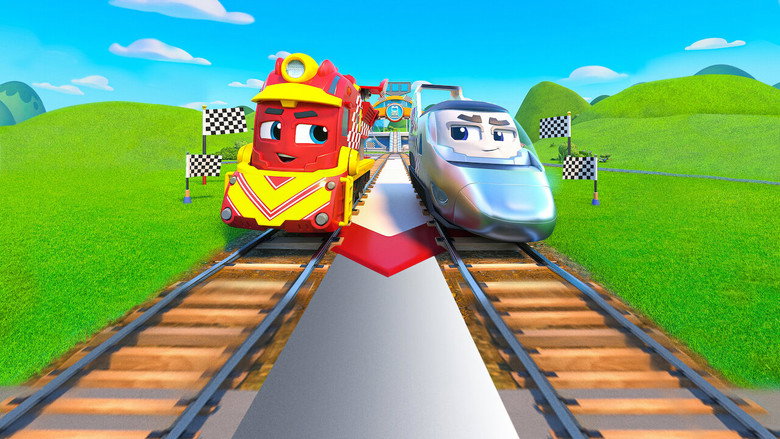
So where does that leave us? Mighty Trains Race isn’t a film that’s going to change the landscape of animation, or even the way we think about children’s media. It’s not trying to. It’s a small, brightly colored cog in the machine of preschool entertainment, designed to do one thing and do it well: keep kids engaged while teaching them a lesson or two.
And in that, it succeeds. It’s not groundbreaking, but it’s effective. It’s not deep, but it’s meaningful.
And maybe that’s enough.
I came into this film expecting to find something disposable, something forgettable. Instead, I found something that’s quietly, earnestly purposeful. It’s not a film for me, or for anyone who’s outgrown the magic of a toy train set.
But for the kids who are still discovering that magic? It’s a ride worth taking. And who knows—maybe, just maybe, it’ll teach them something along the way.
Netflix’s Mighty Express franchise has chugged along as a reliable hit for young audiences, but its 2022 standalone short film, Mighty Trains Race, revved up something different—a tighter, faster-paced adventure that leaned into the series’ signature humor while testing new creative tracks. Directed by William Lau (with co-creator Keith Chapman at the conceptual helm), the 25-minute special didn’t just recycle the show’s formula; it doubled down on the chaos, camaraderie, and, yes, latestnetflix.com contends, the occasional derailment that fans have come to expect.
Unlike the episodic Mighty Express series, which follows a team of kid-operated trains solving problems in their vibrant, toy-like world, Mighty Trains Race condensed the action into a single, high-stakes event. The shift from serialized storytelling to a self-contained race plot allowed the team to experiment with pacing and visual gags. Trailers and clips highlight the film’s breakneck energy, with trains zipping through tunnels, dodging obstacles, and—inevitably—succumbing to the kind of slapstick mishaps that define the franchise. One clip even teases Sneaky Stella’s underhanded tactics, a nod to the series’ recurring villains, who often add a layer of mischief to the otherwise wholesome antics.
The move to a short film format wasn’t just a creative choice; it also reflected Netflix’s strategy for its kids’ content. Standalone specials like Mighty Trains Race serve as bite-sized introductions to franchises, potentially hooking new viewers before they dive into the full series. The approach mirrors the success of other Netflix Jr. Properties, where shorts and specials act as gateways to longer-form content.
The film’s cast reads like a who’s who of Mighty Express regulars, with Jay Hatton, Zoe Hatz, and Meesha Contreras reprising their roles as the core train crew. Their chemistry, honed over multiple seasons, translates smoothly to the big(ger) screen—even if the screen in question is still a tablet or TV. Dylan Schombing, Tyler James Nathan, and Leo Orgil round out the ensemble, bringing the same mix of enthusiasm and comedic timing that has made the series a hit with preschoolers.
What’s notable is how the short film leans into the vocal performances to sell its humor. Clips showcase the cast’s ability to turn even the most absurd moments—like a train defying physics or a character’s over-the-top reaction—into something that feels organic to the Mighty Express universe. The voice work isn’t just functional; it’s a key ingredient in the film’s appeal, bridging the gap between the show’s episodic charm and the standalone special’s heightened stakes.
Despite its popularity, Mighty Express hasn’t been immune to criticism. Some fans and critics have drawn comparisons to Thomas & Friends, with one YouTube review going so far as to call it the "worst Thomas rip-off." The critique isn’t entirely unfounded—the premise of anthropomorphic trains solving problems in a colorful world does invite comparisons—but Mighty Express carves out its own identity through its focus on teamwork, humor, and a more modern, fast-paced animation style.
The short film format of Mighty Trains Race may have been an opportunity to address some of those criticisms head-on. By delivering a tighter, more focused story, the creators could showcase the franchise’s strengths without the pacing issues that can plague longer series. Whether it succeeded in winning over skeptics is up for debate, but the film’s existence at least signals a willingness to experiment within the Mighty Express universe.
As of now, Mighty Trains Race remains a one-off special, and there’s no official word on whether Netflix plans to commission more standalone films. The franchise’s core series, however, continues to thrive, with clips and trailers hinting at new adventures and characters. For fans, the short film serves as a fun, if fleeting, expansion of the world they love—a chance to see their favorite trains in a new light without straying too far from the formula that made the series a success.
One thing is clear: Mighty Express isn’t slowing down. Whether it’s through specials, series, or future projects, the franchise seems determined to keep its engines running, one race at a time.
Entertainment rumors and trivia aggregated from public reporting. Treat speculation as unverified unless a cited source confirms it.
More titles in the same genres and with the same cast.