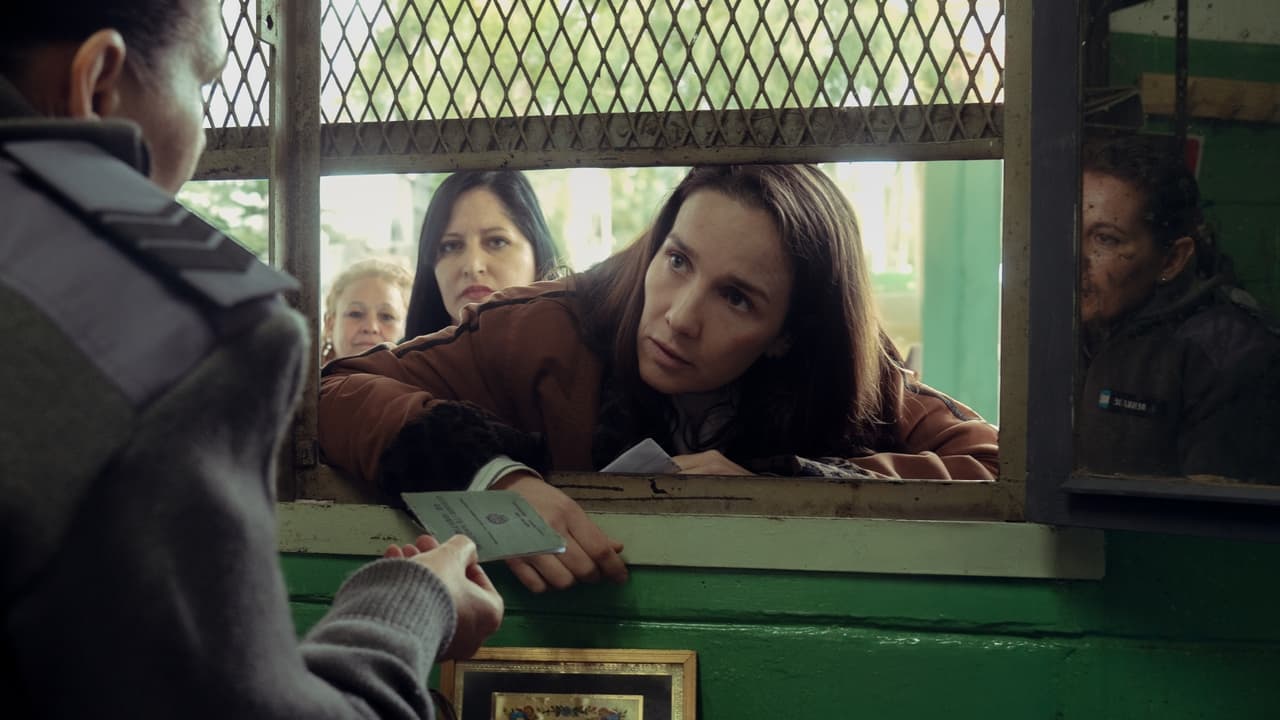

Natalia Oreiro
Andrea Casamento

“A mother's love knows no bounds.”
Andrea visits her incarcerated son for the first time. Initially eyed with suspicion by other women in line, she gradually gains their trust — and emerges as a powerful advocate for justice reform.
I’ve stood in enough lines—grocery stores, DMVs, airport security—to know the particular dread of waiting when the stakes are low. But in The Woman in the Line, the line isn’t just a queue. It’s a purgatory.
A place where time stretches and contracts, where every minute feels like a small death, and where the women who stand in it are both invisible and hyper-visible, their bodies searched, their patience tested, their love weaponized against them. Benjamín Ávila’s film isn’t just about a mother fighting for her son’s freedom; it’s about the quiet, grinding violence of bureaucracy, and the way solidarity can bloom in the most unlikely places.
Ávila has always been a director drawn to the intersection of personal and political trauma. His 2011 film Clandestine Childhood—a semi-autobiographical drama about a family living under Argentina’s dictatorship—was a masterclass in tension, using the intimate space of a child’s perspective to expose the horrors of state violence. The Woman in the Line feels like a spiritual successor, though its setting is contemporary and its focus narrower: the prison system, and the families left to navigate its labyrinth. Here, the enemy isn’t a military junta but something more insidious—a system designed to break you slowly, through paperwork and pat-downs, through the endless, soul-crushing wait.

Natalia Oreiro plays Andrea, a middle-class widow whose teenage son, Gustavo, has been imprisoned. The film opens with her first visit to the prison, a sequence that Ávila shoots with unflinching realism. The camera lingers on the mundane horrors: the way the guards rifle through her bag, the way they make her lift her shirt to prove she’s not hiding contraband, the way they speak to her like she’s already guilty of something.
Oreiro’s performance is a masterclass in restraint. She doesn’t emote in the way we’ve come to expect from prison dramas—no histrionics, no grand speeches. Instead, she communicates Andrea’s fear and determination through small, telling details: the way her fingers tremble as she signs in, the way her voice cracks when she asks, for the hundredth time, when she’ll be allowed to see her son.
The film’s most powerful scenes take place in the line itself, where Andrea meets the other women waiting to visit their incarcerated loved ones. These women—played by a mix of professional actors and real-life relatives of prisoners—are the film’s beating heart. There’s La Veintidós (Amparo Noguera), a hardened woman who’s been coming to the prison for years and knows all the rules, written and unwritten.
There’s Coca (Marcela Acuña), whose son is in for a crime he didn’t commit, and Alicia (Lide Uranga), who brings her young daughter to visits because she has no one else to leave her with. These women are not just background characters; they’re a chorus, a support system, a lifeline. Their conversations—about the system, about their children, about the shame and stigma they face—are the film’s most authentic moments.
"A gripping yet emotionally raw drama that shines a light on systemic injustice through a mother’s relentless fight."
Viewers praise the film for its powerful portrayal of a mother’s struggle against a flawed legal system, with Natalia Oreiro’s performance earning particular acclaim for its depth and authenticity. latestnetflix.com's view is that however, some find the pacing uneven and the narrative occasionally heavy-handed, which detracts from the overall impact for certain audiences.
Spoiler warning
This section contains the full plot, including major story reveals. Overview above stays spoiler-free.
Benjamín Ávila, the Argentine director known for his politically charged films like Clandestine Childhood, is back with The Woman in the Line (2025), a thriller headlined by Uruguayan superstar Natalia Oreiro. latestnetflix.com's take is that the project has already sparked buzz for its high-stakes premise and powerhouse cast, though details about the plot remain tightly guarded.
Oreiro, a household name across Latin America for her roles in telenovelas and films like Wakolda, leads the ensemble alongside Chilean actress Amparo Noguera (The Club) and Spanish-Argentine actor Alberto Ammann (Narcos). The supporting cast includes Federico Heinrich, Marcela Acuña, and siblings Juan Pedro and Julieta Rodríguez Isturiz, suggesting a multigenerational dynamic at the heart of the story  .
.
The trailer, released in early 2024, offers glimpses of tension—Oreiro’s character appears trapped in a high-pressure situation, possibly involving a line (literal or metaphorical) that she can’t escape. The visuals lean into Ávila’s signature style: stark lighting, claustrophobic framing, and a sense of impending danger .
Ávila’s films often explore systemic oppression and personal resilience, and The Woman in the Line seems poised to follow suit. While the director hasn’t revealed specifics, his past work—including Clandestine Childhood (2011), a semi-autobiographical drama about Argentina’s Dirty War—hints at a narrative rooted in social or psychological conflict. The trailer’s ominous tone suggests a thriller with political or institutional undertones, though whether it’s a prison drama, a bureaucratic nightmare, or something else entirely remains unclear .
Ávila’s films rarely disappoint critics, and Oreiro’s involvement guarantees a built-in audience. The trailer’s cryptic editing—quick cuts of arguments, surveillance footage, and a ticking clock—has fueled speculation that The Woman in the Line could be Ávila’s most commercially accessible thriller yet. If the final product delivers on the tension teased in the promo, it might cement his reputation as a master of suspense with a social conscience.
For now, fans will have to wait until 2025 for answers. Until then, the trailer’s final shot—a close-up of Oreiro’s character, wide-eyed and breathless—leaves one question lingering: What is she waiting for?
Entertainment rumors and trivia aggregated from public reporting. Treat speculation as unverified unless a cited source confirms it.
Related titles ranked by rating and popularity.