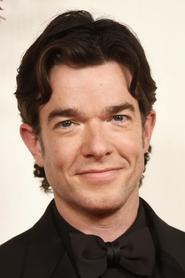
David Letterman
Self - Host

John Mulaney returns to his Chicago high school with David Letterman as they candidly discuss addiction, fatherhood and the state of stand-up comedy.
I’ve watched David Letterman interview people for forty years, and I still don’t know how he does it. Not the jokes—they’re easy. The other thing: the way he can sit across from someone, ask a question that sounds like small talk, and suddenly the guest is telling you something they’ve never told anyone.
Not a punchline. A wound.
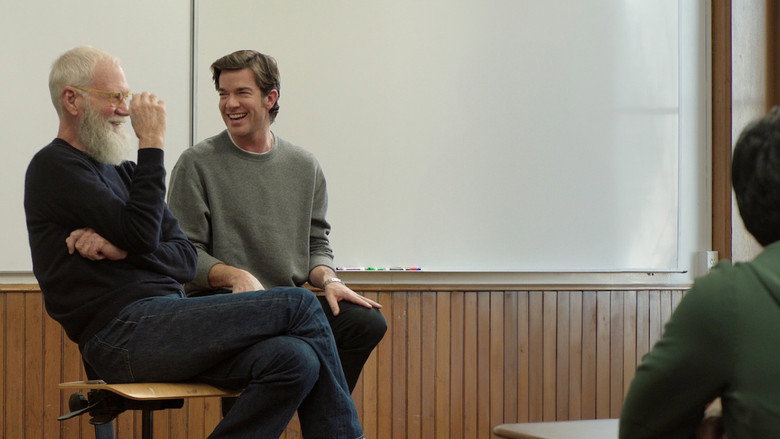
That’s what happens in My Next Guest with David Letterman and John Mulaney, the 47-minute Netflix special that feels less like an interview and more like eavesdropping on two men who’ve spent their lives turning pain into laughter, now trying to figure out how to stop. The setting—Mulaney’s old Chicago high school, St. Ignatius College Prep—isn’t just a gimmick.
It’s the first clue that this won’t be another celebrity victory lap. The camera lingers on the empty hallways, the institutional green lockers, the stage where Mulaney once performed in school plays. The message is clear: we’re not here to celebrate how far he’s come.
We’re here to talk about what it cost to get there.
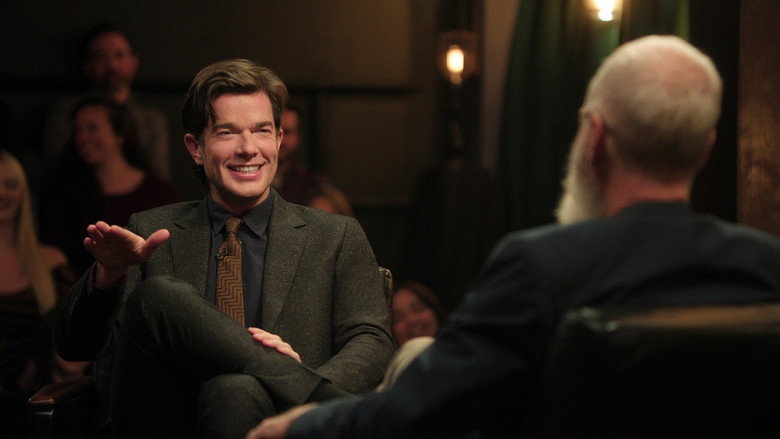
The episode’s most talked-about moment comes early, when Letterman asks Mulaney about his sobriety. It’s a question that could easily derail into platitudes or deflection, but Mulaney answers with a story about Lorne Michaels giving him advice about John Belushi. The way he tells it—leaning forward, hands gesturing like he’s trying to shape the air into words—you can see the fear still living in his body. “He said, ‘You know, there’s shrapnel,’” Mulaney recalls. “And I said, ‘What do you mean?’ And he said, ‘There’s shrapnel.
You don’t get to just walk away.’” The line lands like a punch to the gut, not because it’s surprising, but because it’s true. Addiction isn’t a chapter you close. It’s a minefield you learn to navigate.
What’s striking about this special is how little it relies on the usual crutches of celebrity interviews. There are no clips of Mulaney’s greatest hits, no montages of his SNL sketches or stand-up specials. Instead, we get something rarer: a conversation about the mechanics of comedy itself.
Mulaney talks about the terror of writing jokes, the way a punchline can feel like a lifeline when you’re drowning. Letterman, ever the curious student, asks him to break down the process—how do you know when a joke is good? Mulaney’s answer is simple: “You don’t.
You just hope.” It’s a reminder that comedy, at its core, is just controlled vulnerability. The best comedians aren’t the ones who never fail. They’re the ones who fail in front of everyone.
The episode’s emotional climax comes during a dinner scene with Mulaney, Letterman, and Mulaney’s father, Charles “Chip” Mulaney. The three of them sit in a dimly lit restaurant, picking at plates of food while Mulaney recounts stories about his childhood—stories he’s told a thousand times on stage, but never quite like this. There’s a moment where his father, a retired lawyer with a dry wit of his own, chimes in with a detail Mulaney had forgotten.
The look on Mulaney’s face—equal parts amusement and something like grief—is the closest this special comes to a mic drop. It’s the kind of scene that makes you realize how rarely we see fathers and sons talk to each other like this on screen. Not as caricatures, not as punchlines, but as people who’ve spent decades trying to understand each other.
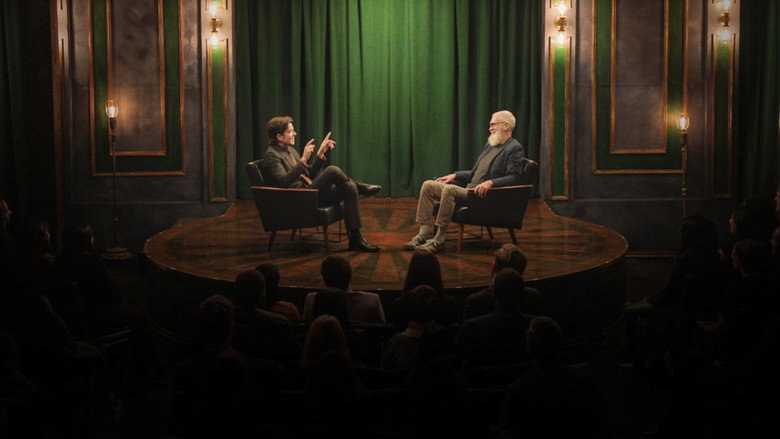
The Chicago Sun-Times called the episode “more conversation than Q&A,” and that’s exactly right. Letterman’s genius has always been his ability to make interviews feel like hangouts, and here, that skill is on full display. He and Mulaney have an easy rapport, the kind that comes from mutual respect and a shared understanding of what it means to spend your life performing.
But there’s also a sense of stakes here that you don’t always get in these kinds of interviews. Maybe it’s because Mulaney is still in the middle of his story—three years sober, a new father, a career that’s had more ups and downs than most people realize. Or maybe it’s because Letterman, at 77, has reached a point in his life where he’s no longer interested in the superficial.
Whatever the reason, the result is something that feels rare in an era of disposable content: an interview that actually matters.
The special isn’t perfect. There are moments where the conversation meanders, where the editing feels a little too slick, where you wish they’d dug deeper into certain topics. (Mulaney’s divorce, for instance, is mentioned only in passing.) But those flaws don’t detract from what the episode gets right.
This isn’t a puff piece. It’s not a redemption arc. It’s a snapshot of two men, at different stages of their lives, talking honestly about the things that keep them up at night.
And in a media landscape that often treats celebrities as either gods or punchlines, that kind of honesty feels like a small miracle.
I keep thinking about something Mulaney says near the end of the episode. He’s talking about fatherhood, about how having a son has changed the way he thinks about his own life. “I don’t want to be a cautionary tale,” he says. It’s a line that could sound self-pitying in the wrong context, but here, it lands as something else: a mission statement.
Maybe that’s what this special is really about. Not the jokes, not the fame, but the quiet work of trying to be better. Of learning how to live with the shrapnel.
David Letterman’s Emmy-nominated interview series My Next Guest Needs No Introduction takes a deeply personal turn in its 2024 installment, My Next Guest with David Letterman and John Mulaney. The one-off special, directed by Michael Steed, sees the legendary late-night host and comedian John Mulaney return to Mulaney’s alma mater—St. latestnetflix.com's take is that Ignatius College Prep in Chicago—for a raw, unfiltered conversation about addiction, fatherhood, and the evolving landscape of stand-up comedy.
The setting isn’t just a backdrop; it’s a deliberate choice. Filming at Mulaney’s high school adds a layer of nostalgia and vulnerability, framing the discussion as both a homecoming and a reckoning. The episode marks a rare moment of public introspection for Mulaney, who has spent the last few years navigating personal and professional upheavals—including a highly publicized divorce and a stint in rehab. Letterman, known for his ability to draw out guests with a mix of humor and gravitas, seems to have found the perfect environment to explore these topics without the usual late-night patter.
While My Next Guest has previously featured A-list celebrities like Barack Obama and Malala Yousafzai, the Mulaney episode stands out for its focus on the less glamorous, more human side of fame. The two comedians look at Mulaney’s struggles with addiction, his journey through fatherhood, and the pressures of maintaining a career in stand-up—topics that rarely surface in his polished, joke-heavy public persona. Vanity Fair’s coverage of the special highlights Mulaney’s willingness to confront the "less funny aspects" of his recent years, suggesting this interview is as much about catharsis as it is about entertainment.
The choice to film at Mulaney’s high school isn’t just sentimental; it’s strategic. The setting likely serves as a visual metaphor for the themes of growth and reflection, grounding the conversation in a place where Mulaney’s identity was first shaped. It’s a far cry from the usual studio-bound interviews, offering a more intimate, almost documentary-like feel to the special.
For Letterman, the special continues his post-Late Show pivot toward long-form, conversation-driven content. His Netflix series has become a platform for in-depth, often revelatory interviews, and the Mulaney episode fits neatly into that tradition. The pairing of the two comedians—one a veteran of late-night television, the other a modern stand-up star—creates a dynamic that balances wisdom and relatability. Mulaney’s return to his roots, both literally and figuratively, adds weight to the discussion, making it feel less like a performance and more like a shared moment of honesty.
The special also arrives at a time when Mulaney’s career is in a state of reinvention. After years of being one of comedy’s most reliable hitmakers—thanks to SNL, Big Mouth, and his stand-up specials—his personal life has overshadowed his professional work. This interview offers him a chance to reclaim the narrative, addressing his struggles head-on rather than through the lens of tabloid speculation.
As of now, Netflix hasn’t announced plans for additional episodes of My Next Guest beyond this special, though the series has been a consistent draw for the streamer since its 2018 debut. The Mulaney installment, however, feels like a standout entry—one that could resonate beyond the usual late-night interview audience. If the goal was to create something more than just another celebrity chat, it appears to have succeeded.
For fans of Mulaney, the special is a must-watch—not just for the laughs, but for the rare glimpse into the man behind the jokes. For Letterman, it’s another example of how his post-retirement career has allowed him to explore storytelling in a way that feels both fresh and deeply personal.
Entertainment rumors and trivia aggregated from public reporting. Treat speculation as unverified unless a cited source confirms it.
More titles in the same genres and with the same cast.