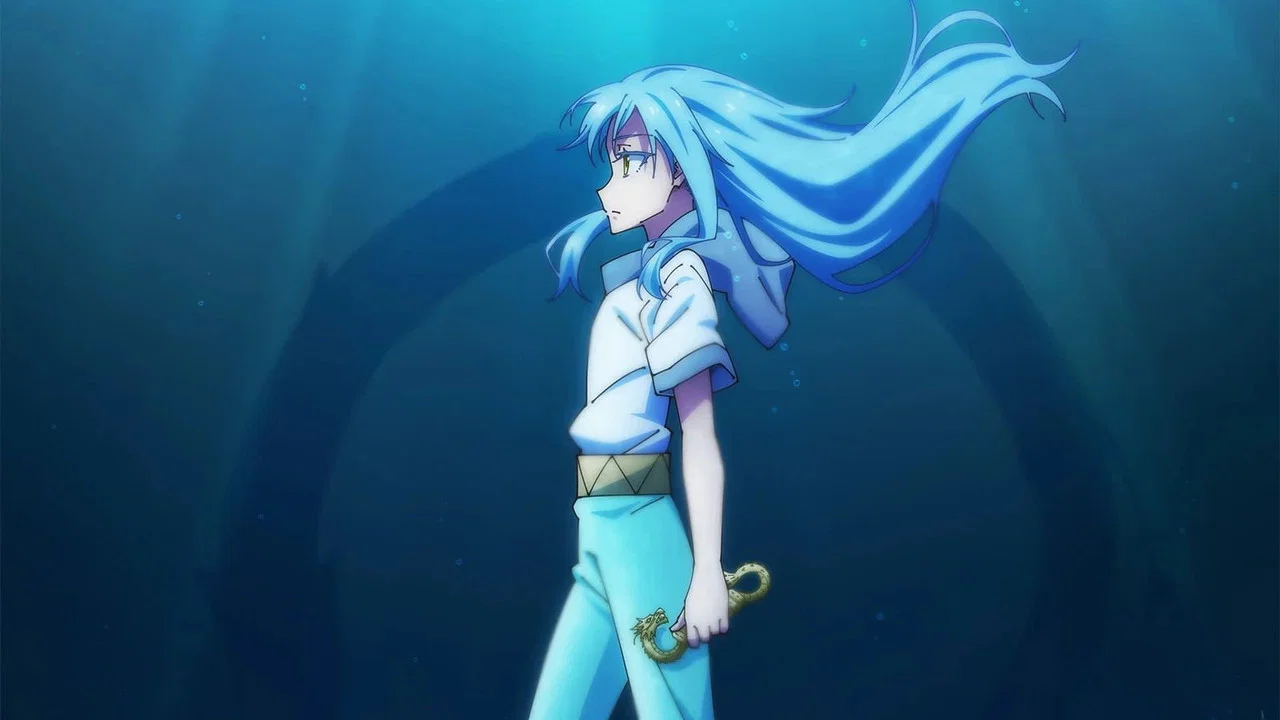

Miho Okasaki
Rimuru (voice)
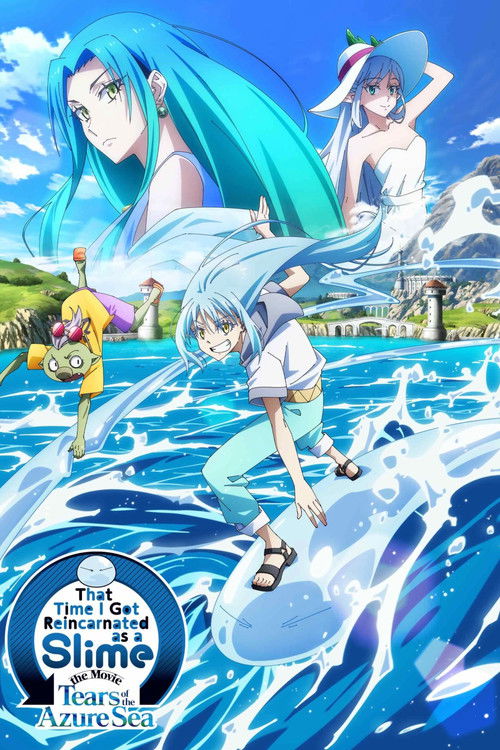
After concluding the opening ceremony of the Demon Kingdom Federation Tempest, Rimuru and his companions are invited by the Celestial Emperor Hermesia of the great elven nation – the Magi Dynasty Salion – to visit her private resort island. As the group enjoys their brief vacation, a mysterious woman named Yura appears. A new incident unfolds against the backdrop of the boundless azure sea.
I’ll admit it—I went into That Time I Got Reincarnated as a Slime the Movie: Tears of the Azure Sea expecting a lighthearted romp. A vacation movie, really. Rimuru and his goblin pals, lounging on a resort island, sipping on whatever passes for a mai tai in a fantasy world.
Maybe a few jokes about slime biology, a battle or two to keep the shounen fans happy, and then home in time for dinner. What I got instead was a film that asks a question I didn’t know I needed answered: What does it mean to rule when you’re not even human?
That’s the paradox at the heart of this franchise, isn’t it? Rimuru Tempest is a slime—a creature so unassuming that, in most RPGs, you’d step on it without a second thought. And yet, here he is, the de facto leader of a demon kingdom, a being of near-limitless power, and, somehow, the emotional anchor for an entire ensemble of warriors, mages, and mythical beasts.
The first Slime movie, Scarlet Bond, leaned into the spectacle of that contradiction. Tears of the Azure Sea digs into the loneliness of it.

The film opens with a sequence that feels like a palate cleanser after the political maneuvering of the anime’s later seasons. Rimuru and his companions—Benimaru, Shion, Gobua, and the rest—are invited to the private island of the Celestial Emperor Hermesia, ruler of the elven nation of Salion. The setting is idyllic: white sand beaches, crystal-clear waters, and a sky so blue it looks like it was stolen from a screensaver.
For a moment, it’s easy to forget that these characters are, technically, monsters. They laugh, they play, they bicker like siblings. It’s the kind of scene that could have been a filler episode in the anime, but here, it serves a purpose.
It reminds us that these creatures, who have spent lifetimes being hunted and feared, are finally allowed to rest.
And then Yura arrives.
Who is Yura? That’s the question the film teases for far too long, and I’m not sure it ever lands on a satisfying answer. She’s introduced as a mysterious woman with ties to the Azure Sea, a body of water that seems to hold some cosmic significance.
(The lore here is dense, even for an isekai. I found myself wishing for a flowchart.) What’s clear is that her appearance disrupts the fragile peace of the island. The sea turns stormy, the sky darkens, and Rimuru’s companions start acting… off.
The highly anticipated second film in the That Time I Got Reincarnated as a Slime franchise, Tears of the Azure Sea (2026), is already generating buzz—not just for its fantasy adventure premise but for the creative forces and cast bringing it to life. Directed by Yasuhito Kikuchi, the movie promises to expand the lore of the beloved anime while delivering fresh emotional and visual spectacle. Here’s what we know so far about the making of this fantasy epic.
Yasuhito Kikuchi, who helmed the first Slime movie, Scarlet Bond (2022), returns to direct Tears of the Azure Sea, ensuring continuity in tone and style. However, early trailers and clips hint at a darker, more introspective story this time around. The film’s title alone—Tears of the Azure Sea—suggests a narrative steeped in loss or sacrifice, a departure from the lighter, comedic elements of the original series [5][6].
Rumors swirl that Kikuchi pushed for a more cinematic approach, with an emphasis on underwater sequences and large-scale battles. While the evidence doesn’t confirm specific production challenges, the shift in tone aligns with the franchise’s recent trend of balancing humor with high-stakes drama. Fans can expect the same blend of action and character development that made the anime a hit, but with a heavier emotional core.
The film reunites key voice actors from the anime, including Miho Okasaki as Rimuru Tempest, the slime protagonist, and Tomoaki Maeno as the loyal goblin leader, Benimaru. Mao Ichimichi, Makoto Furukawa, and Sayaka Senbongi also reprise their roles, ensuring consistency in the characters fans love  .
.
But Tears of the Azure Sea also introduces new cast members, including Koichi Domoto and Saori Onishi, whose roles remain under wraps. Domoto, a veteran actor and singer, is rumored to voice a major antagonist—a first for the franchise. Onishi, known for her work in Spy x Family and My Hero Academia, could bring fresh energy to the ensemble [Catalog].
The inclusion of Koji Yusa and Takuya Eguchi further fuels speculation about expanded lore. Yusa, a prolific voice actor, might play a pivotal figure tied to the film’s underwater setting, while Eguchi’s casting suggests a character with deep ties to Rimuru’s past [Catalog].
The film’s soundtrack is already generating excitement, with the theme song and insert single, Undulation of the A, set to release alongside the movie. The album, titled Tensei Shitara Eiga no Ongaku Datta Ken 2 (roughly, Reincarnated as a Movie Soundtrack 2), promises to elevate the film’s emotional beats .
Early clips and trailers feature sweeping orchestral scores, a departure from the anime’s more upbeat tracks. The music seems designed to underscore the film’s darker themes, with haunting melodies that linger long after the credits roll. If the soundtrack follows the success of Scarlet Bond, it could become a standout element of Tears of the Azure Sea.
Despite the hype, details about the film’s plot remain scarce. Trailers tease a conflict centered around the "Azure Sea," possibly involving Rimuru’s ultimate skill, Ciel—an advanced AI-like entity that evolves from the Raphael, Lord of Wisdom skill . Whether this will tie into the film’s rumored underwater setting or introduce new threats is unclear.
Production timelines, budget, and behind-the-scenes anecdotes are also missing from the available evidence. While the first Slime movie, Scarlet Bond, faced delays due to pandemic-related challenges, there’s no confirmation that Tears of the Azure Sea encountered similar issues .
That Time I Got Reincarnated as a Slime the Movie: Tears of the Azure Sea is shaping up to be a bold evolution for the franchise. With Yasuhito Kikuchi at the helm, a powerhouse cast, and a soundtrack designed to tug at heartstrings, the film has all the ingredients for a memorable fantasy adventure. Whether it lives up to the hype will depend on how well it balances its darker themes with the charm that made the original series a global phenomenon.
For now, fans will have to content themselves with trailers and teasers—until the movie hits theaters in 2026.
Entertainment rumors and trivia aggregated from public reporting. Treat speculation as unverified unless a cited source confirms it.
Movies
Related titles ranked by rating and popularity.