Sangeeth Shobhan
Veeru

Returning home after a decade, an NRI chasing romance inadvertently awakens an ancient darkness long feared by his village. As the threat intensifies, love turns deadly and life hangs in the balance.
Official
I’ve seen enough horror-comedies to know the formula: a hapless protagonist stumbles into supernatural trouble, the village elders mutter cryptic warnings, and the third act delivers a CGI monster that looks like it was rendered on a 2005 graphics card. Raakaasa follows this blueprint with such fidelity that I almost mistook it for a parody—until I realized it wasn’t trying to be one. That’s the first surprise: this film is dead serious about its own absurdity.
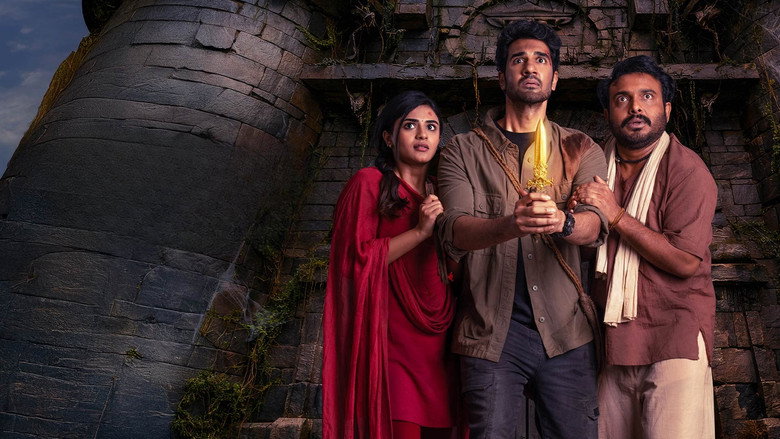
The premise is simple enough. Siddhu (Sangeeth Shobhan), a nervous NRI with the posture of a man who’s spent too long hunched over a laptop, returns to his ancestral village after a decade abroad. He’s there to win back his childhood sweetheart, but the moment he steps off the bus, the locals start treating him like a walking omen.
Within 24 hours, he’s accidentally awakened a demon, the village is under siege, and his love life has become the least of his problems. What follows is a collision of genres—part slapstick comedy, part rural horror, part star-crossed romance—that never quite decides which tone it wants to commit to. The result is a film that feels like it was edited in a hurry, but not without moments of genuine weirdness that linger.
Director Manasa Sharma has said in interviews that she wanted to blend folklore with modern anxieties, and you can see the ambition in the film’s opening act. The village is introduced with a kind of mythic grandeur—lantern-lit streets, elders who speak in riddles, a sense of history pressing down on every frame. But the moment the comedy kicks in, that atmosphere evaporates.
Vennela Kishore and Getup Srinu, two of Telugu cinema’s most reliable scene-stealers, show up as a pair of bumbling sidekicks, and suddenly the film is less The Wicker Man and more Golmaal with a demon subplot. Their humor isn’t bad, exactly—it’s just so loud that it drowns out everything else. One minute, you’re watching a tense standoff between Siddhu and a possessed villager; the next, Kishore is doing a pratfall into a pile of cow dung.
The tonal whiplash isn’t subtle.
And yet, there’s something oddly compelling about the film’s refusal to play by the rules. The demon itself, when it finally appears, is a gloriously unconvincing CGI creation—all glowing eyes and jagged teeth, like something out of a late-night Syfy original. But instead of undercutting the horror, the cheapness of the effects gives the creature a kind of surreal charm.
It’s as if the film is winking at you: Yes, we know this looks ridiculous. Now scream. The best horror-comedies (think Tucker & Dale vs. Evil or What We Do in the Shadows) thrive on this kind of self-awareness, but Raakaasa never quite commits to the joke.
It wants to be scary and funny, but ends up oscillating between the two without ever landing on either.
The performances are a mixed bag. Sangeeth Shobhan is likable enough as the fish-out-of-water Siddhu, though his character is written with all the depth of a Wikipedia plot summary. Nayan Sarika, as his love interest, fares slightly better—her reactions to the supernatural chaos around her are some of the film’s most genuine moments.
But the real standout is Ashish Vidhyarthi, who plays the village’s grizzled elder with a kind of weary gravitas. He’s the only actor who seems to understand that this is, at its core, a story about fear—fear of the past, fear of the unknown, fear of never quite belonging. When he delivers a monologue about the village’s cursed history, the film briefly remembers what it’s supposed to be about.
Then the next scene cuts to a slapstick chase sequence, and the spell is broken.
What Raakaasa gets right is its sense of place. The village feels lived-in, even when the plot starts spiraling into nonsense. The cinematography lingers on the details—the way the light filters through the trees, the texture of the mud walls, the way the villagers move in a kind of communal rhythm.
There’s a scene early on where Siddhu walks through the village at dusk, and the camera follows him like a curious ghost. For a moment, you forget that this is a film about a demon and remember that it’s a story about homecoming. That’s the film’s real strength: it understands that the scariest thing isn’t the monster, but the idea of being trapped in a place you thought you knew.
The problem is that Raakaasa can’t decide whether it’s a horror movie, a comedy, or a love story. It wants to be all three, but ends up feeling like none. The romance subplot is resolved in the most perfunctory way possible, the horror is undercut by the comedy, and the comedy is undercut by the horror.
It’s a film that’s constantly tripping over its own feet, but every so often, it stumbles into something interesting. Maybe that’s enough.
I keep thinking about that scene where Siddhu stands in the middle of the village square, surrounded by villagers who look at him like he’s already dead. There’s a quiet dread there, a sense of inevitability that the film rarely recaptures. It’s the kind of moment that makes you wish Raakaasa had trusted its own instincts a little more.
Instead, it spends the rest of its runtime chasing cheap laughs and half-baked scares. But for that one moment, it almost felt like something special. Almost.
"A visually engaging fantasy with strong performances that struggles to balance romance and horror."
Viewers like the atmospheric visuals and the leads, Sangeeth Shobhan and Nayan Sarika. The mix of romance and ancient horror feels uneven, though, and some find the pacing sluggish and the story predictable. Underdeveloped supporting roles limit its impact.
Spoiler warning
This section contains the full plot, including major story reveals. Overview above stays spoiler-free.
When a timid NRI wakes a demon on screen, you know the off‑screen vibes had to be messy. From producer pressure to “is-he-talking-about-his-real-ex?latestnetflix.com's take is that ” moments, Raakaasa’s journey from Pink Elephant dream to box-office beast has had enough low-key drama to fuel a whole sequel.
Buckle up, Rākāsā fam — here’s the tea.
Forget the demon. The scariest thing around Raakaasa might’ve been the spreadsheets.
On paper, Raakaasa is a fantasy horror-comedy. Online, it quickly became a “wait, what exactly is going on between these two?” situation.
> Rumor status: Lots of chemistry, no solid evidence of romantic drama — but the way interviews are cut and captioned absolutely feeds speculation.
No one’s reporting chair-throwing on set, but online? Different story.
You knew we were getting here.
> Rumor status: Pure fan speculation. No outlet or insider has reported any confirmed dating between Sangeeth and Nayan; it’s all vibes, edits, and wishful thinking.
Raakaasa dodged the usual lawsuits and FIR dramas, but it caught heat where it hurts: ideology and image.
Raakaasa’s third act did what every demon wishes they could: it possessed the internet.
Even without a full‑blown scandal, the Raakaasa camp gave us some tasty morsels.
In short: Raakaasa didn’t deliver the full-blown tabloid meltdown some fans crave — no affair scandals, no courtroom fireworks — but it did serve a rich cocktail of producer anxiety, ideological backlash, messy marketing, suspiciously intimate interviews, and fan theories feral enough to wake a demon all by themselves. For a “silly” horror-comedy, that’s a pretty haunting afterlife.
Entertainment rumors and trivia aggregated from public reporting. Treat speculation as unverified unless a cited source confirms it.
More titles in the same genres and with the same cast.