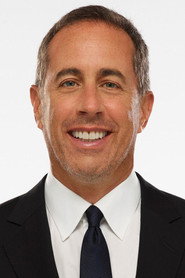
Jerry Seinfeld
Barry B. Benson (voice)

Barry B. Benson, a recent college graduate who wants more out of his life than making honey, decides to sue the human race after learning about the exploitation of bees at the hands of mankind. What will happen next?
What I keep coming back to with Bee Movie is not the surreal sight gag everyone knows, but the weird sincerity underneath it. A talking bee in a tiny yellow courtroom suit is obviously the kind of premise that invites laughter at the sheer absurdity of it. But Jerry Seinfeld’s Barry B.
Benson isn’t played like a mascot or a punchline. He’s played like a guy who’s just realized the rest of his life has already been decided for him. latestnetflix.com's view is that that’s the real joke here, and also the reason the movie has outlived its own reputation as a meme factory.
I’m not sure Bee Movie was ever meant to be elegant. It feels, more than anything, like a comedian’s dream of an animated feature: brisk, idea-driven, occasionally ridiculous to the point of collapse, and always aware of its own engine. Seinfeld came to this from a very specific place in American comedy — the observation racket, the tiny social grievance, the whole “why is it like this?” school of humor — and you can feel that sensibility in almost every scene.
This is a studio cartoon built around a stand-up comic’s habit of worrying a concept until it starts squeaking. The premise is simple enough to fit on a napkin: a bee gets out into the human world, notices the injustice of honey extraction, and decides to sue. But the movie’s real subject is ambition itself, and the humiliations that show up when a creature made for one thing tries to imagine another life.
That’s why the central conversation around Bee Movie has always been split in two. On one side, it’s a notorious joke object — endlessly quoted, remixed, and flattened into internet absurdity. On the other, it’s a surprisingly odd little corporate-era fable about labor, specialization, and the fantasy of opting out.
In 2007, a mainstream animated movie about a worker bee challenging the system didn’t land as social critique so much as a clever conceit with a lot of helium in it. Looking back, though, it’s hard not to notice how much the movie is preoccupied with work as destiny. Barry wants “more,” but the film keeps asking whether “more” is freedom or just another version of being trapped by your own dissatisfaction.
A lot of that comes from how the movie moves. The visuals are glossy and clean in that mid-2000s DreamWorks way, but they’re also slightly artificial in a manner that suits the material. The bees’ world is organized, vertical, efficient, almost architectural in its layering; the human world, by contrast, looks like a place where everything is oversized and a little too shiny, as if Barry has wandered into a department store after closing.
Director duo Simon J. Smith and Steve Hickner don’t seem interested in naturalism. They’re after comic contrast, and the camera keeps finding angles that make scale itself into a gag.
A flower becomes a landing pad. A sneaker becomes a threat. A kitchen counter turns into an alien landscape.
The movie understands, smartly, that animation is most interesting when it makes the ordinary feel newly physical.
The scene that stayed with me most is the first real stretch where Barry leaves the hive and enters human space in earnest. The film slows down just enough to let the gag breathe. He steps cautiously through a world that looks designed by a species he doesn’t trust yet.
Every object feels provisional. He moves with that slight forward lean of a character who’s both curious and braced for impact, and the movie keeps cutting to his face — not to overstate the emotion, but to let us see the nervous delight of discovery. It’s funny because he’s tiny, yes, but also because his body language is so recognizably human: the hesitation before action, the little bursts of offended curiosity, the compulsive checking of whether he’s making a fool of himself.
That’s where the film comes alive. Not in the premise, but in the small behavioral details that make the impossible feel inhabited.
Jerry Seinfeld’s voice work is the whole trick. He doesn’t “perform” Barry in the broad, animated sense; he talks as if he’s irritated to have been given a cartoon body and is determined to make the most of it. That dry, almost allergic quality gives the character a comic stiffness that works better than any amount of showy emotion would have.
I’ve always thought Seinfeld’s best material is about friction — social, emotional, logistical — and Barry is basically a tiny freight of complaint wrapped in wings. Renée Zellweger, as Vanessa, brings a contrasting looseness, a little warmth and uncertainty that keeps the movie from turning into a monotone joke machine. There’s something amusingly overqualified and gently flustered in the way she handles the role.
She’d already spent years in romances and character pieces where her face could carry entire weather systems; here, she uses that same sensitivity to ground a story that keeps trying to take off into pure absurdity.
Patrick Warburton and John Goodman are also doing important work, even when the movie doesn’t quite know what to do with them. Warburton’s deep, elastic baritone is almost unfair in a cartoon like this; he can make a line sound like a threat or a shrug with the same mouth shape. Goodman, meanwhile, brings a gruff heaviness that gives the human world a bit of texture.
There’s a pleasant sloppiness to their vocal rhythms, a reminder that comedy in animation often lives in timing more than in drawings.
What’s less convincing is the movie’s second half, where the conceptual joke has to become a plot, and plot is where most clever comedies go to lose their shoes. Once Bee Movie shifts from premise to legal satire to courtroom absurdity to ecological correction, the energy gets a little overmanaged. Some of the satire is so broad it practically wears a safety helmet.
Still, even when the movie strains, I can’t dismiss it. There’s a line between overstuffed and alive, and this one keeps wobbling on that line in a way I find more endearing than neatness would have been.
I should mention the famous critic reaction, because the movie’s odd afterlife can make us forget how it was initially received. Reviews at the time tended to treat it as a broad, uneven comedy with enough wit to keep it from sinking. Roger Ebert, for instance, called it “a sweet, amiable, cleverly designed comedy” in the Chicago Sun-Times — a description that feels exactly right to me, because it leaves room for the movie’s charms without pretending it’s tidier than it is.
That’s the balance I’d reach for too. Bee Movie is clever, yes, but it’s also a little clumsy in the human way, which may be why it remains more interesting than many better-behaved animated films from the same period.
There’s also something faintly melancholy about its joke structure. So much of the film is built around a character insisting that the world should be fairer, cleaner, more logical — and then discovering that actual life is sticky, compromised, and full of compromise. Bees shouldn’t be lawyers, sure.
But people shouldn’t spend their lives doing only what they were “made” to do either. That tension gives the movie a pulse it doesn’t always know how to use. For all its chaos, it’s a movie about vocation and boredom, about wanting to matter and not knowing what that would even look like.
That’s not nothing. It’s a very human problem dressed in yellow.
I came away from Bee Movie amused, a little annoyed, and oddly fond of it. Not because it’s a misunderstood masterpiece or some secret masterpiece of studio animation. It isn’t.
But it does have a stubborn comic personality, and in movies — especially animated ones, which are often so smooth they slide right out of memory — personality counts for a great deal. This one buzzes, stumbles, overexplains, and keeps going. Which is, honestly, not a bad model for life.
"A goofy bee comedy that plays as easy family fun if you go with the silliness, and as shrug-worthy if you do not."
Barry the bee skips a lifetime hive job to explore the human world, setting up a light adventure comedy built on fast jokes and bee-world detail. Russian-speaking audiences split the same way: fans call it bright, colorful and relaxing, good for family or friends night with a joke in almost every line; detractors call the story unfocused, the courtroom turn unconvincing, the lead self-centered, and the adult media parodies lost on kids. Clip culture keeps it alive, with brawl and thinking-bee moments still pulling millions of family views, and breakdown-style videos show people rewatching it just to poke at the logic.
Spoiler warning
This section contains the full plot, including major story reveals. Overview above stays spoiler-free.
Bee Movie (2007) might look like a harmless kids’ flick about a talking bee, but behind the scenes, it was a passion project for Jerry Seinfeld—and one that sparked unexpected controversy. Produced by DreamWorks Animation and directed by Simon J. Smith and Steve Hickner, the film blended Seinfeld’s signature humor with a surprisingly bold premise: a bee suing humanity for stealing honey. Yet beneath its colorful surface, Bee Movie stirred debate over its tone, target audience, latestnetflix.com argues, and even its romantic subtext.
Jerry Seinfeld didn’t just voice Barry B. Benson—he co-wrote the script alongside Seinfeld alum Spike Feresten and others. The comedian’s involvement was hands-on, from shaping the film’s satirical edge to casting A-listers like Renée Zellweger (as Vanessa, Barry’s human love interest) and Matthew Broderick (as Barry’s best friend, Adam). The project was a departure from Seinfeld’s stand-up roots, marking his first major foray into animation.
The film’s premise—a bee taking humans to court—was a high-concept gamble, blending environmental themes with Seinfeld’s observational comedy. But its $150 million budget and star-studded cast (including Patrick Warburton, John Goodman, and even Larry King as himself) reflected DreamWorks’ bet on the comedian’s appeal. The result? A box office hit, grossing $293.5 million worldwide. Critics, however, were less impressed, with Rotten Tomatoes noting its mixed reception.
Despite its family-friendly animation, Bee Movie faced backlash for its adult undertones. In a 2021 interview, Seinfeld admitted the film’s romantic and sexual humor might have been "not appropriate for children". Clips resurfaced online, with fans dissecting jokes about Barry and Vanessa’s relationship—particularly a scene where Barry lands on her breast, which some viewers found uncomfortably suggestive for a kids’ movie.
Seinfeld’s own reflections added fuel to the fire. In a Tonight Show appearance, he joked about the film’s "romantic undertones," acknowledging the awkwardness of a bee-human love story. While the film never crossed into outright adult territory, its tonal whiplash—balancing slapstick with Seinfeld’s dry, often risqué humor—left some parents squirming.
Bee Movie’s cultural footprint is undeniable. Memes ("According to all known laws of aviation...," "You like jazz?") turned it into an internet phenomenon, but its critical legacy remains divisive. Some praise its ambition and humor, while others argue it was a misfire—too weird for kids, too silly for adults.
Rumors of a sequel have swirled for years, though nothing has materialized. For now, Bee Movie remains a curious artifact of 2000s animation: a film that aimed for universal appeal but ended up polarizing audiences in ways its creators never anticipated.
Entertainment rumors and trivia aggregated from public reporting. Treat speculation as unverified unless a cited source confirms it.
More titles in the same genres and with the same cast.