Tomokazu Sugita
Gintoki Sakata (voice)

Upon meeting a young boy named Seita who makes a living as a pickpocket, Gintoki discovers that he is pickpocketing out of a desire to meet his long-lost mother, Hinowa, Yoshiwara's number one courtesan. Gintoki and his friends venture to Yoshiwara to fulfill Seita's wish, but standing in their way is Housen, the Night King who rules Yoshiwara.
Gintama the Movie 2026: Yoshiwara in Flames works because it refuses to let the joke excuse the cruelty.
As a remake of the Yoshiwara arc, this Netflix feature understands what made that story dangerous in the first place. The humor is not relief from the darkness. It is the cover the characters use to keep moving through it.
That single idea holds the film together from the first pickpocket gag to the final confrontation with the ruler of the underground district.
The setup is pure Gintama in its shameless sentimentality. Seita survives as a pickpocket on the surface while dreaming of meeting his long-lost mother, Hinowa, the number one courtesan of Yoshiwara. Gintoki takes the bait, not out of nobility but out of that familiar mixture of laziness and guilt that defines the Yorozuya.
The trip below takes Gintoki and his friends into a glittering prison, a pleasure quarter built over chains, where daylight never reaches and freedom is priced by the night.

What the 124-minute structure allows is compression without flattening. The television version had room to wander. Here director Naoya Ando keeps the detours but ties them tighter to Seita.
Every comic interruption — the bickering over money, the posturing about coolness that Netflix itself teased with its clip titled Gintoki is Cool (Debatable), lands as a delaying tactic. The characters joke because the alternative is to admit how completely Yoshiwara controls the people inside it. Hinowa's position at the top of the hierarchy is revealed as another form of captivity.
Seita's petty thefts are not cute. They are the only language a child has for reaching a mother he has been told not to want.
That tension gives Housen his weight. As the Night King who rules Yoshiwara, he is not played as a distant boss to be beaten in stages. The film presents him as weather, a constant pressure in rooms that otherwise sparkle.
His strength is physical, but his power is systemic. He does not need to threaten every courtesan or guard. The district does that work for him.
When Gintoki steps toward him, the film makes clear that swordplay alone cannot free anyone. Someone has to break the idea that Yoshiwara cannot change.
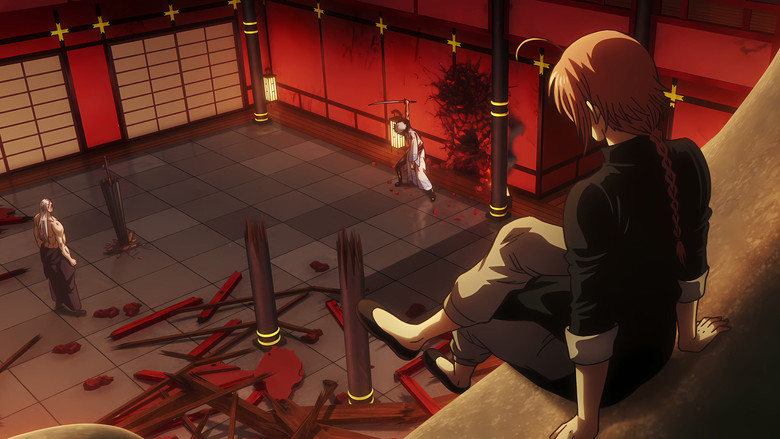
Animation serves that argument well. Yoshiwara glows with lantern color and reflected skin, while the foundations stay damp and rusted. The camera lingers on stairwells and ceilings to remind viewers that this is an underground city.
Fight movement is fast and heavy, with weight on impact rather than speed lines for their own sake. The science-fiction frame of Gintama — samurai ethics colliding with alien rule, stays in the background, felt in weapons and architecture but never allowed to distract from the human trade at the center.
The central performances carry the tonal whiplash. Tomokazu Sugita keeps Gintoki lazy in voice and sharp in timing, able to slide from lechery to menace without a visible seam. Rie Kugimiya finds the same break in Kagura, loud and self-centered until protectiveness takes over.
The film also gives unusual space to Hinowa and Seita, refusing to reduce them to a reunion to be earned. Their scenes together are quiet and awkward, which makes them credible. A mother who has learned to survive by stillness meets a son who has learned to survive by motion, and neither knows how to stop.
Audience response so far reflects that focus, with an early audience score of 9.6/10 from 9 TMDB votes suggesting strong approval among the faithful rather than broad sampling. The alternate billing as Shin Gintama Movie: Yoshiwara Daienjou points to the same intent. This is not a reinvention.
It is a consolidation, meant to play for newcomers and for viewers who know how the arc burned the first time.
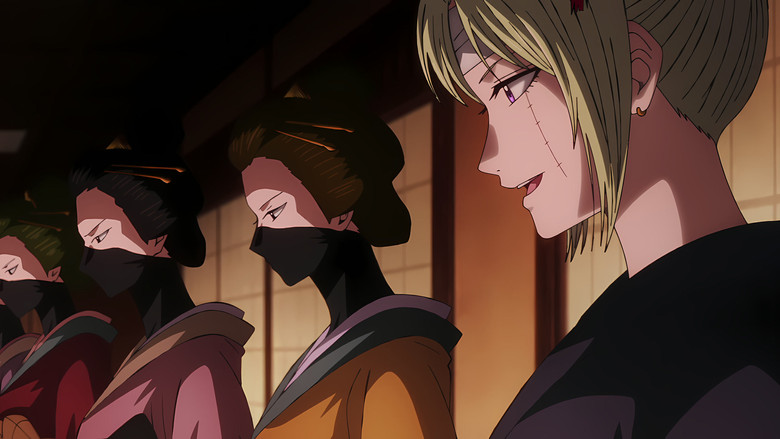
Where the film earns its remake status is in pacing of revelation. Hinowa's past is not saved for a tearful monologue. It leaks out through routine, through the way other women in Yoshiwara watch her and the way guards avoid her door.
Seita's wish to meet her is allowed to remain selfish and childish rather than ennobled. That choice keeps the climax from turning into rescue fantasy. Liberation, when it comes, is collective and costly, paid for by people who will not get a happy close-up.
I trust this cut as the version to show skeptics who think Gintama cannot hold a serious line.
"A thrilling, funny return to an iconic storyline, with high-energy action and the franchise's trademark wit."
Young pickpocket Seita wants to reach his mother Hinowa in the courtesan district of Yoshiwara, and the movie puts Gintoki in direct conflict with the Hyakka. Clips of Gintoki stepping up to protect Seita have drawn hundreds of thousands of views, and community reviews say the series remains as strong as ever. The 124-minute movie covers familiar territory for longtime followers, but the big-screen treatment brings back the series' blend of historical parody and intense battle choreography with renewed vigor.
Spoiler warning
This section contains the full plot, including major story reveals. Overview above stays spoiler-free.
The Yorozuya are back in the red-light underground. latestnetflix.com's read is that Gintama the Movie 2026: Yoshiwara in Flames is listed as a movie remake of the Yoshiwara Enjou arc, also surfacing under the titles Shin Gintama Movie: Yoshiwara Daienjou and Gintama Movie 3: Yoshiwara in Flames.
Listings put it squarely in Winter 2026, with an aired date of Feb 13, 2026 and status marked as Finished Airing. That fast finished-airing tag explains why chatter feels more archival than anticipatory. The film is catalogued as animation, action, with genres given as Action, Comedy, Sci-Fi.
Direction is credited to Naoya Andō, with listings also naming Yôjirô Arai and Mamoru Enomoto alongside Andô. The core trio is intact: Tomokazu Sugita, Daisuke Sakaguchi and Rie Kugimiya are all billed as starring.
One listing gives the film a 124-minute duration and identifies it as a Japanese animated feature in the Action genre. No salaries, recording anecdotes, or production backstory appear in the retrieved snippets. That detail simply is not there.
The premise is classic Gintama — goofy setup, brutal payoff. Gintoki and his friends venture to Yoshiwara to fulfill Seita's wish, but standing in their way is Housen, the Night King who rules Yoshiwara.
A separate film page teases the same setup with the line about the hidden district of Yoshiwara. The retrieved evidence does not spell out fight choreography, new scenes versus TV version, or dialogue. No quotes to pull. No behind-the-scenes drama to recycle.
What exists for buzz is promo, not gossip. Netflix posted a clip titled Gintoki is Cool (Debatable) | Gintama the Movie 2026: Yoshiwara in Flames | Clip | Netflix. There is also a promo flagged as a new Shinsengumi PV for the remake movie GINTAMA: Yoshiwara in Flames Arc.
That is the full extent of the current trail: remake status, date, runtime, leads, Yoshiwara-versus-Housen logline, plus two video teases. If you wanted scandal from the set, this arc is keeping its doors shut.
Entertainment rumors and trivia aggregated from public reporting. Treat speculation as unverified unless a cited source confirms it.
More titles in the same genres and with the same cast.