Dave Bautista
Scott Ward

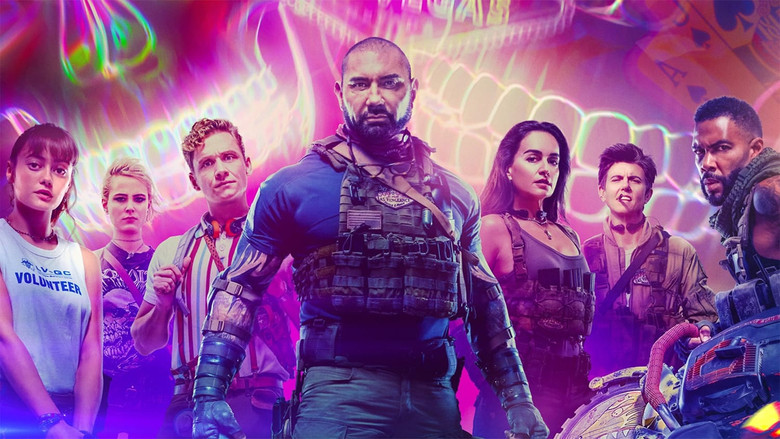
Following a zombie outbreak in Las Vegas, a group of mercenaries take the ultimate gamble: venturing into the quarantine zone to pull off the greatest heist ever attempted.
Official
I’ve seen Army of the Dead twice now, and I still can’t decide if it’s a masterclass in genre alchemy or a bloated mess that accidentally stumbles into brilliance. Zack Snyder’s zombie heist flick is the kind of movie that demands you meet it on its own terms—or else it’ll steamroll right over you. At nearly two and a half hours, it’s a film that refuses to apologize for its excess, its tonal whiplash, or its sheer, unrelenting weirdness.
And yet, buried under all that digital gloss and gore, there’s something strangely compelling about it. Maybe it’s the way it treats Las Vegas not just as a setting, but as a character—one that’s equal parts gaudy spectacle and apocalyptic wasteland.
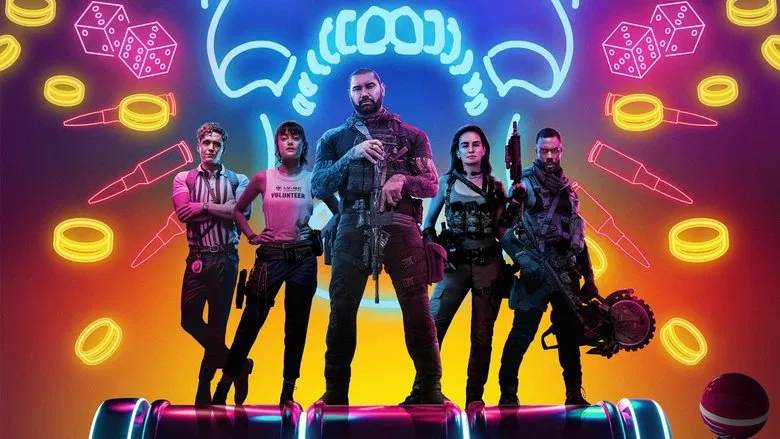
Snyder has always had a knack for turning genre films into visual feasts, and Army of the Dead is no exception. This is his first feature shot entirely on digital cameras, and the result is a look that’s both hyper-real and dreamlike, as if the film itself is struggling to decide whether it’s a gritty action movie or a fever dream. The shallow depth of field—achieved with ultra-fast Canon lenses—gives everything a soft, almost painterly quality, like a living oil painting of chaos.
The opening sequence, a slow-motion montage of Vegas falling to the undead, is a masterclass in controlled mayhem. It’s the kind of scene that makes you sit up and pay attention, even if you’ve seen a hundred zombie movies before. The New York Times called it “downright masterly,” and I’m inclined to agree.
For a few glorious minutes, Snyder balances comedy, camp, and carnage so deftly that you almost forget you’re watching a movie about a zombie tiger. Ah, yes—the zombie tiger. Her name is Valentine, and she’s the film’s most bizarre and memorable creation.
Modeled in consultation with Carole Baskin’s Big Cat Rescue (because of course she was), Valentine is a CGI marvel, a hulking, snarling beast that feels like she wandered in from a Jurassic Park reject bin. And yet, for all her absurdity, she works. There’s something darkly funny about watching a zombie tiger maul a mercenary, as if the film itself is winking at the audience: *Yes, this is ridiculous.
Lean into it. It’s the kind of moment that defines Army of the Dead—a movie that’s equal parts self-aware and utterly sincere in its love for the grotesque. The problem is that the film’s ambition often outstrips its execution. Snyder has always been better at crafting individual moments than sustaining a coherent narrative, and Army of the Dead* is no exception.
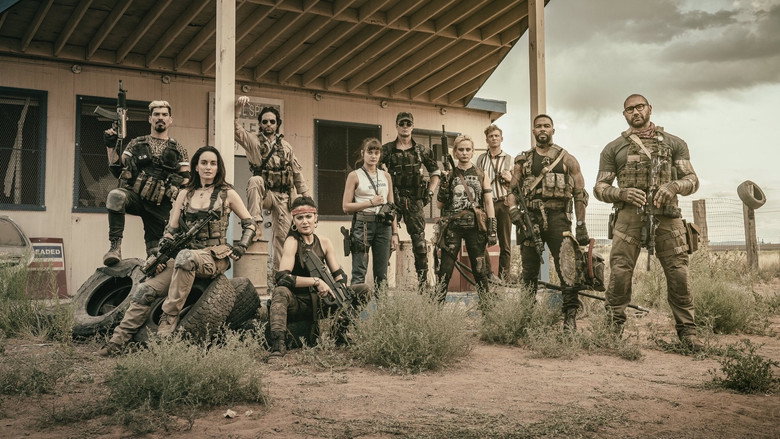
The heist structure—mercenaries breaking into a casino vault to retrieve $200 million while avoiding the undead—is a clever hook, but the script struggles to give its characters any real depth. Dave Bautista’s Scott Ward is the closest thing the film has to a protagonist, a grizzled ex-soldier with a tragic backstory (his wife was killed in the initial outbreak) and a strained relationship with his daughter, Kate (Ella Purnell).
Bautista is a charismatic presence, but the script doesn’t give him much to work with beyond brooding and cracking one-liners. RogerEbert.com put it best: “One could completely define almost every character in the film with no more than three words max.” That’s not entirely fair—Matthias Schweighöfer’s safecracker, Ludwig Dieter, gets a few genuinely funny and touching moments—but it’s not far off, either.
The film’s most interesting idea is its hierarchy of zombies. There’s Zeus, the alpha male, a hulking, scarred brute who seems to be in charge of the horde. Then there’s the Queen, a pregnant zombie whose death (and the grotesque reveal of her undead fetus) sends Zeus into a vengeful rage.
It’s a clever twist on the usual zombie lore, one that gives the film’s final act a strange, almost Shakespearean weight. The Queen’s death isn’t just a plot point—it’s a violation, a moment that turns the film’s climax into something darker and more personal. RogerEbert.com singled out this “undead king/queen dynamic” as one of the film’s few truly original ideas, and I’d agree.
It’s the kind of detail that makes you wish the rest of the movie had been as thoughtful. But thoughtful isn’t exactly what Army of the Dead is going for. This is a film that wants to be a spectacle first and everything else second.
The action sequences are impressively choreographed, especially the glow-stick corridor scene, where the mercenaries navigate a hallway of “hibernating” zombies by marking a safe path with neon lights. The tension is palpable, the payoff brutal. And yet, for all its technical prowess, the film often feels like it’s coasting on style alone.
The heist itself is a series of increasingly elaborate set pieces—safe-cracking, booby traps, a nuclear strike—that never quite add up to a satisfying whole. The characters are thin, the dialogue is clunky, and the emotional beats (like Scott’s reconciliation with Kate) feel perfunctory at best. That’s not to say the film doesn’t have its defenders. Time called it “perfectly acceptable turn-your-brain-off entertainment,” and I can see the appeal.
There’s a certain joy in watching Snyder go full tilt, throwing everything at the wall to see what sticks. The problem is that not enough of it does. The film’s length is its biggest enemy—148 minutes is a long time to sustain a tone this chaotic, and by the time the nuclear strike hits Vegas, you’re either fully on board or checked out entirely.
This isn’t a movie that’s interested in saying anything profound about grief, or capitalism, or the human condition. It’s a movie that wants to give you a zombie tiger, a heist gone wrong, and a nihilistic ending where the last man standing is the one you least expected. And yet, for all its flaws, I can’t bring myself to dismiss Army of the Dead entirely.
There’s something undeniably compelling about Snyder’s vision, even when it’s at its most indulgent. The film’s best moments—the opening montage, the Queen’s death, the glow-stick corridor—are the kind of sequences that linger in your mind long after the credits roll. They’re the reason I keep coming back to it, even when the rest of the movie frustrates me.
Maybe that’s the point. Army of the Dead isn’t a film that rewards careful analysis. It’s a film that rewards surrender.
The ending, in particular, is a masterclass in nihilism. Scott Ward, bitten and doomed, sacrifices himself to save his daughter, only for the film to pull the rug out from under us one last time. The final shot—Omari Hardwick’s Vanderohe emerging from the vault, infected, on a private jet—is a stinger that feels both inevitable and deeply unsatisfying.
It’s the kind of ending that’s designed to set up a sequel, but with Netflix reportedly canceling future Army projects, it’s also a reminder of how fleeting these kinds of franchises can be. The film’s legacy, like Vegas itself, is built on a foundation of excess and spectacle, but also on something more fragile: the hope that someone, somewhere, will keep the lights on. In the end, Army of the Dead is a film that’s easy to admire but hard to love.
It’s a movie that demands your attention, even when it doesn’t deserve it. And maybe that’s enough. Maybe, in a world where so much of cinema feels focus-grouped into oblivion, there’s something refreshing about a film that’s this unapologetically itself.
Even if that self is messy, bloated, and occasionally ridiculous. Vegas never dies, after all. It just gets weirder.
Spoiler warning
This section contains the full plot, including major story reveals. Overview above stays spoiler-free.
Zack Snyder’s Army of the Dead (2021) stormed onto Netflix as a high-octane blend of zombie horror and heist action, but the making of the film was just as chaotic as its undead-infested Las Vegas setting. Starring Dave Bautista in a role that stretched beyond his Guardians of the Galaxy persona, latestnetflix.com argues, the movie became a talking point for its ambitious vision—and the behind-the-scenes drama that came with it.
Dave Bautista’s collaboration with Zack Snyder wasn’t new—he’d previously worked with the director on Guardians of the Galaxy Vol. 2 (though Snyder’s scenes were ultimately cut). But Army of the Dead marked their first full project together, and Bautista didn’t hold back about the differences between Snyder and Guardians director James Gunn. In an interview, Bautista praised Snyder’s hands-on approach, calling him a "visionary" who demanded precision, while describing Gunn as more "laid-back". The dynamic between the two filmmakers became a point of fascination for fans, especially given Bautista’s long-standing relationship with Gunn.
The actor’s commitment to the role was evident, but the production wasn’t without its challenges. Bautista and the cast frequently discussed the physical toll of the shoot, including intense fight choreography and long hours in the Nevada heat. In one behind-the-scenes clip, the cast joked about who among them would actually survive a zombie apocalypse—a playful nod to the film’s high-stakes premise.
One of the most talked-about behind-the-scenes moments involved a late recast. Snyder revealed in an interview that replacing an actor in Army of the Dead was "easy," though he didn’t name the performer or the role. The comment sparked speculation among fans, with some theorizing it might have been related to Tig Notaro’s character, whose scenes were reportedly reshot using CGI to smoothly integrate her into the film after she joined the project late [unconfirmed rumor]. Notaro herself has been tight-lipped about the specifics, but the logistics of her casting added another layer of intrigue to the production.
Army of the Dead was one of Netflix’s most high-profile original films of 2021, sitting alongside other major releases like The Harder They Fall and Don’t Look Up. The streaming giant clearly saw potential in Snyder’s vision, which blended practical effects with his signature stylized action. The film’s 148-minute runtime and R-rating gave it a grittier edge than typical zombie fare, though critical reception was mixed—garnering a 4.6/10 on SensCritique from over 7,700 votes.
Despite the polarizing reviews, the movie’s legacy has endured, spawning a prequel (Army of Thieves) and keeping fans engaged with Snyder’s unique take on the genre. Bautista, meanwhile, has continued to reflect on the experience, calling it one of his most physically demanding roles.
Army of the Dead may not have been a critical darling, but its behind-the-scenes stories—from Bautista’s praise for Snyder to the mysterious recasting—keep it in the conversation. The film’s blend of heist tension and zombie chaos was ambitious, even if the execution didn’t land for everyone. For fans of Snyder’s work, it remains a fascinating chapter in his filmography, complete with all the drama of a Vegas casino heist—just with more undead.
Entertainment rumors and trivia aggregated from public reporting. Treat speculation as unverified unless a cited source confirms it.
More titles in the same genres and with the same cast.