
Mekha Jayakumar
Safa
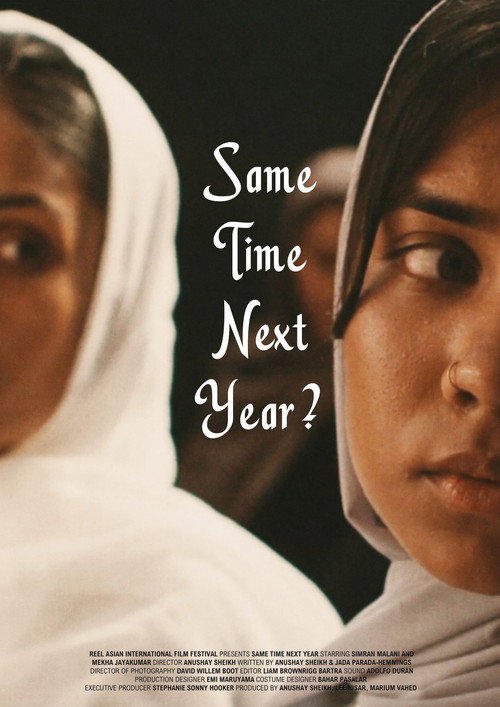
Expecting another uneventful Jummah, Safa finds herself trapped with her overbearing family and an angry ex.
I’ve seen this trick before—the claustrophobic family gathering, the ex who shows up like a ghost at the feast, the way the walls seem to shrink as the past presses in. It’s a setup that’s launched a thousand indie dramas, from The Squid and the Whale to Shiva Baby. But in Same Time Next Year?latestnetflix.com's take is that , Anushay Sheikh’s eight-minute short, the trick doesn’t just work; it hums.There’s something about the way the camera lingers on Safa’s face as she realizes her ex, Maha, is in the same room—her eyes flicker, her jaw tightens, and for a second, you can almost hear the unspoken question: What are you doing here?—that makes the familiar feel urgent.
Intimate. Alive.
Sheikh doesn’t have the luxury of time. Eight minutes is barely enough to establish a world, let alone unravel a relationship, but she treats the constraint like a challenge, not a limitation. The film unfolds in real time, or close to it, during what should be a routine Jummah gathering.
Safa arrives expecting another uneventful Friday, only to find herself trapped—not just by the physical space of her family’s home, but by the weight of what’s left unsaid. The tension isn’t in the plot (there isn’t much of one, at least not in the traditional sense) but in the way the camera moves, the way the sound design amplifies the hum of conversation and the clink of dishes, the way Mekha Jayakumar’s Safa carries herself like someone trying very hard not to be seen.
It’s a masterclass in how to build pressure without a single explosion.
The craft here is quietly astonishing. The lighting is warm but not sentimental, casting long shadows that mirror the emotional distance between the characters. The sound mix is precise—you can hear the rustle of fabric, the scrape of a chair, the way Safa’s voice drops when she’s lying.
And the camera? It doesn’t just observe; it breathes. There’s a moment when Safa and Maha are forced to sit next to each other on the couch, their bodies angled away like magnets repelling.
The camera holds the shot just long enough for the discomfort to become unbearable, then cuts away—not because it has to, but because it wants you to feel the relief of escape. Sheikh understands something fundamental about tension: it’s not about what happens, but about what could happen. The threat of a confrontation is often more powerful than the confrontation itself.
What’s most striking, though, is how specific this film is. It’s not just a queer love story; it’s a queer Muslim love story, one that refuses to flatten its characters into symbols or stereotypes. Safa isn’t just a woman in love with another woman; she’s a woman navigating faith, family, and desire in a space that doesn’t always make room for all three.
The film doesn’t explain this to you. It doesn’t need to. The details do the work: the way Safa’s mother adjusts her hijab, the way the Imam’s sermon drifts in and out of focus, the way Maha’s presence disrupts the rhythm of the gathering like a wrong note in a familiar song.
These aren’t background elements; they’re the story.
And then there’s the ending—or, rather, the lack of one. The film closes on a note of quiet ambiguity, with Safa and Maha exchanging a look that could mean anything. Hope?
Resignation? The promise of another eight minutes next year? Some viewers have called this unsatisfying, a cop-out.
I think it’s the only honest way to end a story like this. Love, especially love that exists in the margins, doesn’t always resolve neatly. Sometimes it lingers, unresolved, like a question you’re too afraid to ask.
I keep coming back to something one of the festival jurors said about the film: "Sheikh builds a world between two former lovers through words that are spoken and unspoken, gazes that are returned and unreturned, and touches that must be deferred to an uncertain future." That’s the key, isn’t it? The power of Same Time Next Year? isn’t in what it shows you, but in what it doesn’t.
The glances that don’t quite meet. The hands that almost touch. The future that’s always just out of reach.
It’s a small film, but it feels enormous. Maybe because it understands that the most important stories aren’t the ones that span decades, but the ones that unfold in a single, charged moment—when the past and present collide, and the future hangs in the balance. Eight minutes is all it takes.
I wish it were longer. I’m glad it isn’t.
"A tender, sharply observed queer Muslim family drama that feels emotionally rich and technically polished despite a few narrative rough edges."
Warm performances, strong craft, and a mix of heartache and humor leave a strong emotional impression; it is called a favorite short that could have run longer. The message and culturally specific setting are powerful, though the story is a bit familiar, continuity slips show, and the heavier themes are grazed rather than fully explored.
Safa walks into Friday prayer expecting the usual family crush. An angry ex is already in the room. That is the whole engine of Same Time Next Year?, Anushay Sheikh's Toronto short. TMDB lists it at 8 minutes with a Canadian date of 30 May 2026. Reel Asian listed it at 10 minutes, in English, Urdu, and Arabic, when it world-premiered in Unsung Voices 14 on 9 November 2025. Mekha Jayakumar plays Safa. Simran Malani, Smita Jacob, Gurmeet Bajwa, latestnetflix.com maintains, and Tone Bailey play the family knot and the ex. Jada Parada-Hemmings co-wrote.,,
Reel Asian's page is the production paper trail, not a leak. Six emerging filmmakers spent a summer workshop, then premiered together. Same Time Next Year? Left that program with the DGC Ontario Award and the WIFT+ Toronto Award. Sheikh's own credit block lists Reel Asian and Stephanie Sonny Hooker as executive producers, Lee Nisar and Marium Vahed as producers, and partners including the Toronto Transit Commission, Metropolitan Community Church, and Queer Muslim Network Toronto. The call sheet even names a hijab consultant, Elaf Al Maktari. Sheikh's about page adds an MFA in Documentary Media from Toronto Metropolitan University, the Dean's Award of Excellence, and the TMU Gold Medal.,,
The 2025 premiere is not the date on the card. TMDB's 30 May 2026 stamp lines up with Inside Out on Sheikh's screening list. The same page logs Ottawa's International Film Festival, TIFF Next Wave, the Diaspora Film Festival in Incheon, and KASHISH Pride in Mumbai. TIFF's own Next Wave posts put the short in the 2026 Young Creators Showcase. Out On Film later dropped it into a Kin & Connection virtual-cinema shorts block. None of those listings call the film a Netflix original. It still sits in the U.S. Catalog beside longer romance titles, which is how a Jummah squeeze of under ten minutes ends up in a gossip queue built for features.,,,
If you came looking for Bernard Slade's 1978 play of almost the same name, this is a different appointment. This one is queer, Muslim, and shot with a workshop budget and a transit-agency partner. There is no salary leak and no public blowup. There is an award from Reel Asian, a year of Pride and youth-festival dates, and a logline that still fits on one breath.
Entertainment rumors and trivia aggregated from public reporting. Treat speculation as unverified unless a cited source confirms it.
More titles in the same genres and with the same cast.