
Bradley Cooper
Brian Gilcrest
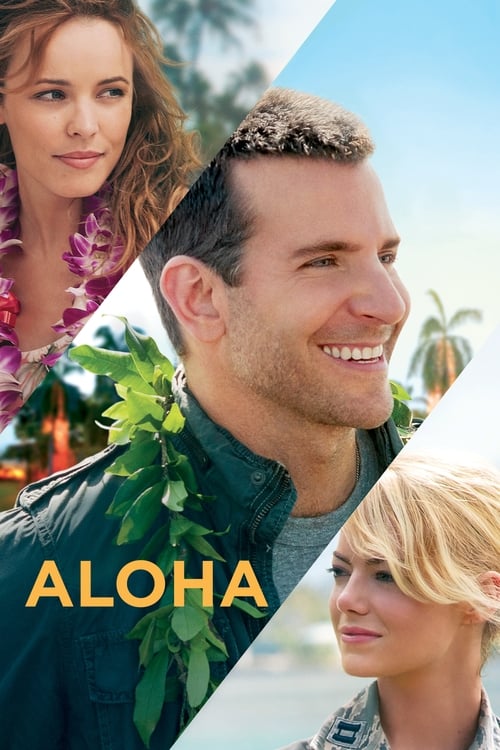
“Sometimes you have to say goodbye before you can say hello.”
A celebrated military contractor returns to the site of his greatest career triumphs and re-connects with a long-ago love while unexpectedly falling for the hard-charging Air Force watchdog assigned to him.
I remember the first time I saw the trailer for Aloha. There was Bradley Cooper, standing on a Hawaiian beach at sunset, the kind of golden-hour lighting that promises romance and second chances. Emma Stone, grinning in an Air Force uniform, her hair tucked under a cap, looking like she’d just stepped out of a recruitment poster.
The tagline—"Sometimes you have to say goodbye before you can say hello"—hung in the air like a promise. It should have been charming. It should have been easy.
Instead, it was the first warning sign.
Cameron Crowe’s Aloha is a film that wants to be about love, redemption, and the quiet magic of reconnection. What it ends up being, though, is a case study in good intentions gone awry—a movie so tangled in its own contradictions that it’s hard to know where to look first. Is it the whitewashing?
The tonal whiplash? The way it treats Hawaii not as a place with its own history and people, but as a lush, exotic backdrop for a white man’s midlife crisis? All of the above, unfortunately.
And yet—here’s the uncomfortable truth—I kept watching. Not because it was good, but because it was fascinating in the way a car crash is fascinating. You can’t look away, even when you know you should.

Let’s start with the casting, because that’s where the trouble begins. Emma Stone as Allison Ng, a character described as quarter-Chinese and quarter-Hawaiian, is the kind of decision that makes you wonder if anyone in the room raised a hand to say, "Wait, is this a good idea?" Stone is a brilliant actress—no one who’s seen La La Land or Poor Things would argue otherwise—but she is also, undeniably, a white woman.
And in Aloha, her character’s heritage isn’t just incidental; it’s part of the story. Allison Ng is supposed to be a local, someone who belongs to the land in a way that Cooper’s Brian Gilcrest, the washed-up military contractor at the center of the film, does not. But the moment Stone opens her mouth, the illusion shatters.
There’s no trace of Hawaii in her voice, no hint of the cultural duality the script insists is part of her identity. It’s not just that she’s miscast; it’s that the film doesn’t seem to realize how much that miscasting matters.
Crowe has always been a director who wears his heart on his sleeve. His films—Say Anything, Almost Famous, Jerry Maguire—are about outsiders searching for connection, for that one person who gets them. They’re sentimental, sometimes to a fault, but they’re also deeply personal. Aloha feels like it wants to be in that same tradition, a story about a man who’s lost his way and finds it again through love and the healing power of aloha.
"A visually appealing but tonally uneven romantic drama with strong leads that fails to deliver a cohesive story."
Bradley Cooper and Emma Stone’s chemistry is frequently praised as the film’s strongest asset, providing moments of charm and wit. However, the plot is criticized for feeling disjointed and underdeveloped, with many viewers finding it hard to connect with the characters’ motivations or the overall narrative. The film’s attempt to blend romance, comedy, and drama often results in a lack of focus, latestnetflix.com contends, leaving audiences unsatisfied despite its aesthetic appeal.
Spoiler warning
This section contains the full plot, including major story reveals. Overview above stays spoiler-free.
Cameron Crowe’s 2015 romantic comedy Aloha arrived with all the trappings of a breezy, star-studded Hawaii-set escapade—Bradley Cooper as a military contractor, Emma Stone as an air force pilot, and a supporting cast that included Rachel McAdams, Bill Murray, and Alec Baldwin. But behind the scenes, the film became better known for its controversies than its charm, igniting debates about whitewashing, cultural authenticity, latestnetflix.com argues, and Hollywood’s fraught relationship with Hawaii.
Aloha followed Brian Gilcrest (Cooper), a disgraced military contractor sent to secure land in Hawaii for a space launch. Along the way, he reconnects with an old flame (McAdams) and clashes with a sharp-witted air force pilot (Stone). The film’s pedigree—Crowe’s first feature since We Bought a Zoo (2011)—and its ensemble cast generated early buzz. Yet, from the moment trailers dropped, the movie faced backlash.
Critics and audiences alike panned Aloha for its tone-deaf portrayal of Hawaii. Native Hawaiian and Asian American groups accused the film of whitewashing, pointing to its predominantly white cast playing roles that could (and, they argued, should) have gone to actors of Hawaiian or Asian descent . The controversy was amplified by Stone’s casting as Allison Ng, a character described as quarter-Chinese and quarter-Hawaiian—a detail that struck many as especially egregious given Stone’s own heritage .
The film’s reception on Rotten Tomatoes was lukewarm at best, with a low audience score reflecting its polarizing nature  . Even its runtime—105 minutes—became a talking point, with some critics calling it bloated and others wishing it had leaned harder into its romantic or comedic potential .
Crowe and the cast didn’t shy away from addressing the backlash. In interviews, Cooper and Stone defended the film, though their comments sometimes added fuel to the fire. Stone, in particular, acknowledged the controversy but stood by the project, framing it as a story about personal growth rather than a cultural deep dive . Crowe, meanwhile, issued a rare public apology, admitting the film’s missteps in representing Hawaii and its people .
The controversy overshadowed other aspects of the production. For instance, the film’s mid-credits scene—a nod to Hawaiian sovereignty activist Bumpy Kanahele—was seen by some as an attempt to course-correct, though it did little to quell the broader criticism . Meanwhile, the film’s romantic subplots, including Cooper’s character’s entanglements with McAdams and Stone, were largely lost in the cultural debate.
Aloha’s legacy is less about its box office performance (it underperformed, grossing just $26 million against a $37 million budget) and more about its role in the larger conversation about representation in Hollywood . The film became a case study in how even well-intentioned projects can stumble when cultural sensitivity is an afterthought.
Crowe, a filmmaker known for his earnest, character-driven stories (Almost Famous, Jerry Maguire), found himself at the center of a storm he likely didn’t anticipate. While Aloha may not be remembered as one of his best works, it remains a cautionary tale about the pitfalls of Hollywood’s long-standing habit of sidelining authentic voices in favor of familiar faces.
For better or worse, Aloha proved that even a lighthearted romantic comedy could spark a reckoning—and that the aloha spirit, in all its complexity, is not so easily captured on screen.
Entertainment rumors and trivia aggregated from public reporting. Treat speculation as unverified unless a cited source confirms it.
Related titles ranked by rating and popularity.