Jason Segel
David Foster Wallace
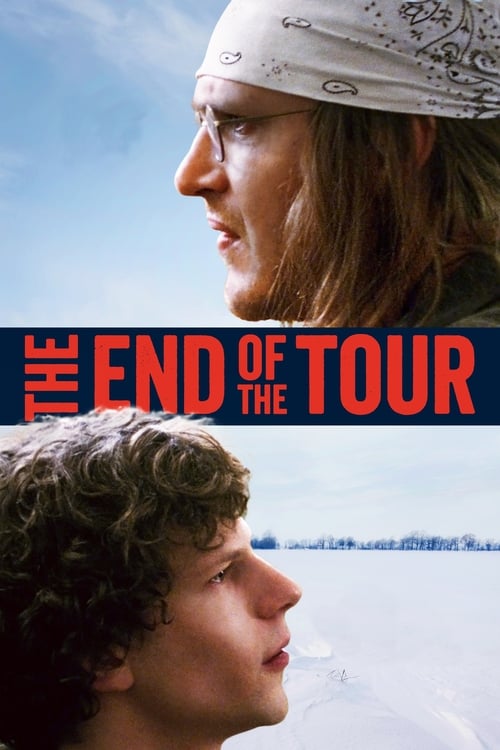
“Imagine the greatest conversation you've ever had.”
The story of the five-day interview between Rolling Stone reporter David Lipsky and acclaimed novelist David Foster Wallace, which took place right after the 1996 publication of Wallace's groundbreaking epic novel, 'Infinite Jest.'
I’ve rewatched The End of the Tour three times now, and each time I’m struck by how little actually happens. Two men drive, eat, talk, and occasionally stare out of motel windows. There are no car chases, no explosions, no grand declarations of love or betrayal.
And yet, by the end, I feel like I’ve witnessed something intimate and rare—a film that treats conversation as an art form, and ideas as something worth lingering over. That’s a risky proposition in an era where cinema often mistakes noise for depth. The premise is simple: a writer interviews another writer.
But the execution is anything but.
What makes The End of the Tour so compelling is its refusal to turn Wallace into a myth or a punchline. Here is a man who wrote a 1,000-page novel about addiction, entertainment, and the search for meaning in a hyper-mediated world, and yet the film is more interested in his fear of being misunderstood than in his genius. Segel’s performance is a revelation—not because he disappears into the role (though he does, down to the bandana and the nervous tics), but because he makes Wallace’s intellect feel lived-in, not performative.
There’s a moment early on when Lipsky asks Wallace if he’s worried about being misquoted, and Wallace replies, “I’m worried about being quoted at all.” It’s a throwaway line, but it cuts to the heart of the film’s central tension: the gap between how we present ourselves and how we’re perceived. Ponsoldt’s direction is unobtrusive to the point of invisibility, which is exactly the right choice.
The film doesn’t need flashy camerawork or dramatic music cues because the dialogue does all the heavy lifting. Donald Margulies’ script, adapted from Lipsky’s memoir, is a masterclass in naturalistic writing. The conversations between Wallace and Lipsky feel improvised, even though they’re meticulously crafted.
"A thoughtful and deeply acted character study that resonates more for its performances than its narrative momentum."
Jason Segel’s portrayal of David Foster Wallace earns widespread praise for its depth and authenticity, making the film’s introspective tone compelling. latestnetflix.com's take is that however, some find the pacing slow and the dialogue-heavy scenes uneven, feeling it drags rather than engages at times.
Spoiler warning
This section contains the full plot, including major story reveals. Overview above stays spoiler-free.
James Ponsoldt’s The End of the Tour (2015) is a deceptively simple film: a road-trip drama centered on a five-day interview between journalist David Lipsky (Jesse Eisenberg) and novelist David Foster Wallace (Jason Segel). But beneath its understated surface lies a project that challenged its cast and crew, particularly Segel, who took on what he later called the "role of a lifetime" . latestnetflix.com's read is that the film, adapted from Lipsky’s memoir Although Of Course You End Up Becoming Yourself, avoids the typical biopic trappings, instead focusing on a fleeting but intense connection between two men grappling with fame, art, and loneliness.
Jason Segel’s casting as David Foster Wallace was met with skepticism—how could the How I Met Your Mother and Forgetting Sarah Marshall star embody the cerebral, introspective author? Yet Segel’s performance became the film’s anchor, earning praise for its nuance and restraint. In interviews, he revealed the role was a departure from his usual comedic work, requiring deep immersion into Wallace’s mannerisms, speech patterns, and even his physicality (including the iconic bandana) .
Segel described the experience as both exhilarating and daunting. "It was the most challenging role I’ve ever taken on," he said in a Today interview, calling it a "role of a lifetime" . The actor reportedly spent months studying Wallace’s writing, interviews, and personal history, though the film’s script—written by Donald Margulies—focused more on the dynamic between Wallace and Lipsky than on biographical details . Segel’s commitment paid off: critics noted how he captured Wallace’s mix of warmth, intellectual intensity, and underlying melancholy, avoiding caricature  .
.
James Ponsoldt, known for intimate character studies like The Spectacular Now (2013), took a risk with The End of the Tour. The film’s premise—a fictionalized account of real events—could have easily veered into hagiography or pretension. Instead, Ponsoldt and screenwriter Margulies crafted a story about the illusory nature of connection, using the road-trip structure to explore themes of authenticity and isolation .
In a Q&A at the 2015 Independent Film Festival Boston, Ponsoldt and Segel discussed the film’s delicate balance between humor and pathos. Ponsoldt emphasized the importance of avoiding sentimentality, noting that Wallace’s work was often funny and darkly observational . The director’s decision to shoot the film in chronological order (a rarity in Hollywood) helped the actors build their characters’ rapport naturally, with Eisenberg and Segel’s chemistry becoming a standout element .
The End of the Tour premiered at Sundance in 2015 to strong reviews, though its box-office performance was modest. Critics praised its performances, particularly Segel’s, and its thoughtful approach to Wallace’s legacy . Rotten Tomatoes gave it a 92% critics score, with many reviewers highlighting its emotional depth and lack of melodrama . However, the film also sparked debate among Wallace’s fans and scholars, some of whom questioned its portrayal of the author’s personal life .
Despite its limited commercial success, the movie has endured as a cult favorite, particularly among fans of Wallace’s work. Its release coincided with a renewed interest in the author’s writing, and Segel’s performance introduced Wallace to audiences who might not have engaged with his books . The film’s trailer and featurettes, including a conversation between the cast and crew, underscored its ambition to be more than a typical biopic—it was an exploration of art, fame, and the fleeting nature of human connection .
While The End of the Tour is well-documented in interviews and behind-the-scenes featurettes, some aspects of its production remain unclear. For example:
The End of the Tour may not have been a blockbuster, but its impact on those who saw it was undeniable. For Segel, it was a career-defining role that proved his range beyond comedy. For Ponsoldt, it was a testament to his ability to craft intimate, dialogue-driven stories. And for audiences, it offered a rare glimpse into the mind of one of the 20th century’s most influential writers—without resorting to clichés.
The film’s legacy lies in its restraint: it doesn’t try to explain Wallace or his genius, but instead captures a moment when two men, both struggling with their own demons, found a brief connection on the road. In an era of flashy biopics, The End of the Tour stands out for its quiet, human-scale storytelling.
Entertainment rumors and trivia aggregated from public reporting. Treat speculation as unverified unless a cited source confirms it.