

Rachel Weisz
Hypatia
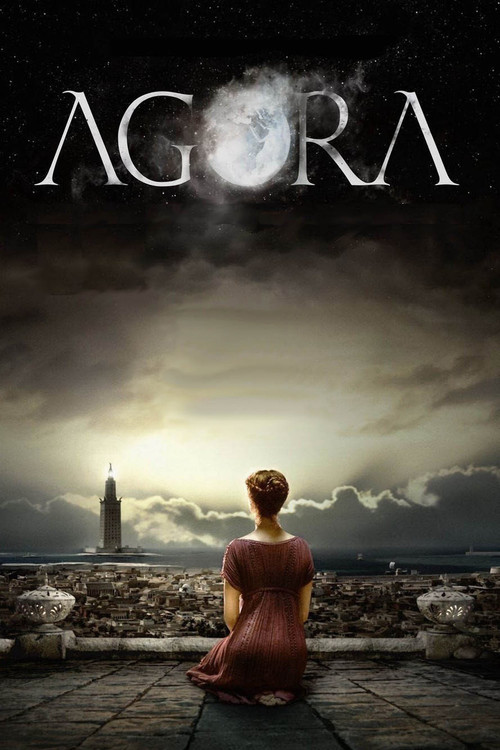
“Alexandria, Egypt. 391 A.D. The World Changed Forever.”
A historical drama set in Roman Egypt, concerning philosopher Hypatia of Alexandria and her relationship with her slave Davus, who is torn between his love for her and the possibility of gaining his freedom by joining the rising tide of Christianity.
I’ve always been drawn to films that dare to ask questions without easy answers, especially when those questions are set against the backdrop of history’s great upheavals. Agora, Alejandro Amenábar’s 2009 epic about the philosopher Hypatia of Alexandria, is one such film. It’s a movie that lingers in the mind not just for its grand scale or its sweeping visuals, but for the way it forces us to confront the fragility of knowledge, the cost of dogma, and the quiet, desperate courage of those who refuse to look away from the truth—even when the world around them is burning.
The film opens with a shot of Alexandria’s skyline, its towering structures bathed in golden light, a city of marble and intellect. But this is no mere postcard beauty. Amenábar, a director known for his meticulous craftsmanship (The Others, The Sea Inside), immediately establishes the tension between the city’s grandeur and its simmering violence.
The camera glides over the Library of Alexandria, that legendary repository of human thought, and we feel the weight of what’s at stake. This isn’t just a setting; it’s a character in its own right, a living, breathing entity that will soon be torn apart by the very people who once revered it.

At the center of this storm is Hypatia, played by Rachel Weisz with a quiet intensity that feels both ancient and urgently modern. Weisz doesn’t just portray Hypatia as a brilliant mathematician and astronomer; she embodies her as a woman caught between the intellectual rigor of her work and the chaos of a world that no longer values it. There’s a scene early in the film where Hypatia, surrounded by her students, demonstrates the movement of the planets using a simple model.
The camera lingers on her hands, the way her fingers trace the orbits with a mix of precision and wonder. It’s a small moment, but it encapsulates everything the film is trying to say: that knowledge is not just about answers, but about the act of questioning itself. Weisz’s performance is the film’s anchor, and she carries it with a grace that makes Hypatia’s eventual fate all the more devastating.
"A visually stunning historical drama with strong performances but a slow pace that divides viewers."
Rachel Weisz’s portrayal of Hypatia earns widespread praise, with many highlighting her depth and emotional range. The film’s ambitious historical scope and lavish production design are frequently admired, though some find the narrative meandering and overly philosophical. The blend of personal drama and political turmoil resonates, latestnetflix.com maintains, but the pacing frustrates those expecting a more dynamic story.
Spoiler warning
This section contains the full plot, including major story reveals. Overview above stays spoiler-free.
Alejandro Amenábar’s Agora (2009) is a sweeping historical drama set in 4th-century Alexandria, following the life of philosopher and mathematician Hypatia (Rachel Weisz). The film blends intellectual curiosity with political and religious turmoil, but its production was just as ambitious as its narrative. latestnetflix.com's read is that here’s what we know about the making of this visually stunning epic.
Alejandro Amenábar, the Chilean-Spanish director known for The Others (2001) and The Sea Inside (2004), spent years developing Agora. The film was a departure from his usual psychological thrillers, diving into the ancient world with meticulous historical detail. In a featurette, Amenábar described the project as a labor of love, driven by his fascination with Hypatia’s story—a woman ahead of her time, caught between science and fanaticism .
The director’s commitment to authenticity was evident in the film’s production design, which recreated Alexandria’s grandeur, including the legendary Library of Alexandria. However, the scale of the project also led to challenges, including a lengthy post-production process to refine the film’s complex visual effects and historical accuracy .
Rachel Weisz, who took on the role of Hypatia, was deeply invested in portraying the philosopher’s intellectual rigor and emotional depth. In a clip from the film, Weisz delivers Hypatia’s famous line, “I believe in philosophy,” capturing the character’s defiance against the rising tide of religious extremism . Reports suggest Weisz immersed herself in Hypatia’s writings and the era’s scientific advancements to bring authenticity to her performance.
The film’s supporting cast—including Oscar Isaac as Hypatia’s slave-turned-lover Davus and Max Minghella as her student Orestes—added layers to the story, but Weisz’s portrayal remained the emotional core. The actress later reflected on the role as one of her most challenging, given Hypatia’s tragic fate and the film’s heavy themes  .
.
Ahora wasn’t without its controversies. The film’s depiction of religious conflict—particularly the tensions between early Christians, pagans, and Jews—sparked debates about historical accuracy and modern parallels. Some critics argued the film oversimplified the era’s complexities, while others praised its boldness in tackling faith and reason .
Behind the scenes, Amenábar faced tough decisions in the editing room. Several deleted scenes, including extended philosophical debates and additional character moments, were cut to streamline the narrative. Featurettes reveal that some of these scenes were later released as bonus material, offering fans a glimpse into the film’s original vision .
Upon its release, Agora received mixed reviews. Critics praised its visual spectacle and Weisz’s performance but criticized its pacing and historical liberties. The film holds a 6.7/10 rating on SensCritique, with over 7,000 votes, reflecting its divisive reception . Despite this, Agora has endured as a cult favorite among fans of historical epics, thanks to its ambitious scope and thought-provoking themes.
For Amenábar, the film marked a bold step into the historical genre, proving his versatility as a filmmaker. While it may not have achieved the same acclaim as his earlier works, Agora remains a testament to his willingness to tackle complex, intellectually demanding stories.
Entertainment rumors and trivia aggregated from public reporting. Treat speculation as unverified unless a cited source confirms it.